Make AI Agent Builder: Your Step-by-Step Guide
Learn how to make ai agent builder with practical steps, tooling, governance, and safety—a comprehensive guide for developers, product teams, and leaders exploring AI agents and agentic AI workflows.


By the end, you will understand how to create an AI agent builder—an integrated framework for designing, testing, and deploying autonomous agents that automate tasks across systems. You’ll learn core concepts, recommended architectures, and practical steps to set up tooling, governance, and observability. This quick guide helps developers, product teams, and leaders start building agentic AI workflows with confidence.
Architectural Foundations for an AI Agent Builder
Designing an AI agent builder starts with a clear architectural blueprint. At a high level, you combine a dynamic agent runtime, a policy layer, data pipelines, and governance controls into a cohesive platform. According to Ai Agent Ops, the most durable implementations separate concerns into four layers: agent logic, orchestration, data and memory, and platform services. This separation makes it easier to scale, test, and secure agentic AI workflows across teams and domains. A well-structured foundation also supports composability: you can mix and match agents, tools, and prompts without rewriting large parts of the system. Begin by outlining the core capabilities you expect: task decomposition, tool invocation, memory of prior steps, error handling, and safe fallbacks. Map these capabilities to minimal viable components, then expand through iterations. Consider nonfunctional requirements early: latency targets, throughput, privacy constraints, auditability, and governance signals. By anchoring the design to these principles, you can avoid piecemeal tech debt and achieve a builder that remains adaptable as models evolve and new tools emerge. This work matters for anyone pursuing a scalable, auditable agentic AI strategy, including teams learning to “make ai agent builder” as a repeatable operating model.
Core Components: Agents, Orchestration, and Tools
An AI agent builder rests on three core components: agents (the decision-makers), orchestration (the flow control and memory), and tools (actions the agent can invoke). In practice, you design a small, testable agent that can call a handful of tools—APIs, databases, or local functions—then layer in orchestration logic for sequencing, retries, and fallbacks. The builder should expose clean interfaces for creating new agents, swapping tools, and adjusting prompts without rewriting core code. For developers, this means modular services and well-defined data contracts; for product teams, it means predictable behavior and faster experimentation; for leaders, it means traceability and governance. Consider how to model agent memory: what should be remembered, for how long, and under what privacy constraints? A practical approach is to implement memory as a lightweight key-value store or a structured memory graph that can be exported and sanitized. Finally, define acceptance criteria early: can the agent complete a simple task end-to-end? Can you observe its decisions and identify failure points? With these foundations, you unlock scalable experimentation and safer, more reliable agentic workflows.
Data, Models, and Safety Considerations
Data collection, model choice, and safety controls shape how well an AI agent builder performs in production. Start by mapping data provenance: where prompts originate, how memory is stored, and how tool outputs are logged. Select models and runtimes that align with your latency and cost targets; you may combine smaller, private models for control with larger providers for capability. Establish guardrails: input validation, action limits, and safe fallbacks when a tool fails. Implement access control, data minimization, and encryption for sensitive prompts and responses. Plan for drift monitoring: set up dashboards that flag out-of-distribution prompts, model performance shifts, and tool reliability changes. Finally, design an evaluation protocol that tests real-world task completion under varied conditions, including failure scenarios and latency spikes. This disciplined approach keeps agent behavior explainable and auditable while enabling rapid iteration as models and tools evolve.
Scaffold: Reusable Patterns and Templates
A practical builder relies on reusable templates and patterns to accelerate development. Create a library of agent templates for common tasks (e.g., data retrieval, meeting scheduling, report generation) that define prompts, memory schemas, and tool sets. Use standardized interface contracts for agents and tools so new capabilities can be plugged in with minimal code changes. Design prompts as modular pieces: a task instruction, a tool invocation spec, and a result verification step. Maintain a catalog of tool definitions with versioned schemas and health checks. Adopt a template-driven UI so engineers can configure agents without touching code—this is essential for rapid experimentation and governance. Apply code generation where safe, complemented by strong reviews and automated tests that protect against regressions. By building these scaffolds, you enable teams to spin up new agents quickly while preserving consistency and safety.
Governance, Observability, and Compliance
Governance should be baked in from day one. Implement role-based access control, data lineage, and retention policies for prompts and memories. Instrument observability across agents: trace prompts, memory reads/writes, tool calls, successes, and failures. Use dashboards to monitor latency, error rates, and decision patterns, with alerts for anomalies. Establish incident response playbooks and post-incident reviews to learn from failures. Compliance considerations include privacy-by-design, data minimization, and transparent disclosures about automated decisions when relevant. Document interfaces, expectations, and golden paths for escalation. Regular audits should verify that agent actions align with business rules and regulatory requirements. Finally, maintain an audit trail that can be exported for governance reviews or regulatory inquiries. A well-governed builder reduces risk and builds trust with users and stakeholders.
Make ai agent builder: Focus on UX and DX
When you design the experience around developers and users, you accelerate adoption and reduce friction. Start with an intuitive workspace: a clean dashboard for creating agents, managing templates, and inspecting logs. Expose readable, well-documented APIs and a low-friction CLI for power users, plus a visual designer to assemble prompts, memory, and tool integrations. Provide real-time validation: confirm tool availability, prompt syntax, and memory schemas before deployment. Build guided wizards that help new users clone proven templates and adapt them to new tasks. Include comprehensive in-line help and example prompts to shorten learning curves. Remember that DX (developer experience) drives DWELL (developers who stay) and reduces onboarding time. From Ai Agent Ops’ perspective, success hinges on a structured, discoverable, and secure onboarding path that scales from prototype to production with minimal rework. As you iterate, prioritize clear telemetry, debuggable prompts, and predictable failure modes.
Tooling and Integration Checklist
Before you ship, verify a practical set of tools and integrations to support development, testing, and deployment. Ensure your environment supports containerized services, version control, and a reproducible runtime. Validate that memory storage and prompt templates are versioned and backed by sensible defaults. Confirm that you can connect to external APIs with rate limiting and retry policies. Establish a local test harness that mimics production traffic and tool responses. Create a lightweight monitoring layer to observe agent decisions in real time. Finally, maintain a changelog and CI checks to catch regressions early. This checklist keeps your builder reliable and maintainable as teams scale and new tools emerge.
Real-world Use Cases and Patterns
Organizations deploy AI agent builders across numerous domains. Common patterns include autonomous data gathering agents that synthesize insights from multiple sources, task automation agents that coordinate across services, and decision-support agents that propose actions with human-in-the-loop review. Typical architectures involve a central orchestrator that routes requests, memory modules that track context, and a toolbox of adapters to APIs, databases, and messaging systems. Reuse templates for recurring domains like customer support, operations analytics, and internal tooling. Observe how agents collaborate with humans: define escalation points, explainable prompts, and review queues that ensure accountability. The most successful builders structure experiences around small, testable missions and progressively widen their tool ecosystems as confidence grows. This iterative approach minimizes risk while delivering measurable value.
Common Pitfalls and How to Avoid Them
Common mistakes include over-engineering the initial MVP, underestimating memory management, and neglecting observability. Start with a minimal viable builder (MVB) and expand through controlled experiments. Avoid tying your platform to a single model provider; design abstractions for tool swapping and model switching. Don’t skip security reviews or privacy protections. Invest in data lineage, prompt auditing, and robust testing under edge cases. Finally, beware feature creep: prioritize a few high-value templates and guardrails rather than a sprawling, opaque system. By anticipating these challenges, you can build a resilient AI agent builder that scales with confidence.
Next Steps: Roadmap for Incremental Buildout
Plan a staged roadmap that starts with a minimal but functioning builder and grows through iterations. Phase one focuses on core agents, a single orchestration workflow, and essential tools. Phase two introduces templates, memory management, and observability dashboards. Phase three adds governance controls, multi-model support, and advanced safety layers. Throughout, maintain strict versioning and testing regimes, and document interfaces for new contributors. Establish success metrics early: task completion rates, average latency, and safety incident counts. With a clear, incremental plan, you can deliver value quickly while building a durable, adaptable platform for agentic AI workflows.
Conclusion and Practical Takeaways
Building an AI agent builder is a multi-faceted endeavor that blends architecture, tooling, governance, and user experience. Start with a strong foundation, reusable patterns, and measurable milestones. Involve developers, product teams, and business leaders from the outset to align on outcomes and guardrails. By iterating in small, safe steps, you can create an enduring platform that enables smarter, faster automation with agentic AI.
Tools & Materials
- Development workstation(Modern PC or Mac with at least 16GB RAM and SSD storage)
- Python 3.11+(Create a virtual environment to manage dependencies)
- Node.js 18+(For orchestration tooling and front-end dashboards)
- Container runtime (Docker or containerd)(Run isolated services and ensure reproducible tests)
- API access for AI models(Obtain API keys and manage usage limits)
- Git and CI workflows(Version control and automated testing)
- Storage with versioning(Store prompts, templates, and tool definitions)
- Evaluation datasets and metrics(Define success criteria and test cases)
Steps
Estimated time: 90-120 minutes
- 1
Define scope and outcomes
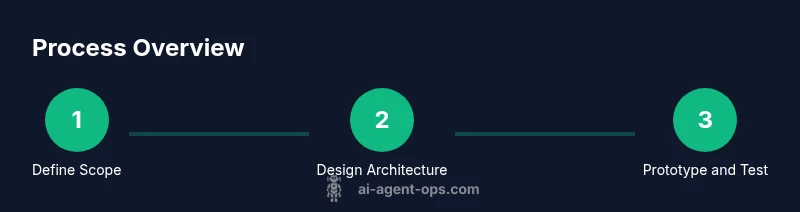
Clarify the problem the builder will solve, target users, and success criteria. Establish constraints on latency, memory, and safety. This step sets the north star for the entire build.
Tip: Capture a minimal viable outcome first; expand only after validated results. - 2
Design agent runtime and memory model
Draft how agents will execute tasks, what memory is persisted, and how memory is refreshed. Decide on storage and privacy controls to prevent leakage of sensitive data.
Tip: Use a memory schema that is easy to review and sanitize for audits. - 3
Select tools and prompts templates
Choose a core set of tools (APIs, databases, functions) and create modular prompt templates. Ensure interfaces are stable and documented.
Tip: Start with 3-5 reusable templates before expanding tool slots. - 4
Implement governance and safety guards
Add access controls, prompt auditing, and safety fallbacks. Establish logging and alerting for unusual agent behavior.
Tip: Automate safety checks in the deployment pipeline. - 5
Build observability dashboards
Create dashboards to track latency, success rates, tool usage, and decision traces. Ensure operators can reproduce failures.
Tip: Instrument at the component level for precise root-cause analysis. - 6
Prototype with MVP templates
Deploy a minimal builder using a small set of templates and a single orchestration flow to validate end-to-end tasks.
Tip: Validate with real-world tasks before broader rollout. - 7
Iterate based on feedback
Gather user feedback from developers and product teams, refine prompts, memory policies, and tool availability.
Tip: Adopt a channel for rapid feedback cycles. - 8
Plan incremental scaling
Add more templates, expand tool coverage, and enhance governance as you move toward production.
Tip: Maintain a backlog and prioritize items by impact and risk.
Questions & Answers
What is an AI agent builder?
An AI agent builder is a framework that lets teams design, test, and orchestrate autonomous agents to perform tasks. It combines models, prompts, memory, and tool integrations into a cohesive platform.
An AI agent builder is a framework to design and run autonomous agents that can perform tasks across apps and services.
How do I choose models and tools for my builder?
Choose models and tools based on latency, cost, and capability requirements. Favor modular interfaces and a small core set of tools to start, then expand as you validate value.
Pick models and tools that fit your latency and cost limits, starting small and expanding as you prove value.
What governance practices are essential?
Implement access control, prompt auditing, data retention policies, and safety guards. Maintain an audit trail for decisions and ensure compliance with privacy standards.
Use access controls, audits, and clear data policies to stay compliant and trustworthy.
What deployment patterns work well for agents?
Common patterns include autonomous data collection agents, service orchestration agents, and decision-support agents with human-in-the-loop review. Structure ideas as reusable templates.
Autonomous, orchestration, and decision-support patterns are common, all built from reusable templates.
How do you measure success and ROI?
Define concrete metrics such as task completion rate, latency, and error rate. Track improvements over time and tie outcomes to business objectives.
Track task success, speed, and reliability, then tie improvements to business goals.
Are there safety concerns I should plan for?
Yes. Build guardrails, monitor for policy violations, and restrict sensitive actions. Establish escalation paths and human oversight where needed.
Yes—guardrails and monitoring are essential with clear escalation paths.
Watch Video
Key Takeaways
- Define a clear architectural foundation before coding.
- Use modular templates to accelerate agent creation.
- Governance and observability are essential from day one.
- Design for DX as a driver of adoption and quality.