AI Agent Building Software: A Practical How-To Guide
A comprehensive, educational guide for developers and leaders on building AI agent software, covering architecture, tooling, testing, deployment, and governance for reliable agentic AI workflows.


By completing this guide, you will learn how to plan, design, and build AI agent software that can autonomously perform tasks. You’ll define goals and constraints, select the right tools, implement perception, reasoning, and action loops, and establish safety, testing, and monitoring practices for resilient agentic workflows. The approach emphasizes modular architecture and rigorous verification.
What is AI Agent Building Software?
AI agent building software refers to a structured approach for creating autonomous software agents that perceive their environment, reason about goals, and act to achieve those goals. Rather than a monolithic application, an agent architecture emphasizes modular components: perception to collect data, a reasoning layer to plan actions, and an execution module to carry out those actions. This separation enables safer upgrades, easier testing, and scalable collaboration among multiple agents. According to Ai Agent Ops, the most successful teams treat agent construction as an iterative loop: define goals, build capabilities, validate behavior in realistic scenarios, and refine continuously. This mindset aligns with agentic AI workflows, where agents operate with bounded autonomy while remaining auditable and controllable. In practice, teams start small—solving a narrow task—and gradually broaden the agent’s domain, creating a pipeline that can be monitored and governed over time. The goal is to deliver measurable outcomes, not just impressive capabilities. By embracing modularity and disciplined governance, organizations can unlock practical value without compromising safety or reliability.
Core Architecture: Perception, Reasoning, and Action
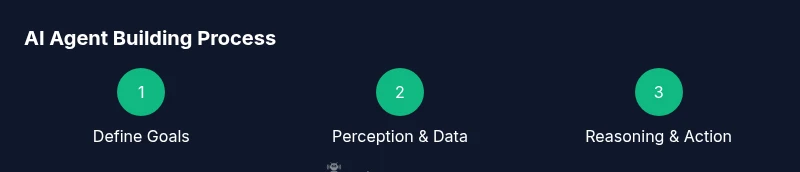
A robust AI agent software stack relies on three interlocking layers. Perception modules ingest data from sensors, APIs, or user input, normalizing it for downstream processing. The reasoning layer interprets this data to identify goals, constraints, and potential plans, often leveraging planning algorithms or learned policies. The action layer executes commands, interacts with external systems, or returns results to users. Across these layers, clear interfaces and data contracts reduce coupling and enable incremental improvements. Ai Agent Ops emphasizes designing interfaces that support testability and observability, so each component can be validated in isolation and as part of end-to-end scenarios. Security guards, rate limits, and auditing hooks should be baked into every transition between perception, decision, and action. A well-defined loop helps teams diagnose failures quickly and prevents cascading errors when the environment changes. By prioritizing these three pillars, you create a foundation that scales as the agent’s responsibilities grow.
Defining Goals and Constraints
Defining explicit goals is critical because an agent’s behavior is guided by what it is trying to achieve. Start with a concrete objective, success criteria, and failure modes. Translate goals into measurable prompts, reward signals, or decision policies that the agent can reason about. Equally important are constraints: safety bounds, ethical guidelines, and operational limits that keep the agent from taking unsafe actions. Document these constraints in a public, version-controlled spec so stakeholders can review and adjust them as the project evolves. A disciplined approach to goals and constraints helps prevent scope drift, reduces the risk of unexpected behavior, and provides a clear path for testing and evaluation. Throughout, keep a log of decisions and rationale to support audits and future iterations; Ai Agent Ops notes that traceability is essential for agent governance and trust.
Data and Interfaces: Connecting Perception to Action
The effectiveness of an AI agent depends on reliable data and clean interfaces. Perception sources may include internal databases, real-time streams, or user interactions. Normalize data into consistent schemas, handle missing values gracefully, and implement data validation to prevent garbage in, garbage out scenarios. Interfaces should expose well-documented APIs or message contracts so perception, reasoning, and action components can communicate deterministically. Consider latency budgets, throughput requirements, and error handling strategies to maintain responsiveness. Security concerns—such as authentication, authorization, and data privacy—must be baked into every interface. When possible, use simulated environments to test perception and action flows before touching production data. This approach minimizes risk and accelerates learning for your team, a point Ai Agent Ops repeatedly emphasizes in practical agent development.
Agent Loops and Orchestration
Agent loops tie perception, planning, and action together into a continuous cycle. A typical loop begins with input gathering, followed by interpretation and goal selection, then action execution, and finally evaluation and adaptation. Orchestration may involve coordinating multiple agents, each with its own loop and responsibilities, so message passing and scheduling become crucial. Use a central orchestrator or a lightweight event-driven orchestrator to manage task queues, concurrency, and failure recovery. Logging and tracing should be pervasive to diagnose slow steps or misaligned decisions. Be mindful of race conditions and deadlocks when multiple agents interact. A well-designed loop supports incremental improvements, allowing teams to add capabilities without destabilizing existing behavior. Ai Agent Ops highlights the importance of tuning loop timing to balance responsiveness with accuracy.
Safety, Governance, and Ethics
Safety and governance are not add-ons; they are foundational. Establish guardrails that prevent dangerous actions, monitor for adversarial inputs, and implement rollback mechanisms. Create an audit trail for decisions and outcomes so you can justify actions and adjust policies as needed. Define ownership: who can modify goals, constraints, or data sources? Implement access controls, versioning, and change management procedures to maintain accountability. Ethics considerations include bias detection, data privacy, and ensuring user consent where appropriate. Regular independent reviews, red-teaming, and scenario testing are recommended to uncover blind spots before a deployment. By embedding governance into the development lifecycle, teams can maintain trust and reliability in agentic AI workflows across evolving use cases.
Testing and Validation Strategies
Testing AI agents requires both synthetic and realistic evaluation. Start with unit tests for perception components, decision rules, and action interfaces. Then use simulations to stress-test planning under varied conditions, including edge cases and noisy data. End-to-end tests should validate the full loop, including failure modes and recovery paths. Define concrete success criteria and use dashboards to monitor key indicators such as latency, accuracy, and error rates. Run controlled pilots in staging environments before any production exposure, and plan for rapid rollback if safety thresholds are breached. Ai Agent Ops underscores that iterative testing—coupled with strong telemetry—drives confidence in agent reliability and governance readiness.
Tooling, Libraries, and Platforms
This domain benefits from a mix of tooling for perception, reasoning, and orchestration. Emphasize modular libraries, clear interface definitions, and lightweight execution environments to avoid tight coupling. Favor open standards, well-documented APIs, and simulation tools that support reproducibility. For planning and decision-making, consider frameworks that support both rule-based logic and learning-based policies. Visualization and monitoring tools help teams understand agent behavior, spot anomalies, and optimize performance. Always align tooling choices with your team’s skills, project timelines, and governance requirements. Ai Agent Ops reminds teams to favor interoperability and gradual migration over wholesale platform swaps.
Deployment, Monitoring, and Maintenance
Deployment marks a transition from development to operation. Use gradual rollout strategies, feature flags, and blue-green or canary deployments to minimize risk. Implement robust observability: logs, metrics, traces, and alerting for actionable incidents. Establish maintenance routines: scheduled retraining, data quality checks, and periodic policy reviews to adapt to new use cases. Document rollback procedures and data retention policies to ensure compliance and resilience. Ongoing monitoring should quantify whether the agent continues to meet goals and constraints, and provide a clear path to iterations when performance degrades. The Ai Agent Ops team emphasizes a disciplined maintenance plan to sustain long-term value.
Why This Approach Works: A Practical Synthesis
The steps above form a practical, repeatable approach to AI agent software that balances capability with safety. By starting with well-scoped goals, designing modular components, validating through simulations, and embedding governance from day one, teams can reduce risk while delivering real value. The approach also supports cross-functional collaboration between product, security, and data science teams, which is essential for agentic AI workflows. The end goal is not to chase novelty but to build reliable agents that users can trust and depend on. Consistency across teams, thorough documentation, and continuous learning are the hallmarks of success in ai agent building software.
Tools & Materials
- Development environment (IDE, version control)(Git-based workflow; set up a clean repo scaffold)
- Python 3.x environment(For agent modules and scripting; virtual environments recommended)
- Node.js or TypeScript runtime(Frontend tooling and automation scripts; keep to LTS version)
- AI agent framework concepts primer(Understand perception, planning, and action loops; no vendor lock-in)
- Secure storage for credentials(Use environment variables or secret managers; never hard-code keys)
- Sample datasets for testing(Synthetic data preferred when real data is sensitive)
- Monitoring and observability tooling(Logs, metrics, traces, and alerting configured in staging)
- Documentation templates(Readme, API docs, and decision records)
Steps
Estimated time: 4-8 weeks
- 1
Define project goals and success criteria
Clarify the problem statement and expected outcomes. Translate goals into measurable metrics and identify failure modes. Establish a governance plan and assign ownership for ongoing decisions.
Tip: Start with a narrow scope that can be validated in a few weeks. - 2
Map the reference architecture
Sketch the perception, reasoning, and action layers and how they will communicate. Define data contracts, interfaces, and error-handling boundaries. Decide on orchestration strategy for single or multiple agents.
Tip: Keep interfaces small and versioned to ease future changes. - 3
Set up the development environment
Create a clean workspace with version control, virtual environments, and linting. Establish a reproducible run process and a baseline test suite to catch regressions early.
Tip: Use containerization for reproducibility where appropriate. - 4
Specify agent capabilities and prompts
Document the agent’s required sensing skills, decision policies, and action endpoints. Design prompts or policy inputs that are robust to input variability and auditable.
Tip: Version prompts and policies; track prompt changes over time. - 5
Implement perception module
Build adapters to ingest data sources, normalize formats, and handle missing or noisy data. Validate data quality before it enters the reasoning stage.
Tip: Include data validation tests and fallback paths. - 6
Implement planning and decision-making
Add a planning layer capable of selecting actions that align with goals. Support both rule-based logic and learning-based policies where appropriate.
Tip: Keep a clear log of planned vs. executed actions for auditability. - 7
Implement action/execution module
Create interfaces to external systems or internal components. Ensure robust error handling and idempotent operations where possible.
Tip: Test action idempotency to avoid duplicate effects in retries. - 8
Incorporate safety, monitoring, and governance
Embed guardrails, access controls, and data privacy checks. Implement telemetry to track behavior and trigger alerts when thresholds are crossed.
Tip: Run red-teaming exercises to surface unsafe patterns. - 9
Test with simulations and pilots
Use simulated environments to validate performance under varied conditions before production exposure. Run staged pilots with clear kill-switches and rollback plans.
Tip: Automate end-to-end tests and document observed failures. - 10
Deploy, monitor, and iterate
Release with gradual rollout, monitor key metrics, and iterate based on real-world feedback. Maintain a cadence of policy reviews and data quality checks.
Tip: Treat deployment as a learning loop, not a one-off event.
Questions & Answers
What is an AI agent?
An AI agent is software that senses its environment, reasons about goals, and takes actions to achieve outcomes. It operates within defined constraints and is designed to be observable and auditable. Agents often work in loops, continually refining their behavior based on feedback.
An AI agent is software that senses, thinks, and acts to achieve a goal. It runs in a loop and is designed to be auditable and safe.
What are the essential components of an AI agent architecture?
Key components include perception (data input), reasoning/planning (decision making), and action/execution (interacting with systems). A communication layer coordinates between components, while governance and safety controls ensure compliance and safety.
The essentials are perception, reasoning, and action, plus a governance layer for safety.
How do I start safely when building an AI agent?
Begin with a narrow scope, use simulations, implement guardrails, and iterate in stages. Establish rollback plans and monitoring to catch unsafe behavior early.
Start small, test in simulations, and add guardrails early.
What metrics matter when evaluating AI agents?
Focus on reliability, latency, accuracy of decisions, and safety compliance. Telemetry should reflect how often the agent achieves goals and how often it deviates from constraints.
Key metrics are reliability, latency, and safety compliance.
Can I reuse existing tools to build AI agents?
Yes, leverage interoperable libraries and open standards where possible. Avoid vendor lock-in by designing with modular adapters and clear data contracts.
Yes, reuse interoperable tools and avoid vendor lock-in.
How do I deploy updates to agents without downtime?
Use gradual rollouts with feature flags and blue-green or canary deployment strategies. Maintain rollback procedures and continuous monitoring to detect issues early.
Roll out changes gradually with feature flags and have a rollback plan.
Watch Video
Key Takeaways
- Define clear goals and success criteria
- Prioritize modular, testable architecture
- Embed safety, governance, and observability from day one
- Use simulations and pilots before production
- Plan for iteration and continuous improvement