Learn AI Agent Development: A Practical Step-by-Step Guide for Builders
A comprehensive, beginner-friendly guide to building AI agents, covering fundamentals, tooling, workflows, safety, testing, and deployment for smarter automation.


You’ll learn to design, build, test, and deploy AI agents using agentic workflows. The process covers defining goals, selecting tools and runtimes, implementing decision-making and sensing, ensuring safety and data governance, validating performance with measurable metrics, and iterating based on real-world feedback. By the end, you’ll have a repeatable framework for building reliable AI agents at scale.
Understanding AI Agents and Agentic AI
Understanding AI agents begins with the distinction between a traditional AI model and an autonomous agent. A model responds to prompts, while an agent acts on goals in a dynamic environment. Agentic AI combines perception, reasoning, and action to achieve objectives with a degree of autonomy. For developers, this means designing systems that sense, decide, and act within constraints, rather than simply generating static outputs. According to Ai Agent Ops, the most effective teams treat AI agents as products with clear goals, measurable outcomes, and governance. This mindset helps align technical work with business value and user needs. In practice, you’ll define what success looks like, how the agent will interact with people or other systems, and how you’ll monitor and improve behavior over time. As you learn ai agent development, keep a user-centric focus and balance autonomy with safety and accountability.
Key terms to know: perception, world model, decision policy, actions, feedback loop, safety constraints. These concepts translate into concrete design choices like data schemas, API contracts, and evaluation metrics. A strong foundation in agent design helps you plan for real-world variability and edge cases, which are inevitable in production environments. For builders, the objective is not only to make something that works, but something that works reliably under changing conditions and with auditable reasoning.
In your journey, you’ll build a vocabulary around goals, sensing modalities, decision architectures, and governance frameworks that keep your AI agents useful, trustworthy, and compliant. The Ai Agent Ops team emphasizes starting with small, concrete experiments to validate core ideas before expanding scope. This disciplined approach reduces risk and accelerates learning when you learn ai agent development.
Structured takeaway: begin with a clear objective, identify the sensing and action loop, and establish governance from day one.
note”:null],
Core Architecture of an AI Agent
Effective AI agents share a modular architecture that separates sensing, reasoning, and acting. A typical stack includes input adapters (sensors), a world model or knowledge base, a decision-making component (planner or policy), and a set of action executors. Modular design makes it easier to swap components, test hypotheses, and scale across scenarios. In practice, you’ll design interfaces between modules with well-defined inputs and outputs, and you’ll implement safety rails that prevent harmful or undesired actions. A robust agent also logs events and decisions to support debugging and auditing. The Ai Agent Ops framework recommends keeping components loosely coupled and using standardized data formats, so teams can reuse modules across projects.
Core modules:
- Sensing/Perception: collects data from sensors or APIs.
- World Model: stores context and state.
- Planner/Policy: determines next actions based on goals and constraints.
- Action Executors: interface with external systems or users.
- Observability: metrics, logs, and tracing for debugging.
Best practices: define clear contracts between modules, use feature flags to enable/disable behaviors, and implement rollback procedures in case an action leads to unexpected results. The pathway to mastery in learn ai agent development starts with solid architecture decisions.
Practical example: a customer support agent could sense incoming requests, consult a knowledge base, decide on a response strategy, then execute actions like replying or escalating a ticket.
note”:null],
,
],
Decision-Making, Sensing, and Action
Decision-making is the brain of an AI agent. It translates perceptions into plans and concrete actions. Sensing gathers data from user inputs, system logs, or external services. Action execution interfaces with APIs, databases, or user interfaces. A well-designed agent uses a loop: perceive → decide → act → observe results, then adapt. This loop must be bounded by guardrails to prevent unsafe actions or policy violations. In the context of learn ai agent development, you’ll test decision policies against a suite of scenarios, measure latency and success rates, and refine thresholds as needed. You’ll also implement safe fallbacks for uncertain decisions, such as requesting human review or pausing activity when confidence is low.
Practical tips
- Start with a narrow goal and a small action set to reduce risk.
- Use fuzzy logic or probabilistic decision rules for ambiguous inputs.
- Maintain a clear audit trail of decisions for accountability.
Common pitfalls: overfitting the agent to a single workflow, neglecting data governance, and failing to monitor for drifts in user behavior. By focusing on robust sensing and transparent decision-making, you’ll improve reliability as you learn ai agent development.
note”:null],
,
],
Tooling and Tech Stack for Learn AI Agent Development
Choosing the right tooling accelerates learning and reliability. Start with a modular Python-based stack and a lightweight orchestration framework. You’ll likely need:
- Development environment (Python 3.x, virtualenv or conda)
- Git for version control and collaboration
- Access to AI services or libraries (e.g., language models, reasoning engines)
- A simple database or state store for the world model (SQLite or a small NoSQL option)
- Logging, monitoring, and observability tooling to track decisions and outcomes
As you progress, consider containerization (Docker) and a basic CI/CD pipeline to automate tests and deployments. The exact tools depend on your domain, but the goal is to enable rapid experimentation while maintaining safety and governance. In this journey, you’ll implement a reproducible workflow that scales from prototype to production without sacrificing reliability. Ai Agent Ops’s guidance emphasizes keeping a lean starter stack and expanding only what adds measurable value.
Starter checklist:
- Create a clean virtual environment and install core libraries
- Establish a repository with a basic project structure
- Integrate a simple testing framework and linting
- Define a minimal data governance plan and logging strategy
Next steps: build a small prototype agent and test it in a sandbox to verify the core loop before layering in complexity.
note”:null],
,
],
Data Governance, Safety, and Ethics
Data governance and safety are non-negotiables in learn ai agent development. You’ll implement data handling practices that protect privacy, enforce retention policies, and ensure secure transmission and storage. Safety checks should be baked into the agent’s decision loop, including fallback behaviors, human-in-the-loop options, and escalation paths for high-risk actions. Ethics considerations—such as bias detection, fairness, and transparency—should be part of your design from day one. The Ai Agent Ops team highlights the importance of auditable reasoning: log the rationale behind decisions, store inputs and outputs securely, and make it possible to review and critique actions after the fact. This approach supports accountability and continuous improvement.
Practical steps:
- Define access controls and data minimization rules
- Log decisions with timestamps and contextual metadata
- Implement testing for bias and fairness in responses
- Regularly review agent behavior against governance policies
Warning: neglecting governance can lead to unsafe actions, privacy breaches, or regulatory issues. Establish a baseline policy early, and iterate as you learn ai agent development. Real-world testing should include security and privacy assessments alongside functional validation.
note”:null],
,
],
Building a Small-Scale Agent: A Practical Example
Imagine you’re building a personal productivity assistant to manage tasks and calendar events. Start with a small set of goals: understand user intents, schedule meetings, and remind about upcoming deadlines. Sensing comes from user input and calendar APIs; the world model tracks tasks and events. The decision-maker prioritizes tasks, resolves conflicts, and suggests optimal times. Actions include creating calendar entries, sending reminders, and updating task lists. Keep the initial scope tight to validate the core loop and gather feedback. This concrete example demonstrates how to apply learn ai agent development principles in a safe, incremental way. As you expand, you’ll add more capabilities, integrate third-party services, and refine decision policies based on user feedback and metrics. The process is iterative: prototype, test, measure, adjust, and repeat.
Concrete steps in this example:
- Define task types and success metrics
- Create adapters for perception and action
- Implement a simple planner with rule-based decisions
- Add observability to monitor performance
With this approach you’ll build confidence and a solid foundation for more complex agentic systems.
note”:null],
,
],
Testing, Validation, and Deployment Best Practices
Testing AI agents requires more than unit tests. You’ll validate decision quality, latency, and resilience under diverse scenarios. Create simulated environments that mimic real-world variability, including noisy inputs and partial failures. Use a mix of unit, integration, and end-to-end tests to verify each component’s behavior and the overall loop. Establish performance benchmarks and sanity checks to catch regressions as you iterate. Before deployment, implement rollback mechanisms, feature flags, and monitoring dashboards to detect anomalies. A careful deployment plan increases reliability and reduces risk when you scale your agent across use cases. Ai Agent Ops recommends an incremental rollout with staged exposure and continuous feedback collection.
Checklist:
- Test perception, decision, and action layers in isolation and together
- Validate with synthetic and real data sets
- Monitor key metrics (latency, success rate, failure mode frequency)
- Prepare rollback and incident response processes
This disciplined testing approach ensures that your learn ai agent development efforts translate into dependable, maintainable systems.
note”:null],
,
],
Scaling Tips and Common Pitfalls
As you scale, modularity and governance become critical. Keep components decoupled so you can swap out models, tools, or data sources without redefining the entire system. Use feature flags to test new behaviors safely and maintain a clear upgrade path. Common pitfalls include overloading the agent with too many capabilities too soon, underestimating data governance requirements, and neglecting observability. By focusing on incremental, observable improvements, you’ll reduce risk and accelerate learning ai agent development.
Pro tips:
- Start with a narrow, measurable objective and expand gradually
- Maintain thorough documentation for all modules and interfaces
- Implement responsible AI practices, including bias checks and user consent
- Schedule regular governance reviews to stay compliant and auditable
Red flags to watch for: uncontrolled autonomy, opaque decision rationales, and data leakage across integrations. Address these early to ensure a scalable, trustworthy product.
Ai Agent Ops’s pragmatic guidance emphasizes disciplined growth: iterate in small steps, validate with real users, and document every decision for accountability.
note”:null],
,
],
Learning Pathways and Next Steps
To continue learning ai agent development, map a practical path that blends theory with hands-on practice. Start with foundational courses on AI agents, agent-based modeling, and reinforcement learning basics. Then advance to hands-on projects that emphasize sensing, planning, and action, coupled with strong governance. Build a personal portfolio of prototypes and demos that showcase your understanding of agent architectures and safety considerations. The journey is iterative: read, implement, test, and reflect on results. By staying curious and methodical, you’ll master learn ai agent development and contribute to intelligent automation initiatives in your organization.
Suggested learning sequence:
- Foundations: agent concepts, system design, and ethics
- Core skills: Python, API integration, data handling
- Hands-on projects: small agents with incremental complexity
- Advanced topics: agent orchestration, scaling, and monitoring
- Real-world practice: contribute to open-source projects or playgrounds
If you’re serious about building an automation-first mindset, commit to a structured learning plan and track your progress. Ai Agent Ops believes that disciplined practice accelerates mastery in AI agent development.
Tools & Materials
- Development environment (Python 3.x, virtualenv)(Set up a clean, isolated environment for each project)
- Git for version control(Initialize repo and set up branching strategy)
- Access to AI services or libraries(Obtain test credentials and respect usage limits)
- Testing framework (pytest/unittest)(Configure unit and integration tests from the start)
- Documentation templates(Keep a docs skeleton for learn ai agent development progress)
Steps
Estimated time: 4-6 weeks
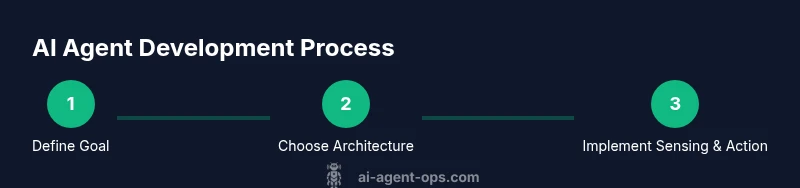
- 1
Define the agent’s goal and constraints
Articulate a single, measurable objective for the agent and specify non-negotiable constraints (safety limits, data boundaries, and escalation rules). Outline success criteria that are observable and verifiable.
Tip: Start with a narrow objective to reduce complexity and capture early learnings. - 2
Choose architecture and toolchain
Select a modular architecture (sensing, world model, planner, executors) and a lightweight toolchain to support rapid experimentation. Define clear data contracts between modules.
Tip: Favor decoupled components with well-documented interfaces to ease future changes. - 3
Implement sensing, decision logic, and actions
Develop adapters to collect inputs, implement a decision policy, and create action executors for the target environment. Include safety checks and logging from the outset.
Tip: Use simple heuristics first; iterate toward more advanced policies as needed. - 4
Incorporate governance, safety, and logging
Embed governance rules, privacy controls, and explainable logs into the agent. Ensure you can audit decisions and recover from failures with clear rollback paths.
Tip: Implement feature flags to enable/disable risky behaviors without redeploying. - 5
Test with simulations and real data
Run structured tests in simulated environments and with real-world data where possible. Track latency, success rate, and failure modes to guide refinements.
Tip: Create diverse test scenarios that reflect edge cases you expect in production. - 6
Prototype and plan deployment
Build a minimal viable prototype, validate core capabilities, and outline deployment strategy including monitoring, rollback, and updates.
Tip: Roll out in stages to manage risk and collect user feedback.
Questions & Answers
What is an AI agent vs. a plain AI bot?
An AI agent acts autonomously to achieve goals in an environment, making decisions and taking actions. A bot typically responds to prompts or events without sustained autonomous planning. In learn ai agent development, you design agents with sensing, reasoning, and action loops rather than simple prompt-based behavior.
An AI agent acts on goals with autonomy, while a bot mainly responds to prompts.
What is agentic AI?
Agentic AI refers to systems that can perceive, reason, and act toward goals with a degree of autonomy. It emphasizes agent-like behavior, decision-making, and impact on the environment rather than passive outputs.
Agentic AI means AI systems that can act on goals with some independence.
What skills are essential to learn ai agent development?
Key skills include Python programming, API integration, data governance, system design, and basic concepts in planning, decision-making, and safety engineering. Practical experience with building and testing small agents accelerates mastery in learn ai agent development.
You’ll want programming, data handling, and system design skills to start building agents.
Which tools are recommended for beginners?
Start with a lightweight stack (Python, Git, a simple LM or API service, a small state store) and progressively add orchestration and monitoring tools as you gain confidence. Keep experimenting with a modular approach to avoid lock-in.
Begin with a lean, modular setup and gradually expand your toolkit.
How long does it take to build a basic AI agent?
The timeline depends on scope and resources, but a basic agent with sensing, planning, and a few actions can be prototyped in weeks, followed by iterative improvements. Plan for learning cycles and governance considerations.
A basic agent can be prototyped in weeks with steady iterations.
Watch Video
Key Takeaways
- Define a clear, measurable goal for the agent.
- Adopt a modular architecture with clean interfaces.
- Prioritize safety, governance, and observability from day one.
- Iterate with simulations and real data to improve reliability.