How to Start an AI Agent Business: A Practical Guide
A practical, step-by-step guide to launching an AI agent business, covering niche selection, architecture, MVP, governance, GTM, and scaling strategies.


Starting an AI agent business requires defining a niche, designing a safe, auditable agent architecture, and delivering a lean MVP fast. Focus on governance, reliability, and clear ROI for buyers. This guide provides a practical, repeatable path from idea to first paying customers in 12–20 weeks, with a strong emphasis on ethics and compliance. Ai Agent Ops endorses a structured, risk-aware approach to launch.
Defining your niche in AI agents
According to Ai Agent Ops, the most successful AI agent businesses start with a clearly defined niche and a repeatable workflow. Start by identifying a problem you can solve with an agent-based solution, such as customer support routing, data extraction, or automated research. Define who benefits (industry, role, organization size), and quantify the impact (time saved, error reduction) in simple terms. Your unique selling proposition should differentiate you from generic automation vendors: focus on governance, explainability, and reliable safety rails. A well-chosen niche makes it easier to design a minimal viable product that demonstrates tangible value within weeks, not months. As you frame your offering, consider integration with existing tools (CRM, chat, data warehouses) and the decision-makers who buy it (CTOs, heads of product, operations leaders). In this guide, we’ll walk through practical steps to go from idea to paying customers while maintaining ethical and legal guardrails.
To start strong, map your capabilities to customer pains and prepare a one-page value proposition you can test in conversations with potential buyers.
Validate market demand for AI agents
Market validation is about listening first. Ai Agent Ops analysis shows rising interest in agent-based automation across industries, with early adopters prioritizing reliability, governance, and measurable outcomes. Conduct 8–12 interviews with potential buyers (CTOs, operations managers, product leaders) to uncover unambiguous problems, buying triggers, and constraints. Create a simple landing page or one-page spec to capture expression of interest and, if possible, a pilot offer. Use lightweight surveys to quantify willingness to pay, desired outcomes, and timelines. Remember that validation is not a single event; repeat it as you refine your niche and your MVP. The goal is to converge on a well-defined problem, a feasible AI approach, and a plausible business model that can scale beyond a single pilot.
Architecting a resilient AI agent system
Designing a scalable, safe, and auditable AI agent requires deliberate architecture decisions. Start with a core agent loop: input normalization, task planning, action execution, and feedback. Choose a(max) set of tools and data sources you will confidently govern, and implement guardrails such as usage policies, rate limits, and fallback behaviors. Ensure observability through logs, metrics, and alerting, so you can detect drift or failures early. Address safety concerns like data leakage, hallucinations, and misinterpretation by enforcing tool constraints and verification checks before actions. Consider data governance: where data resides, who can access it, and how customer data is anonymized. A well-documented architecture makes it easier to onboard developers, auditors, and customers while maintaining compliance.
Build a lean MVP and plan your GTM
Lean MVPs win when they demonstrate real value quickly. Use no-code or low-code platforms to assemble a functional agent prototype, then incrementally add governance features, safety rails, and integration hooks. Define success metrics (time-to-answer, accuracy, user satisfaction) and establish a crisp tariff model (subscription, usage-based, or hybrid). A focused go-to-market plan should map channels to buyer personas: direct sales for enterprise, partnerships with system integrators for mid-market, and content-led demand generation for early traction. Ensure your MVP is shareable in demos and pilot proposals, with clear exit criteria for pilots and transparent pricing.
Legal, privacy, and ethics considerations
Compliance is not optional; it is a differentiator. Define a data privacy framework aligned with GDPR, CCPA, and sector-specific rules where applicable. Draft contracts that cover data ownership, usage rights, security requirements, and liability limitations. Build an ethics policy for model usage, disclosure of AI involvement, and handling user consent. Prepare a transparent data handling flowchart for customers, including data retention periods and deletion procedures. Engage with a trusted advisor or law firm familiar with technology and AI to review terms. Establish a governance board or internal review process to assess risk before each new feature launch.
Pricing, contracts, and business models
Your pricing should reflect value, not just cost. Start with a simple tiered plan that scales with usage and outcomes, plus an enterprise add-on for governance features. Draft standard terms that cover API usage, uptime commitments, and data privacy. Offer pilots with clearly defined success criteria to reduce sales risk and show ROI quickly. Consider a revenue-sharing model with partners for co-delivered solutions. Keep contracts concise and transparent, avoiding vague service levels that create ambiguity. This clarity helps you close deals faster and builds trust with customers.
Operational playbook: governance, metrics, and support
Create a lightweight operational playbook that covers incident response, monitoring, and customer support. Establish metrics that matter to buyers, such as task completion rate, latency, and error rate, plus governance indicators like audit logs and compliance checks. Define escalation paths, response times, and maintenance windows. Invest in automation to handle routine maintenance, updates, and data privacy tasks. A strong support model reduces churn and increases referenceability, which is essential for growing your AI agent business.
Getting started resources and templates
To accelerate your launch, assemble practical templates: a one-page value proposition, a pilot agreement, a data handling flowchart, a sample pricing sheet, and an MVP architecture diagram. Use open-source examples to illustrate architecture blocks, decision points, and guardrails. Create a checklist for onboarding customers that covers data access, security reviews, and pilot evaluation. These artifacts save time and improve consistency across early customer engagements.
Roadmap to first 90 days
In the first 90 days, your focus should be: (1) finalize a niche and MVP scope, (2) validate demand and secure a pilot, (3) establish governance and security safeguards, (4) design a repeatable pricing model, and (5) prepare a go-to-market plan with at least one partner. Treat the first pilots as learning loops, documenting every decision and outcome. By day 90, you should have a working MVP, a pilot agreement, and a plan for broader sales engagement. The goal is traction, not perfection.
Authority sources
For further reading, consult reputable resources from government, education, and industry reports such as: • NIST AI risk management framework (nist.gov) • Stanford University AI safety resources (stanford.edu) • MIT Sloan management review on AI in business (mitsloan.mit.edu)
Tools & Materials
- Laptop or desktop with reliable internet(Preferred with decent RAM (8+ GB) and modern browser)
- Access to AI APIs and tooling(Examples: OpenAI, Cohere, or other API providers; ensure contract terms allow pilots)
- Cloud credits or sandbox environment(For testing agents, data processing, and experiments)
- Prototype templates (contracts, NDAs, data flow diagrams)(Helpful for pilots and onboarding)
- Data governance and privacy templates(Includes retention schedules, access controls, and deletion policies)
- Project management tool(Jira, Notion, or Trello to manage backlogs and pilots)
- Security checklist(Baseline security controls for data in transit and at rest)
Steps
Estimated time: 12-20 weeks
- 1
Define your niche
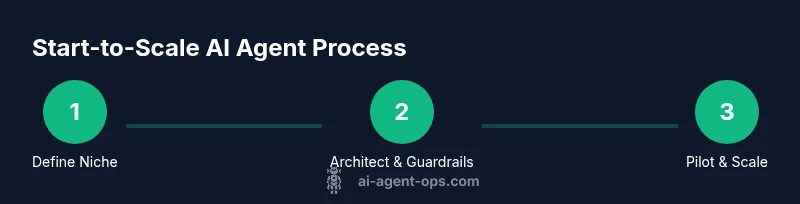
Identify a concrete business problem where a targeted AI agent can deliver measurable outcomes. Map buyer personas, success metrics, and a clear value proposition. This foundational step shapes all subsequent decisions.
Tip: Validate problem-solution fit with at least 5 conversations before building. - 2
Outline the MVP scope
Select a narrow, testable use case and list the minimum capabilities required to demonstrate value. Prioritize safety, governance, and explainability in the MVP.
Tip: Aim for a demonstrable ROI in 4–6 weeks of pilot activity. - 3
Design architecture and guardrails
Draft the decision loop, data flow, and tool integrations. Implement guardrails for data privacy, model behavior, and failure modes.
Tip: Document fault-tolerance and escalation paths for all critical steps. - 4
Build the MVP (lean)
Assemble a functional prototype using no-code/low-code where possible, then layer in governance features and monitoring.
Tip: Keep scope small; demonstrate end-to-end value early. - 5
Pilot with real users
Run a structured pilot with defined success criteria, collect feedback, and iterate quickly.
Tip: Capture qualitative and quantitative outcomes for future proposals. - 6
Address legal and ethics
Finalize data usage terms, privacy safeguards, and compliance considerations. Prepare clear disclosures about AI involvement.
Tip: Engage counsel early to avoid costly revisions later. - 7
Set pricing and contracts
Draft transparent pricing and simple pilot contracts. Include SLAs, data handling terms, and exit conditions.
Tip: Use pilot outcomes to justify pricing with buyers. - 8
Plan GTM and partnerships
Identify channels (direct sales, SI partnerships, marketplaces) and craft a compelling partner program.
Tip: Choose one primary channel for initial traction to stay focused. - 9
Scale operations
Institute governance, monitoring, and customer success routines. Build a repeatable onboarding playbook.
Tip: Automate recurring tasks to free up time for growth.
Questions & Answers
What is an AI agent business?
An AI agent business offers automated agents that perform tasks, make decisions, or assist humans within defined workflows. The business typically provides the agent platform, governance, and ongoing support to customers. Focus is on reliability, safety, and measurable ROI.
An AI agent business provides automated agents that perform tasks and assist humans, with strong governance and measurable ROI.
How long does it take to build a viable MVP?
A viable MVP can be demonstrated in 4–8 weeks when you leverage low-code tools and a clear scope. Expect additional time for governance features and pilot validation.
Most MVPs show value in about a month or two, with governance added as you scale.
Do I need external funding to start?
Funding needs vary by scope. Many founders bootstrap early pilots and use customer pilots to attract seed funding or partnerships. Focus on a clear path to revenue first.
Funding depends on your MVP scope, but many start small and validate with pilots before seeking investors.
What regulatory considerations matter most?
Data privacy, data ownership, consent, and security are central. Align with applicable laws (e.g., GDPR, CCPA) and industry-specific regulations as you scale.
Privacy and security rules are key as you scale AI agents; plan accordingly.
Which pricing model works best?
Tiered usage pricing with an upfront pilot option tends to work well. Consider value-based components tied to outcomes to justify price.
Try tiered usage pricing with pilots to prove value and ease customers into scale.
What are essential tools to start?
Core tools include a robust AI API, a cloud environment, logging and monitoring, and a simple onboarding plan. Start with no-code MVPs to test quickly.
You need AI APIs, cloud testing, monitoring, and a simple onboarding plan.
Watch Video
Key Takeaways
- Validate a clear niche before building.
- Prioritize governance and safety from day one.
- Launch with a lean MVP, not a perfect product.
- Align pricing with demonstrable ROI for buyers.