How to Start an AI Agency: A Practical Step-by-Step Guide
Learn how to start an AI agency with a practical, ethics-first approach. Define services, build your stack, price engagements, onboard clients, and scale responsibly in 2026.


If you're wondering how to ai agency, this guide gives you a practical, step-by-step path to launch a client-focused AI agency. You’ll define services, assemble a repeatable delivery playbook, and establish governance and pricing that scale with growth. According to Ai Agent Ops, success hinges on clear value, solid contracts, and responsible AI practices.
What is a modern AI agency and why start one
An AI agency helps organizations leverage agentic AI and automation to improve decision making, customer interactions, and operational efficiency. It’s not just about building fancy models; it’s about delivering repeatable outcomes for clients through a defined playbook, ethical governance, and measurable value. If you’re wondering how to ai agency, this guide will walk you through a practical, scalable path. According to Ai Agent Ops, the most successful firms pair strong delivery playbooks with responsible AI governance to deliver durable client outcomes. In 2026, the market rewards agencies that can translate AI capabilities into business results, while maintaining transparency and safety for end users.
In this guide you’ll see concrete steps, not fluff, with real-world considerations for building an agency that can win repeat business and scale responsibly. The focus is on client outcomes, not just technology, so you’ll learn how to articulate value, manage risk, and build a capable, compliant team.
Key takeaways you’ll implement include defining a core service catalog, creating repeatable delivery processes, and establishing pricing and governance that align with client risk tolerance.
Defining your client value and niche
To stand out, start by clarifying who you serve and what you deliver better than competitors. Many AI agencies succeed by focusing on a narrow domain (e.g., customer support automation, supply chain optimization, or sales enablement with AI agents) and then expanding later. Your value proposition should connect client pain points to concrete outcomes like faster response times, higher conversion rates, or reduced manual toil. Build a simple service map that translates business problems into AI-enabled capabilities, then test it with a handful of pilot clients. This early work helps validate demand and shapes your pricing model.
From the outset, map your services to tangible metrics (time saved, revenue uplift, or error reduction). This clarity makes it easier to explain your value in proposals and onboarding discussions, and it lays the groundwork for a repeatable delivery framework. The more you can tie your offerings to measurable business outcomes, the more confident potential clients will be in your ability to deliver.
Core service lines to offer
A successful AI agency typically features a balanced mix of strategy, delivery, and governance services. Consider these core lines:
- AI strategy and governance: roadmaps, risk assessments, and governance models for responsible AI use
- Agent orchestration and workflow automation: designing agent-based workflows that coordinate data, prompts, and actions
- Custom AI agent development: building domain-specific agents for repetitive tasks
- Data strategy and quality: data collection, cleaning, labeling, and privacy considerations
- Evaluation and monitoring: setting KPIs, performance tracking, and post-deployment adjustments
- Training and enablement: coaching client teams to operate and maintain AI systems
As you define these lines, keep a client-focused language. Describe how each service impacts business outcomes and aligns with client maturity. This clarity will drive proposals, onboarding, and renewals.
In practice, you’ll often bundle these lines into packages or tiered engagements. Packages help clients understand scope and price, while a la carte services give you flexibility for bespoke needs. The goal is to provide predictable value with scalable delivery.
Building your stack: tools, data, and partnerships
Your tech stack should enable repeatable delivery while remaining adaptable to client constraints. Start with a core stack that covers three layers:
- AI platform layer: access to LLMs, retrieval-augmented generation, or specialist models; ensure you have the right usage policies and rate limits
- Orchestration and integration: tools to chain tasks, manage prompts, monitor state, and handle errors; look for platforms that support agent orchestration and workflow automation
- Data and governance: secure data handling, privacy controls, logging, and auditing capabilities; include data quality checks and risk assessment templates
Beyond software, establish partnerships with trusted platforms and consultants who can supplement your capabilities. These relationships help you deliver on bigger projects without overextending your internal team. Create a lightweight security and compliance baseline so clients know you’re mindful of data privacy, consent, and risk management.
Delivery and client onboarding playbook
A repeatable delivery playbook is the backbone of a scalable AI agency. Build templates for discovery, scoping, design, build, test, deploy, and monitor stages. Include a client onboarding checklist, a kickoff deck, and a communication cadence. Your playbook should cover:
- Discovery and requirements gathering
- Architecture and design decisions
- Implementation milestones and acceptance criteria
- Change management and user training
- Post-deployment support and monitoring
Set expectations early about data ownership, access controls, and governance commitments. A well-documented onboarding process reduces miscommunication and accelerates time-to-value.
In practice, you’ll tailor the playbook to client size and risk tolerance, but keep the core steps consistent. Reusable templates ensure your team can deliver consistently across engagements, which is essential for growth.
Pricing models and client contracts
Pricing an AI project depends on scope, risk, and outcomes. Common models include time-and-materials, fixed-price engagements for well-defined scopes, and retainer arrangements for ongoing optimization and governance. To help clients understand value, pair pricing with outcome-based success criteria and clear acceptance criteria. Always include a data rights clause, security requirements, and a governance plan in your contract. Transparent terms reduce disputes and improve trust.
Contracts should outline deliverables, milestones, responsibilities, and contingency plans for unforeseen AI risks. Consider including a pilot phase with a set duration to build confidence before broader rollout. This approach lowers client risk and provides a natural opt-in for expanded collaboration if pilots succeed.
Sales, marketing, and client acquisition
Market positioning for an AI agency hinges on credibility and demonstrated outcomes. Build a lean go-to-market plan that emphasizes case studies, pilot results, and client references. Focus on channels where your target buyers spend time, whether that’s industry events, LinkedIn thought leadership, or tech communities. Create a strong, education-forward narrative that explains what your AI agents do, how they integrate with existing systems, and how you measure success. A clear value narrative accelerates conversations with decision-makers and reduces sales cycles.
As you onboard clients, invest in a robust onboarding program, a client portal for project visibility, and proactive risk communication. The better you communicate early with stakeholders, the higher your win rate and client satisfaction.
Risks, ethics, and governance in AI agency work
Ethical and governance considerations are not optional add-ons; they’re essential for long-term viability. Establish a formal AI ethics framework that covers transparency, data privacy, consent, and bias mitigation. Regular risk assessments, model monitoring, and explainability tooling help you demonstrate responsibility to clients and regulators. Document how you handle changes in data sources, model updates, and regulatory requirements. Proactive governance reduces liability and builds client trust over time.
Educate your team and clients about responsible AI usage. Provide ongoing training on data handling, prompt management, and safety best practices. A well-structured governance program becomes a competitive differentiator in a market where risk tolerance varies by industry.
Growth, scaling, and talent strategy
Growing an AI agency means balancing capability expansion with disciplined execution. Start by hiring core roles in delivery, sales, and operations, then partner with specialized experts as needed. Build internal processes for knowledge management, code reviews, and security practices to scale efficiently. When to scale depends on demand signals, client outcomes, and the ability to maintain quality. Consider partner networks to access niche capabilities without overburdening the core team. Sustainable growth relies on repeatable playbooks, strong governance, and a culture of continuous improvement.
Tools & Materials
- Business plan template(Structured vehicle for mission, services, pricing, and go-to-market)
- Market research data sources(Industry reports, competitors, and client personas)
- Project management software(Jira, Asana, or equivalent for delivery playbooks)
- AI platform access (LLMs, agents, APIs)(API keys, rate limits, usage policies)
- Standard contract templates(Engagement letters, NDAs, and SOWs)
- Data governance and privacy templates(Data handling, consent, and retention policies)
- Security guidelines(Access control, encryption, and incident response)
- Legal/compliance checklist(Regulatory considerations by industry)
- Branding and collateral templates(One-pagers, decks, and proposal templates)
Steps
Estimated time: 6-12 weeks
- 1
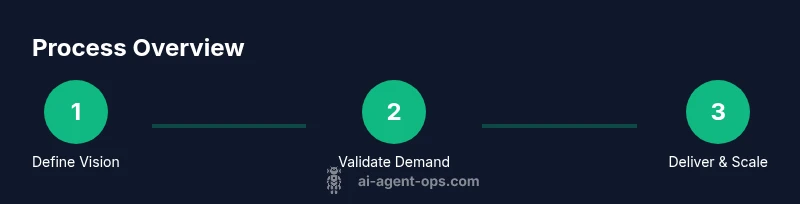
Define vision and niche
Articulate the specific business problem you will solve and the target industry. Create a one-page narrative that ties your AI capabilities to measurable client outcomes. Establish a clear go-to-market thesis.
Tip: Validate your niche with 3-5 pilot discussions before writing a full business plan. - 2
Validate demand and early fit
Conduct lightweight market validation through interviews and small pilots. Refine your service catalog based on feedback and perceived value. Secure a few early commitments to demonstrate momentum.
Tip: Use a simple value proposition canvas to map pains, gains, and jobs-to-be-done. - 3
Design service catalog and packages
Create clearly scoped offerings with defined outcomes, milestones, and inclusions. Package into at least three tiers to accommodate varying client needs and budgets.
Tip: Link each package to a concrete KPI and a pilot option for risk reduction. - 4
Build core tech stack and partnerships
Select a core stack for AI, orchestration, and data governance. Establish partner agreements to fill capability gaps while preserving internal quality control.
Tip: Document data lineage and security controls early to ease client approvals. - 5
Create repeatable delivery playbooks
Develop templates for discovery, design, build, test, deploy, and monitor phases. Include acceptance criteria and client sign-off workflows.
Tip: Treat the pilot as a live proof of concept with explicit success criteria. - 6
Set pricing, contracts, and risk controls
Choose engagement models aligned with scope and risk. Include data rights, governance commitments, and a pilot clause to reduce client risk.
Tip: Offer value-based pricing where feasible to align incentives. - 7
Launch go-to-market and onboarding
Publish thoughtful content, reach out to target accounts, and run structured onboarding for new clients. Establish a client portal for visibility and updates.
Tip: Use a strong onboarding checklist to ensure consistency across engagements. - 8
Deliver first engagements and iterate
Run the initial projects with tight governance and feedback loops. Capture outcomes to build case studies and testimonials for future wins.
Tip: Document lessons learned and update playbooks accordingly. - 9
Scale operations and talent strategy
Hire core delivery and sales roles, then partner for specialized skills. Invest in knowledge management and security training to sustain quality as you grow.
Tip: Develop a formal developer and data scientist onboarding protocol.
Questions & Answers
What is an AI agency?
An AI agency helps clients design, deploy, and govern AI-powered systems and workflows. It combines strategy, engineering, and governance to deliver measurable business outcomes.
An AI agency designs and executes AI solutions for clients, balancing technology with business goals and governance.
What services should a new AI agency offer?
Start with strategy, governance, and a core delivery line such as agent orchestration and custom AI agents. Add data strategy, monitoring, and training as you scale.
Begin with strategy, governance, and agent delivery, then expand into data and monitoring as you grow.
How do you price AI projects?
Use a mix of time-and-materials, fixed-scope engagements, and retainer models for ongoing oversight. Tie pricing to outcomes when possible and document acceptance criteria.
Price by scope and risk, with pilots and clear success criteria to reduce client uncertainty.
What skills are needed on an AI agency team?
Delivery leads, data engineers, AI/ML engineers, product managers, and client-facing strategists are essential. Add security, governance, and compliance experts as you scale.
You’ll want delivery, data, and product leadership, plus governance support as you grow.
How do you acquire first clients?
Start with pilots at a discount or equity-for-services arrangement to build case studies. Leverage industry networks, speak at events, and publish practical guides to attract buyers.
Pilot projects and content-based outreach help you land early clients and build credibility.
What are common risks and how can you mitigate them?
Data privacy, model bias, and governance gaps are the top risks. Mitigate with explicit data rights, robust monitoring, and transparent explainability.
Major risks include privacy, bias, and governance; address them with clear policies and monitoring.
How long does it take to launch an AI agency?
A credible launch can take several weeks to months, depending on client validation, team readiness, and the maturity of your playbooks.
Launching a credible AI agency takes weeks to a few months as you validate offers and build processes.
Watch Video
Key Takeaways
- Define a clear niche with measurable outcomes.
- Use repeatable delivery playbooks for consistency.
- Establish governance and ethical practices early.
- Offer transparent pricing and strong contracts.
- Plan for growth with scalable processes and talent.