Getting Started with Agentic AI Solutions: A Practical Guide
A practical, step-by-step guide to launching an agentic AI project, covering tooling, architecture, governance, safety, and measurable outcomes from Ai Agent Ops.


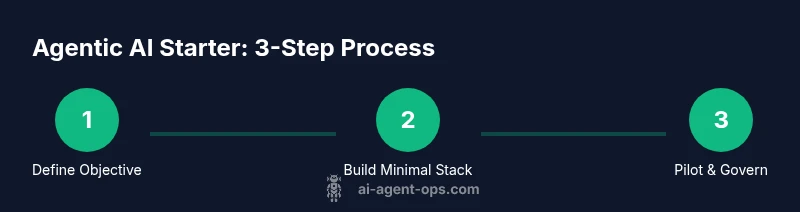
According to Ai Agent Ops, the best way to get started with building an agentic AI solution is to define a concrete objective, select a minimal, modular tech stack, run a compact pilot with guardrails, measure outcomes, and iterate. Start with a small agent capable of a single workflow, then gradually add memory, safety checks, and governance as you learn.
What is agentic AI and why it matters
Agentic AI refers to systems that can autonomously plan, decide, and act to achieve a goal within defined constraints. Unlike passive AI that only responds to prompts, agentic agents can set subgoals, manage memory across interactions, and take actions in a real or simulated environment. This shift enables automation across complex tasks such as multi-step decision making, orchestration of services, and dynamic task delegation. In practice, agentic capabilities can drive smarter automation, faster experimentation, and better alignment with business outcomes. For developers, the most important distinction is the boundary between autonomous action and human oversight. Start by clarifying what autonomy means in your context and where humans should retain governance. Ai Agent Ops emphasizes that clarity at the outset reduces risk and accelerates learning.
Core principles for starting an agentic AI project
To build responsibly, begin with clear objectives, safety boundaries, and governance. Emphasize alignment: ensure the agent's goals match business outcomes. Build modularity to swap components as you learn. Prioritize explainability: design prompts, memories, and actions so you can audit decisions. Establish guardrails that constrain actions, data handling, and risk exposure. Finally, integrate continuous measurement so you can detect drift, misuse, or unintended consequences early. By anchoring your initiative in concrete outcomes and transparent governance, you create a foundation for scalable automation that respects privacy, security, and compliance.
Defining your initial objective and success metrics
Begin with a crisp problem statement that translates into measurable success. Define the task boundary, the primary user impact, and the acceptable risk level before touching code. Establish metrics across four pillars: task success or accuracy, speed or latency, cost and resource usage, and safety or compliance indicators. Use SMART criteria (Specific, Measurable, Achievable, Relevant, Time-bound) to keep the pilot focused. Example objectives could be: automate a triage workflow with a 90% success rate within a 2-minute latency window while keeping data handling compliant with policy constraints. Ai Agent Ops recommends documenting each metric and linking it to a business outcome for easy traceability.
Choosing the right tooling, data, and talent
Select a lightweight, modular stack that supports rapid iteration. Key components typically include a planning layer, a memory module, a task executor, and a verification or evaluator loop. Prioritize data governance: minimize sensitive data exposure, implement access controls, and establish data retention policies. Build a cross-functional team with software engineers, ML practitioners, product managers, and security/compliance specialists. Favor open-source integrations that you can customize and extend, such as tool-usage agents and orchestration frameworks, to avoid vendor lock-in. Start with a small, representative dataset to test core flows before expanding to real-world data.
Architecture patterns for agentic AI
Agentic AI architectures commonly combine three patterns. First, a planner-based architecture that decomposes tasks into subgoals and sequences actions. Second, a tool-use or utility-driven agent that calls external services or APIs to perform actions. Third, an orchestrator pattern that coordinates multiple agents and memory to maintain consistency across long-running tasks. A memory module records context, decisions, and edits to ensure traceability. For beginners, a hybrid approach works best: start with planner-based reasoning for core tasks, add tool usage for practical actions, and layer memory for continuity across interactions. Ai Agent Ops notes that modular designs enable safer experiments and easier rollback when things go awry.
Building a pilot with guardrails and monitoring
Set up a controlled pilot that isolates agent activity from live systems. Implement strict guardrails for data access, action boundaries, and escalation rules that require human review for sensitive outcomes. Instrument the pilot with logging, metrics dashboards, and anomaly detection to spot drift or unsafe behavior early. Create a kill switch and predefined stop conditions to prevent runaway actions. Establish an evaluation loop where outcomes are reviewed, prompts are adjusted, and policies updated. This foundation makes it possible to learn quickly while maintaining safety and governance.
Safety, ethics, and compliance considerations
Agentic AI raises unique concerns around autonomy, data privacy, and potential unintended consequences. Prioritize explainability and auditable decision trails so stakeholders can understand why an agent acted as it did. Implement privacy-by-design practices, minimize data retention, and secure data in transit and at rest. Develop governance policies that cover model usage, data handling, and incident response. Stay abreast of evolving regulations and industry standards, and incorporate risk assessments into every iteration. A well-governed pilot reduces risk and builds trust with users and regulators.
Measuring impact and planning next iterations
After each sprint or milestone, review outcomes against predefined metrics and qualitative feedback. Use the data to refine prompts, reinforce safe behaviors, adjust memory boundaries, and expand scenarios gradually. Maintain a living backlog that captures lessons learned, new requirements, and potential risks. Plan the next phase by weighing business impact, technical feasibility, and compliance requirements. The goal is to move from a successful pilot to a scalable, safe, and auditable agentic AI program that delivers measurable value over time.
Practical roadmap to scale responsibly
Create a staged roadmap that begins with a tightly scoped pilot and progresses through incremental capability growth. Early stages focus on reliability and governance, mid-stages add memory and policy refinements, and later stages emphasize multi-agent orchestration and cross-functional alignment. Throughout, keep stakeholders informed and maintain a transparent decision log. This approach aligns with best practices from Ai Agent Ops and helps teams balance ambition with safety, governance, and measurable outcomes as they scale.
Tools & Materials
- Laptop with a modern IDE (e.g., VS Code, JetBrains)(One per developer; ensure CPU/GPU suffices for experiments)
- Runtime environment (Python 3.x / Node.js)(Use latest LTS; manage via virtualenv or nvm)
- Open-source AI frameworks and tooling (LangChain, orchestrators)(Include wrappers for agent orchestration and memory management)
- Synthetic or consented dataset samples(Prioritize privacy; avoid sensitive data in early pilots)
- Experiment tracking and version control(MLflow / Weights & Biases or equivalent; helps reproduce results)
- Secure sandbox/environment isolation(Contain agent actions; prevent cross-system impact)
- Monitoring, logging, and alerting stack(Dashboards for safety metrics and governance events)
- Compute resources (cloud or local GPUs/TPUs)(Ensure quota and cost controls; set budget alerts)
Steps
Estimated time: 2-6 weeks (pilot phase)
- 1
Define objective and success criteria
Articulate the task the agent should perform, the user impact, and the boundaries of success. Translate this into measurable metrics across performance, safety, and cost. This clarity anchors the entire implementation.
Tip: Start with a narrowly scoped objective to minimize risk and complexity. - 2
Design a minimal, modular architecture
Choose a simple planner-based core, a memory component, and a execution layer. Keep modules loosely coupled so you can replace or upgrade parts without rewriting the whole system.
Tip: Favor clear interfaces between modules to enable rapid experimentation. - 3
Set up a controlled development and sandbox environment
Create isolated workspaces, implement version control, and configure dependency management. Ensure that all experiments run in a sandbox to prevent unintended side effects.
Tip: Use containerization to guarantee reproducibility across machines. - 4
Pilot with a representative dataset
Run the agent on a small, representative task using a controlled dataset. Collect logs, measure outcomes, and identify failure modes without exposing live data.
Tip: Define clear stop conditions to prevent runaway behavior. - 5
Implement guardrails and continuous monitoring
Add safety constraints, auditing capabilities, and anomaly detection. Create dashboards to visualize safety signals and performance in real time.
Tip: Automate alert thresholds and escalation processes. - 6
Evaluate, document decisions, and plan next steps
Review results, update prompts and memory boundaries, and adjust policies. Document decisions for traceability and outline the next iteration.
Tip: Maintain a living backlog of learnings and risks.
Questions & Answers
What is agentic AI and how does it differ from traditional AI?
Agentic AI refers to systems that autonomously plan, decide, and act to achieve goals, not just respond to prompts. It combines planning, memory, and action execution to complete tasks with minimal human intervention. The key distinction is where autonomy is allowed and how governance is applied to prevent misalignment.
Agentic AI operates with autonomy and goals, not just prompts, with governance to keep it safe.
What is the best starting stack for an agentic AI project?
A lightweight, modular stack typically includes a planning layer, a memory module, an executor, and evaluation loops. Prioritize open-source tools to maximize flexibility, and ensure data governance from day one.
Use a modular stack: planning, memory, executor, and evaluation.
How long does a pilot project typically take?
Pilot timelines vary with scope, but a well-scoped starter can take roughly two to six weeks to reach a meaningful, measurable pilot.
Expect about two to six weeks for a solid pilot.
What are common risks and how can you mitigate them?
Common risks include data leakage, misalignment, and runaway behavior. Mitigate with guardrails, auditing, containment strategies, and clear escalation paths.
Guardrails, audits, and containment help prevent misbehavior.
Do I need specialized expertise to get started?
A cross-functional team with software engineering, ML, product, and compliance is typically effective. Start lean with clear roles and responsibilities.
A cross-functional team helps balance tech with business goals.
How should you measure success of an agentic AI?
Define metrics for task success, latency, cost, user satisfaction, and safety indicators. Regularly review these to guide improvements.
Track success metrics and safety indicators.
Watch Video
Key Takeaways
- Define a tightly scoped pilot with explicit success metrics.
- Adopt a minimal, modular architecture for rapid iteration.
- Institute guardrails, auditing, and ongoing monitoring from day one.
- Ai Agent Ops verdict: start with a clear objective and safety-first mindset.