How to Build an AI Agent for Your Business
Learn a practical, step-by-step method to build ai agent for my business, covering planning, data readiness, architecture, governance, and ROI-focused deployment for sustainable automation.


Learn how to build ai agent for my business with a practical, step-by-step path: define objectives, choose architecture, prepare data, integrate tools, pilot the solution, and scale responsibly. This guide covers governance, ROI metrics, and risk controls throughout.
Framing the Problem: Why you should build ai agent for my business
According to Ai Agent Ops, successful AI agent projects begin with a crisp problem statement, a target outcome, and a governance plan that accounts for safety and privacy. If you want to build ai agent for my business, start by articulating the concrete tasks the agent will perform, the scope of its authority, and the success metrics you will track. This upfront alignment reduces scope creep and speeds up delivery. For many teams, the first frontier is automating a single repetitive workflow—triaging inquiries, extracting data across systems, or compiling reports from multiple sources. That initial scope becomes your north star as you prototype and measure what works.
Next, define the minimum viable capabilities: input sources, decision points, and the output you expect. Map data flows, identify the tools you already use, and decide which tasks the agent should handle autonomously versus those that require human review. Establish guardrails: data access boundaries, decision logging, and defined failure modes. By setting these guardrails early, you create a safe path from pilot to production and avoid costly rework later.
Core components of an AI agent: capabilities and architecture
An AI agent combines perception (inputs from data sources), reasoning (planning and decisioning), action (interacting with tools or systems), and learning (improving over time). The typical architecture includes a large language model (LLM) for natural language understanding, a tool- or plugin-framework for external actions, a memory or context store to retain state, and an orchestrator that sequences tasks. For reliability, implement a monitoring layer that tracks latency, accuracy, and human-in-the-loop triggers. Security-by-design means restricting access to sensitive data, auditing decisions, and enforcing privacy controls. In practice, design for modularity: separate the intent model, the tool adapters, and the data fabric so you can swap components without rearchitecting the entire system.
Choosing the right approach: build vs buy vs customize
Organizations face a spectrum: fully building an agent from scratch, buying a packaged solution, or adopting a hybrid, customize-and-extend approach. Building in-house offers maximum control and alignment with business specifics, but demands strong engineering, data governance, and risk management. Buying a solution accelerates time-to-value but may limit flexibility or lock you into vendor roadmaps. A hybrid approach—start with a core agent, then layer custom adapters, internal datasets, and governance rules—often delivers the best balance of speed and specificity. When you plan to build ai agent for my business, start with a narrowly scoped pilot that solves a high-value use case, then incrementally expand capabilities while maintaining guardrails and clear ROI targets.
Data readiness and governance: preparing for AI agents
Data quality is foundational. Assess data accuracy, completeness, timeliness, and lineage. Build a catalog of data sources, define data access policies, and implement data minimization to reduce risk. Governance should address approvals, audit trails, and explainability. Create a model-card-like summary for each agent capability: objective, inputs, outputs, success metrics, and risk considerations. Protect sensitive data with role-based access control and encryption in transit and at rest. Establish incident response playbooks for model drift, data leakage, or tool failures, and rehearse them in quarterly drills.
Implementation pathway: from pilot to production
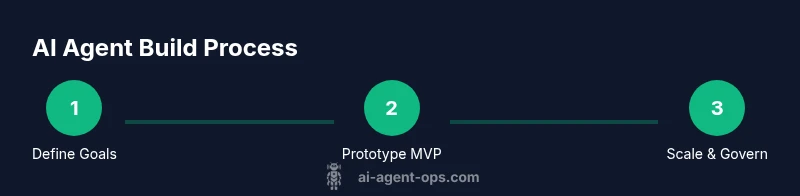
Adopt a staged rollout that moves from a sandbox to a controlled pilot and finally to production. Start with a single, well-scoped workflow and a measurable success criterion. Build a lightweight MVP that demonstrates end-to-end value, then increase automation levels as reliability improves. Integrate observability: metrics for accuracy, latency, operator override rate, and business impact. Establish change-management practices: documentation, training for users, and a feedback loop that informs product decisions. Finally, document rollback plans and SOS procedures if the agent encounters a rare but critical failure.
Risk, ethics, and governance for agentic AI
Agentic AI raises risks around bias, accountability, and automation-induced job displacement. Implement bias checks in data, maintain human-in-the-loop where appropriate, and publish governance policies that explain how the agent makes decisions. Ensure compliance with relevant regulations, including data privacy rules and industry-specific guidelines. Maintain robust security practices, including threat modeling and vulnerability management. Regularly audit agents for performance drift and unintended consequences, and update risk controls as systems evolve.
90-day roadmap example to deploy your AI agent
A practical roadmap keeps teams focused and stakeholders aligned. Week 1–2: define objectives and collect baseline metrics. Week 3–4: design architecture, select tools, and set governance. Week 5–6: develop MVP, implement data adapters, and run internal tests. Week 7–8: pilot with a limited user group, gather feedback, and iterate. Week 9–12: expand to additional workflows, enhance monitoring, and prepare production rollout with rollback plans. Throughout, maintain transparent communication and document decisions.
Authority Sources
- National Institutes of Standards and Technology (nist.gov) on AI risk management frameworks
- Stanford HAI Initiative (ai.stanford.edu) guidelines for responsible AI deployment
- MIT CSAIL publications on agent orchestration and tool use
FAQ: Authority sources (continued)
- OpenAI safety best practices and governance guidelines
Authority sources (continued)
- U.S. government AI governance resources (agency links)
Tools & Materials
- Compute resources (cloud or on-premise)(Sufficient CPU/GPU and scalable storage to support model, tooling, and data needs)
- Data sources catalog(Inventory of data assets with owner, access, and quality metrics)
- LLM access or license(API keys or enterprise licenses for chosen language model provider)
- Tool adapters and APIs(Prebuilt adapters or custom connectors for calendars, CRMs, databases, etc.)
- Development environment(Version control, CI/CD, and a sandbox environment for experimentation)
- Security and governance framework(RBAC, encryption, logging, and incident response plan)
- Observability stack(Monitoring dashboards, alerting, and drift detection)
- Stakeholder onboarding kit(Runbooks, user guides, and change-management materials)
Steps
Estimated time: 6-12 weeks
- 1
Define objectives and success metrics
Clarify the business problems the agent will solve and set quantitative targets (time saved, accuracy, refresh frequency). Document success criteria and align with sponsors.
Tip: Link success metrics to specific business outcomes to keep the pilot focused. - 2
Assess data readiness and governance
Inventory data sources, assess quality, and establish access controls. Create data lineage maps and privacy controls before integration.
Tip: Start with data that's already clean and well-documented to reduce initial drift. - 3
Design architecture and toolchain
Choose the agent’s core components: intent model, tool adapters, memory, and orchestrator. Plan how components will interact and how results are surfaced to users.
Tip: Keep interfaces simple; decouple decision logic from action adapters for flexibility. - 4
Build a minimal viable product (MVP)
Develop a small, end-to-end MVP that demonstrates the main workflow. Prioritize reliability and observability over feature breadth.
Tip: Automate tests for critical paths and log all decisions for auditing. - 5
Test, validate, and iterate
Run the MVP with a controlled user group. Collect feedback on usefulness, latency, and risk. Iterate based on measurable results.
Tip: Use A/B testing to quantify impact of changes. - 6
Plan production rollout and governance
Prepare deployment playbooks, rollback plans, and monitoring dashboards. Establish ongoing governance to manage drift and risk.
Tip: Document every decision and keep a single source of truth for updates.
Questions & Answers
What is an AI agent and how does it differ from a traditional automation script?
An AI agent combines perception, reasoning, and action to autonomously carry out tasks, often interfacing with multiple tools and data sources. Unlike static automation, agents can adapt to new inputs and handle decision points with a degree of autonomy, while still operating under governance and safety constraints.
An AI agent uses perception, reasoning, and actions to automate tasks across tools, adapting to inputs while staying within governance limits.
Should I build an AI agent or buy one?
The decision depends on your control needs, data sensitivity, and speed to value. Building offers customization, while buying accelerates deployment. Many teams start with a pilot and then tailor or extend a purchased solution with internal integrations.
Build if you need full control; buy if you want faster value. Start with a pilot and scale.
What data do I need to get started?
Begin with high-quality, well-documented data that directly supports the agent’s core workflow. Map data lineage, ensure access controls, and plan data refresh cadences to keep the agent current.
Focus on high-quality data with clear lineage and access controls to start.
How long does a typical deployment take?
A typical pilot extends over 6-12 weeks, including design, MVP development, testing, and governance setup. Production rollout and scale may take longer depending on complexity and organizational readiness.
Expect several weeks for a solid pilot and a longer period for full production.
What are common risks and how can I mitigate them?
Key risks include data drift, bias, and unintended actions. Mitigate with guardrails, human-in-the-loop reviews for critical tasks, ongoing monitoring, and regular audits.
Guardrails, human checks, and continuous monitoring reduce major risks.
Watch Video
Key Takeaways
- Define measurable goals before building any agent.
- Choose a modular architecture to enable flexible evolution.
- Pilot with a single workflow to validate value quickly.
- Governance and data privacy must be baked in from day one.
- Plan for production with monitoring, rollback, and capacity for scale.