Custom AI Agent Development: A Practical Guide
A comprehensive, step-by-step guide to building robust, safe, and scalable custom AI agents for business processes. Learn architectures, data strategy, governance, deployment, and ROI.


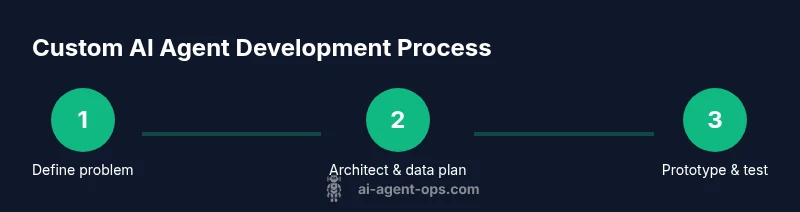
This guide provides a clear, actionable path to building a custom ai agent development pipeline. You will define objectives, select architectures, assemble data and tooling, prototype safely, test rigorously, and deploy with monitoring and governance. By following these steps you’ll establish a repeatable process for reliable, maintainable agents in real-world workflows.
The Foundation of custom ai agent development
According to Ai Agent Ops, successful custom ai agent development starts with clearly defined goals and a measurable success framework. Begin by identifying the business problem you want the agent to solve and the constraints it must respect. Translate this into concrete outcomes, like response accuracy, latency, or user satisfaction, and assign ownership to a product or engineering lead. This foundation ensures every subsequent choice—architecture, data, and tooling—aligns with a value-driven objective. Emphasize agent boundaries: what the agent can and cannot do, and how it should escalate when uncertainty rises. By anchoring ambitions to business value and governance from day one, teams avoid scope creep and build trust with stakeholders. Across departments, alignment on success criteria accelerates decision-making and reduces rework later in the lifecycle. The Ai Agent Ops team emphasizes clear problem framing as the first step toward scalable agent systems, and this mindset should permeate design reviews and planning sessions alike.
Architectural patterns for AI agents
Choosing the right architectural pattern is fundamental to successful custom ai agent development. Start by distinguishing core patterns: plan-and-execute agents that outline a sequence of steps; reactive agents that respond to prompts with minimal internal state; and goal-driven agents that maintain a dynamic plan. Decide whether to build a single-agent system or a multi-agent orchestration where specialized agents collaborate to complete tasks. Consider introducing a central orchestrator or toolformer-style framework that coordinates tool usage (search, databases, or external APIs). Evaluate latency, reliability, and explainability when selecting components. Also map how the agent will access tools, manage state, and recover from failures. The end result should be a maintainable architecture that supports incremental improvements, with clear APIs and well-defined data contracts for each component.
Data strategy and training cycles
Data is the fuel of any custom ai agent development effort. Establish a data strategy early that covers data collection, labeling, privacy, and governance. Identify source systems, consent requirements, and data quality checks, and design pipelines that feed both offline evaluation datasets and live feedback streams from production use. Define an evaluation protocol that includes reproducible test cases, ground truth data, and metrics such as accuracy, coverage, and latency. Create a feedback loop where user interactions and outcomes refine prompts, tools, and decision boundaries. Invest in data versioning and lineage so you can trace how changes affect behavior over time, and plan for synthetic data generation to augment rare but critical scenarios. Ai Agent Ops highlights the importance of a robust data strategy as the backbone of reliable agent performance.
Safety, governance, and ethics
Safety and governance are essential in any custom ai agent development initiative. Start with risk assessment to identify potential harms, privacy concerns, and compliance issues. Implement guardrails such as policy constraints, explicit escalation paths, and harm minimization strategies. Establish access controls, audit trails, and data retention policies to support regulatory requirements. Regularly conduct threat modeling and red-teaming exercises to uncover failure modes and ensure robust defenses. Document decision boundaries and acceptable uncertainties so engineers know when to override or pause automation. Ethics considerations, including fairness, transparency, and user consent, should be embedded in the design process. Following a disciplined governance regime helps avoid later reworks and protects the organization’s reputation.
Integration and deployment pipelines
A practical custom ai agent development effort builds with strong integration and deployment discipline. Design clean interfaces for model components, data sources, and tooling APIs. Containerize services to ensure reproducibility, and implement CI/CD pipelines that automate testing, security checks, and deployment to staging before production. Adopt feature flags to control rollout and enable quick rollback if issues arise. Ensure observability with structured logging, metrics, and tracing so you can diagnose performance regressions quickly. Plan for tool discovery and rate limits, and design idempotent operations to guard against duplicate executions. A well-structured deployment pipeline minimizes downtime and accelerates iteration while maintaining reliability.
Evaluation and iteration strategies
Continuous evaluation is central to improving custom ai agent development outcomes. Define quantitative success metrics (e.g., task completion rate, latency, confidence thresholds) and qualitative indicators (user satisfaction, perceived usefulness). Use A/B testing or multi-armed bandits to compare prompts, tools, and flows, and apply causal inference where possible to attribute improvements. Establish a transparent evaluation plan that runs in parallel with development sprints, allowing rapid feedback loops. Regularly review edge cases and failure modes, and document learnings to inform future iterations. Remember that iteration isn’t only about performance gains; it’s also about safety, reliability, and user trust. The more you iterate with real feedback, the faster you’ll converge on a dependable agent design.
Monitoring, maintenance, and governance in production
Once in production, monitoring is the lifeblood of a healthy custom ai agent development program. Implement dashboards that track latency, success rate, tool usage, and escalation frequency. Set up alerting for drift, hallucinations, or policy breaches, so you can respond before user impact escalates. Establish retraining triggers based on observed data shifts and performance thresholds, and maintain a backlog of improvements to address in sprints. Continuous maintenance also requires updating prompts, tools, and policies to reflect changing business needs, API changes, or regulatory updates. Build a culture of observability and governance so production agents remain trustworthy and aligned with business goals.
Cost considerations and ROI for custom ai agent development
Understanding the cost implications of custom ai agent development helps teams optimize investments and maximize ROI. Major cost drivers include compute for model inference, data pipeline operations, tooling licenses, monitoring infrastructure, and incident response. To control costs, design for efficiency by caching results, reusing tool outputs, and batching requests where feasible. Use scaling strategies such as serverless endpoints or autoscaling containers to match demand without overspending. Build a clear cost model that links expenses to tangible outcomes like reduced cycle time or improved customer satisfaction. While ROI can be intangible, documenting time saved, error reductions, and decision quality makes the business case compelling. Ai Agent Ops emphasizes that understanding cost drivers early enables smarter trade-offs between capability and cost.
Real-world patterns and deployment roadmaps
In practice, organizations progress through recognizable patterns when adopting custom ai agent development. Start with a pilot focused on a high-impact use case, such as a customer support agent or automated data extraction, then expand to more complex workflows as confidence grows. Build a staged roadmap that prioritizes governance, data quality, and reliability before dialing up tool complexity. Leverage existing platforms and open standards to ease integration, and design for interoperability so you can swap components without a complete rewrite. Finally, cultivate cross-functional collaboration between product, data, security, and operations teams to sustain momentum. The outcome is a repeatable, scalable approach that delivers real value while maintaining guardrails and accountability.
Tools & Materials
- Integrated development environment and runtime(Python 3.9+/Node.js 18+, virtualenv or nvm)
- Access to LLMs or local runtime(OpenAI API, Cohere, or on-premise model with inference server)
- Data sources and storage(APIs, enterprise logs, and privacy-compliant datasets)
- Experimentation & telemetry platform(MLflow, Weights & Biases, or similar for tracking experiments)
- Version control(Git with branching strategy and code reviews)
- Containerization & orchestration(Docker, Kubernetes, or equivalent for reproducible deployments)
- Monitoring & observability stack(Prometheus, Grafana, and logging/alerting setup)
- Security & compliance toolkit(Secrets management, access controls, data governance)
- Documentation tooling(Markdown/Confluence for design docs and runbooks)
Steps
Estimated time: 8-12 weeks
- 1
Define the problem and success metrics
Articulate the business objective the agent will support and establish measurable success criteria. Create a problem statement, identify stakeholders, and define primary metrics such as accuracy, latency, and user satisfaction. Align on boundaries and escalation rules to prevent scope creep.
Tip: Capture success criteria in a single-page document and circulate for sign-off. - 2
Choose an architecture and toolchain
Select an agent pattern (plan-and-execute, reactive, or multi-agent orchestration) and map how tools, data, and APIs will be accessed. Decide on a central orchestrator or modular components with clear interfaces. Plan for data contracts and error handling across components.
Tip: Draw a system diagram showing data flow, tool calls, and decision points. - 3
Assemble data and define evaluation
Identify data sources, labeling requirements, and privacy constraints. Build a robust evaluation dataset with ground truth, plus a live feedback loop from production usage. Document metrics and acceptance criteria for each data slice.
Tip: Incorporate privacy-preserving practices and data minimization from day one. - 4
Prototype a minimal viable agent
Create a simple agent that demonstrates core capability with a small toolset. Validate behavior in a controlled sandbox, iterate on prompts and tool usage, and establish a baseline for performance.
Tip: Use a sandboxed environment to isolate experiments and protect production data. - 5
Implement safety guardrails
Define policies and boundary checks to prevent unsafe actions. Implement escalation paths for uncertain situations and log all critical decisions for auditing.
Tip: Test guardrails with simulated failure scenarios to ensure reliability. - 6
Build integration and tooling
Connect the agent to external systems with robust interfaces, including retries and idempotency. Build mock versions of external services to enable rapid testing.
Tip: Use mocks and stubs to speed up early integration testing. - 7
Set up CI/CD and deployment
Automate tests, security checks, and deployment to staging before production. Use feature flags to control rollout and enable quick rollback if issues arise.
Tip: Automate rollback procedures and maintain a clean production hotfix path. - 8
Measure, learn, and iterate
Continuously monitor key metrics and user feedback, compare with baseline, and implement incremental improvements. Schedule regular review cycles to incorporate learnings into the next sprint.
Tip: Prioritize changes with the highest impact-to-risk ratio. - 9
Operate production with governance
Maintain drift detection, retraining triggers, and incident response drills. Update policies and tools as requirements evolve. Document runbooks for operators and developers.
Tip: Treat governance as a living process, not a one-time task.
Questions & Answers
What is custom ai agent development?
Custom ai agent development refers to designing and building AI-driven agents tailored to specific business tasks, combining language models, tools, and workflows to automate decisions and actions. It emphasizes architecture, data, safety, and governance to meet real-world needs.
Custom ai agent development means building AI-driven agents tailored to your business tasks by combining models, tools, and workflows to automate decisions. It emphasizes architecture, data, safety, and governance.
How long does it typically take to build an agent?
Timelines vary by scope, data availability, and tooling. A phased approach with a pilot can yield a usable agent in a few weeks, followed by iterative improvements over several sprints.
Timelines vary, but you can start with a pilot in weeks and iterate over multiple sprints to reach production readiness.
What should I measure to gauge success?
Important metrics include task completion rate, latency, accuracy, user satisfaction, and safe operation. Qualitative feedback and governance adherence are also critical indicators.
Track task completion, latency, accuracy, and user satisfaction, plus governance and safety indicators.
How do I handle data privacy and compliance?
Integrate privacy by design: minimize data collection, anonymize where possible, enforce access controls, and maintain audit trails. Align with applicable regulations and document data handling policies.
Incorporate privacy by design, minimize data collection, anonymize data, and keep audit trails and compliance policies up to date.
What are common risks and failure modes?
Common risks include hallucinations, tool misuse, data leakage, and escalation failures. Proactive guardrails, monitoring, and escalation policies help mitigate these issues.
Risks include hallucinations, tool misuse, data leaks, and escalation failures; guardrails and monitoring help reduce them.
Watch Video
Key Takeaways
- Define clear goals before building.
- Choose architecture that matches your use case.
- Prioritize data governance and safety.
- Automate testing and observability.
- Plan for cost and governance early.