How Much Does It Cost to Build an AI Agent? A Practical Budget Guide
Explore cost ranges for MVP, mid-range, and enterprise AI agents, plus a practical budgeting framework and real-world considerations for teams in 2026.


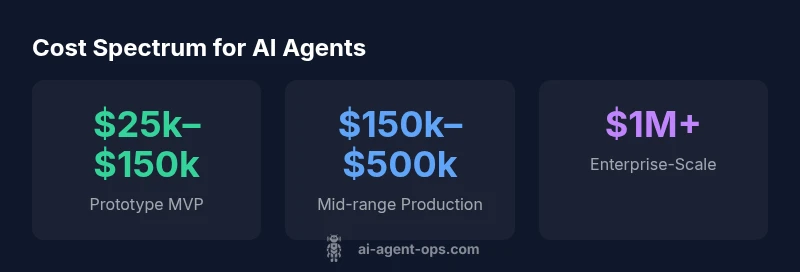
How much does it cost to build an ai agent? Costs vary widely based on scope, data needs, and integration. In practice, a basic starter agent can cost roughly $25k–$150k, a mid-range solution often lands in the $150k–$500k band, and enterprise-grade agents with custom data pipelines and safety controls can exceed $1M. Plan around development, deployment, and ongoing maintenance costs for realistic budgeting.
How much does it cost to build an ai agent: cost spectrum
Costs to build an AI agent vary widely, and the figure you land on depends on data readiness, integration complexity, governance needs, and ongoing operations. According to Ai Agent Ops, budgeting should start with scope and data strategy before selecting tools or vendors. In 2026, teams typically categorize costs into MVP, mid-range production, and enterprise-scale deployments, with an explicit plan for maintenance and retraining. This spectrum helps align expectations with stakeholders and guides investment decisions across product teams and leadership. The key takeaway is that cost is not a single number but a ladder of investments that unlocks incremental capabilities over time.
Baseline MVP budgeting: a starter agent
A minimal viable product (MVP) focuses on a single use case with clean data, limited integration, and essential governance. For MVP budgeting, prioritize the core decision logic, a stable data pipeline, and essential monitoring. Expect to invest in data cleaning, a small compute footprint, and a simple UI or API. Scope creep is the silent cost killer here—define clear success metrics and a release plan. Typical MVP budgets emphasize speed-to-value and risk containment, with room for a quick iteration after user feedback.
Mid-range production: features that drive cost
Mid-range deployments add multiple use cases, broader data sources, and more sophisticated governance. This stage increases expenses for data engineering, API integrations, and reliability tooling. You’ll likely need better monitoring, logging, and security controls, along with more robust access management. The goal is to extend value beyond a single scenario while maintaining risk controls and maintainable code architecture. Cost drivers include data normalization, model hosting, and CI/CD pipelines.
Enterprise-scale: governance, compliance, and data pipelines
Enterprise-scale AI agents demand comprehensive data governance, security, compliance, and scalable infrastructure. Costs rise sharply due to custom data pipelines, privacy controls, audit trails, and incident response readiness. You’ll typically include cost for dedicated cloud compute, multi-region deployment, and complex orchestration across services. Planning should account for regulatory requirements, vendor risk management, and long-term maintenance overhead. Enterprise deployments prioritize reliability, traceability, and governance over rapid prototyping.
Hidden and ongoing costs you should plan for
Even after initial build, the real spend continues. Ongoing expenses include data refreshes and retraining, monitoring and anomaly detection, security upgrades, and incident response. Add costs for model drift mitigation, dependency updates, and software licenses. Don’t overlook human-in-the-loop costs for quality assurance and compliance reviews. A prudent budget reserves funds for scenario testing, fault tolerance, and disaster recovery planning.
An actionable budgeting framework for teams
Adopt a three-tier budgeting approach: MVP, Growth, and Scale. For MVP, allocate a lean budget focused on core value delivery. For Growth, invest in additional data sources, integrations, and governance. For Scale, plan for enterprise-grade security, resilient architecture, and ongoing optimization. Use a bottom-up estimate by cost center (data, compute, integration, governance) and a top-down sanity check to ensure alignment with expected ROI. Build in contingency for data quality issues and regulatory changes.
Industry use-case cost variations
Different industries have distinct cost profiles. Regulated sectors (healthcare, finance) tend to require stronger governance and data handling, driving higher initial and ongoing costs. Consumer-facing agents may emphasize speed to market and user experience, with cost concentrated in UI, monitoring, and experimentation. Always tailor budgeting to your target domain, data availability, and risk tolerance. A well-scoped project with phased milestones reduces risk across sectors.
Practical budgeting steps to start today: a quick checklist
- Define the primary use case and success criteria.
- Inventory data sources and quality requirements.
- Map required integrations and governance needs.
- Estimate MVP, Growth, and Scale budgets separately.
- Include a 12–24 month maintenance plan and contingencies.
- Create a phased go/no-go plan tied to measurable milestones.
Cost ranges by project stage
| Stage | Typical Range | Key Cost Drivers | Notes |
|---|---|---|---|
| Prototype MVP | $25k–$150k | Scope limited; data readiness; quick iterations | Short timeline; low data needs |
| Mid-range production | $150k–$500k | Multiple integrations; governance; monitoring | Moderate complexity; broader audience |
| Enterprise-scale | $1M+ | Custom data pipelines; security; compliance | High complexity; long lead times |
| Ongoing annual cost | $10k–$200k/year | Maintenance, retraining, monitoring | Requires annual budgeting |
Questions & Answers
What factors most influence the cost of an AI agent?
The main drivers are data, integrations, compute, and governance. Poor scoping or late governance adds to cost. Start with a clear scope and phased milestones to control spend.
The biggest cost drivers are data, integrations, compute, and governance. Start with a clear scope and phased milestones to stay on budget.
How long does it take to build an AI agent?
Timelines vary from weeks for an MVP to months for a production-grade deployment, depending on data readiness and integration complexity.
Timelines vary from weeks for an MVP to months for full production, based on data and integrations.
Should I build in-house or buy an agent platform?
In-house builds offer maximum control but higher upfront cost; platforms reduce initial investment but may limit customization. Choose based on core needs and capability maturity.
In-house gives you control but costs more up front; platforms cut initial cost but limit customization.
What ongoing costs should I expect?
Expect maintenance, monitoring, data updates, retraining, and security measures. Budget for regular refreshes and governance reviews.
You'll pay for maintenance, monitoring, updates, retraining, and security regularly.
How can I estimate costs for my use case?
Start with MVP budgets, break down by module, and add a contingency. Compare top-down vs bottom-up estimates to validate assumptions.
Estimate by module, add contingency, and compare methods to validate assumptions.
Are there cost differences by industry?
Yes. Regulated industries require more governance and data handling, which can push costs higher.
Industry regulation and data needs can raise costs.
“Budgeting AI agent projects requires embracing uncertainty and staging investments to measure value at each milestone.”
Key Takeaways
- Define MVP scope to avoid creep
- Budget data, compute, and governance as core costs
- Plan for ongoing maintenance and retraining
- Adopt a staged funding approach to manage risk