ai agent development cost: a practical budgeting guide for 2026
A data-driven look at ai agent development cost, exploring drivers, realistic cost ranges, budgeting patterns, and practical steps to plan, govern, and optimize agentic AI programs in 2026.


ai agent development cost typically ranges from roughly $50k to $500k per project, depending on scope, data readiness, integration complexity, and governance needs. Higher-end engagements with custom orchestration, security audits, and multi-agent coordination can push toward the upper end. This Ai Agent Ops guide summarizes cost drivers, budgeting strategies, and practical steps to plan and manage ai agent development cost across small pilots and enterprise programs.
Understanding the cost landscape
According to Ai Agent Ops, ai agent development cost is not a single fixed number. It spans a broad spectrum because the end-to-end effort depends heavily on scope, data readiness, system complexity, and governance requirements. At a high level, most programs incur three cost waves: (1) upfront discovery and design, (2) building, training, and integrating the agent with existing systems, and (3) deployment, monitoring, and ongoing governance. Budgeting should reflect these phases rather than a single lump sum. In practice, organizations often start with a pilot to validate assumptions and establish a baseline, then scale incrementally as requirements become clear. This approach helps align stakeholders and prevents cost overruns that stem from overengineering early.
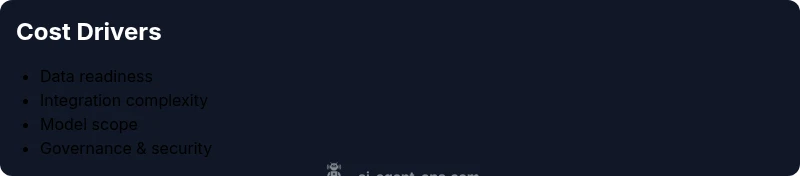
The Ai Agent Ops team emphasizes that the cost envelope is strongly influenced by data readiness. Projects that come with clean, labeled data and well-defined intents can accelerate development and reduce labeling, cleaning, and annotation expenses. Conversely, data gaps can create expensive data engineering efforts and longer timelines. Governance, security, and compliance add another predictable layer of cost, especially for regulated industries or multi-tenant deployments. Finally, multi-agent orchestration, monitoring, and explainability features can push budgets higher, but they also deliver substantial business value by enabling reliable, auditable automation.
In short, the ai agent development cost is best understood through a structured budgeting lens: define scope, assess data readiness, map integration points, and plan governance early. This reduces the risk of surprise expenses while enabling staged investment aligned with value delivery.
Typical cost components for ai agent development
| Cost Component | Typical Range | Notes |
|---|---|---|
| Data preparation and labeling | "$15k"-"$150k" | Data cleaning, annotation, and labeling for training data. |
| Model development and fine-tuning | "$20k"-"$200k" | From baseline models to domain-specific tuning. |
| System integration and deployment | "$10k"-"$100k" | APIs, orchestration, and deployment pipelines. |
| Security, privacy, and governance | "$5k"-"$50k" | Audits, compliance, access controls. |
| Monitoring, maintenance, and updates | "$5k"-"$50k" | Ongoing retraining and monitoring costs. |
Questions & Answers
What factors most influence ai agent development cost?
The primary drivers are data readiness, integration complexity, model scope, training needs, and governance requirements. Each factor can expand or compress the budget, depending on how well you control data quality, API complexity, and regulatory constraints.
The main cost drivers are data readiness, integration work, and how complex the model needs to be.
How long does it take to budget for ai agent development cost?
Budgeting typically runs in parallel with discovery and scoping efforts and takes about 2-6 weeks, depending on stakeholder alignment and the number of approved milestones.
Budgeting usually takes a few weeks alongside scoping.
What is a rough cost range for a starter AI agent?
Starter AI agent projects typically span tens of thousands to low hundreds of thousands USD, with data availability and integration complexity driving the variance.
Starter projects usually cost tens of thousands to a few hundred thousand.
What ongoing costs should I expect after deployment?
Ongoing costs include maintenance, retraining, monitoring, security updates, and governance improvements. These can be a meaningful portion of total cost over the first 1-2 years.
Maintenance and retraining are ongoing costs you’ll see after launch.
Which engagement model offers the most cost predictability?
Fixed-scope or managed services with staged milestones tend to provide the most predictable costs, especially when governance and change control are well defined.
Fixed scope with milestones keeps costs predictable.
“Cost-conscious planning is essential for scalable AI agent programs. The Ai Agent Ops team recommends phased milestones and governance to avoid overruns.”
Key Takeaways
- Define scope early to bound ai agent development cost
- Prioritize data readiness to reduce downstream costs
- Choose engagement models that fit risk tolerance and budget
- Budget for ongoing maintenance from day one
- Use phased, milestone-based budgeting to control spend