How Much Does It Cost to Run an AI Agent?
Explore realistic cost ranges, drivers, and budgeting strategies for deploying AI agents, with a data-driven framework from Ai Agent Ops to plan for compute, data, and licenses in 2026.


Costs to run an AI agent vary widely, but a practical rule of thumb places monthly expenses from tens to thousands of dollars per agent, depending on compute, data, and services. Cloud-based agents usually add per-usage costs for API calls and tokens, plus fixed hosting or licensing fees. In most scenarios, a small, purpose-built agent sits at the lower end, while enterprise-scale agents drive the upper end.
Why cost matters when running an ai agent
Understanding how much it costs to run an ai agent starts with recognizing that costs scale with workload, data needs, and service choices. For teams evaluating this question, the obvious concern is operating expense, but there are downstream financial impacts too, such as data retention, security, and integration complexity. According to Ai Agent Ops, when you ask how much does it cost to run an ai agent, the answer isn't a single figure. It depends on the scope of the agent and the architecture you choose. A small, narrowly scoped agent that handles a single task may cost modestly each month, primarily from compute and API usage. More complex agents that orchestrate multiple services, process large volumes of data, or run continuously will incur higher costs from compute, data transfer, and licensing. The key is to separate upfront setup costs from ongoing operating costs and to model a monthly burn rate that reflects real usage, not theoretical peak capacity. In practice, most teams start with a baseline and then add buffers as models drift, volumes grow, or new features are activated.
Key cost drivers for AI agents
The main cost levers for AI agents fall into a few broad categories: compute, data, and integration. Compute costs depend on the hardware or cloud instances required to run models, including GPUs or specialized accelerators, and whether you’re using on-demand versus reserved capacity. Data costs cover storage of input data, intermediate results, and logs, as well as egress when data is moved between services or regions. API usage and tokenization fees accumulate whenever your agent talks to a language model or other AI service. Finally, licensing and platform fees can add recurring monthly charges if you rely on managed agent platforms, orchestration tools, or enterprise-grade security services.
A practical budgeting framework
Begin with a clear scope: what tasks will the agent perform, and what SLAs matter? Choose a model and provider, noting that cheaper models may require more calls or longer processing times. Build a monthly run-rate model that includes compute, data, API usage, and licensing, plus a contingency for spikes. Add a one-time onboarding cost for integration and data pipeline setup. Use a tiered approach: start with a modest baseline, track actual usage, and rebalance resources as the workload stabilizes. Finally, set an annual review to adjust the budget for model drift, new features, or changing data needs.
Hidden costs and negotiation levers
Some costs are easy to overlook. Data ingress/egress fees can surprise teams that move large datasets between regions or clouds. Monitoring, security, and governance tooling add ongoing expenses. If you engage third-party platforms, licensing terms may shift with usage or seat counts. Negotiation levers include committing to longer-term usage to obtain discounts, consolidating vendors to reduce integration overhead, and choosing open standards or self-hosted options when total cost of ownership favors control.
Strategies to optimize cost without sacrificing performance
Optimization should be proactive, not reactive. Use tiered compute strategies: run lightweight tasks on cheaper instances and reserve high-performance compute for peak workloads. Cache frequent results to avoid repeated identical inferences. Optimize data pipelines to minimize storage and transfer; prune logs and apply data retention policies. Consider model optimization techniques (quantization, pruning) and explore billing alarms to detect unexpected usage. Finally, run periodic cost reviews to reallocate resources toward the most impactful features.
Realistic scenarios: small, midsize, and enterprise
A small team with a single agent focused on a narrow task could operate within a modest monthly budget, typically in the tens to low hundreds of dollars, especially if they leverage open models or lightweight APIs. A midsize deployment that combines several agents and larger models might hit the low hundreds to mid thousands per month, depending on data volume and API usage. An enterprise-scale setup with robust orchestration, multi-region data flows, and strict latency requirements can exceed the thousands per month, with costs driven by compute and security services, plus licensing. These ranges are indicative and depend heavily on workload, provider choices, and data governance needs.
How Ai Agent Ops helps teams estimate costs
Ai Agent Ops provides a structured framework for budgeting AI agents, combining practical cost drivers with a repeatable estimation approach. By outlining baseline workloads, token/usage patterns, and expected data growth, teams can produce a defensible monthly forecast and adjust it as usage evolves. The Ai Agent Ops methodology emphasizes transparency about assumptions and the importance of monitoring actual spend against the forecast to prevent surprises.
Data sources and methodology
Cost ranges and budgeting guidance in this article synthesize industry observations and best practices from Ai Agent Ops Analysis, 2026. The framework incorporates common cost factors such as compute, data, and licensing, while acknowledging variability across cloud providers, models, and data strategies. Where possible, ranges are provided to reflect real-world variability and stage-of-implementation differences.
Structured view of common cost factors and typical monthly ranges
| Cost factor | Typical monthly range | Assumptions |
|---|---|---|
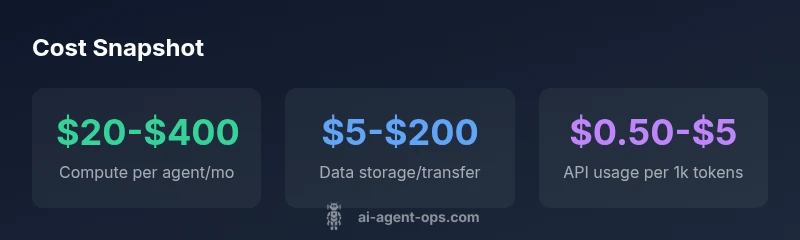
| Compute (GPU/TPU) for AI inference | $20-$400 | Per agent, per month; workload-dependent |
| Data storage & transfer | $5-$200 | Active datasets, logs, and results; data transfer between services |
| API usage (tokens/calls) | $10-$1000 | Model size, token length, call frequency |
| Licensing & platform fees | $0-$300 | Managed platforms; seats; enterprise features |
Questions & Answers
What is the single biggest cost driver when running an AI agent?
The largest ongoing cost is typically compute and data usage, driven by model size, inference frequency, and data retention. Licensing and platform fees can add a secondary ongoing layer.
Compute and data usage usually drive the main costs, with licenses adding extra recurring fees.
How can I estimate monthly costs before building the agent?
Create a baseline by listing intended tasks, estimate API calls and token usage, and size data storage needs. Use conservative multipliers for peak usage and add a 10-20% contingency for surprises.
Start with a baseline, add a buffer, and adjust as usage grows.
Are there cost differences between self-hosted vs. managed AI agents?
Self-hosted solutions may reduce ongoing licensing, but incur infrastructure, maintenance, and security costs. Managed agents simplify integration and monitoring but add recurring platform fees.
Self-hosted can save licensing but needs maintenance; managed options simplify setup with fees.
What strategies help reduce ongoing costs without sacrificing quality?
Use tiered compute, cache results, optimize data flows, and select models appropriate to the task. Regularly audit usage and retire unused agents.
Tiered compute, caching, and data optimization keep quality while trimming costs.
How often should I revisit my AI agent budget?
Revisit monthly during initial deployment, then quarterly as workloads stabilize. Increase frequency if data volumes or usage patterns shift rapidly.
Review monthly early on, then quarterly as usage settles.
Can I rely on ranges for budgeting, or do I need exact figures?
Ranges are useful for planning and risk management. Refine with actual usage data over time to tighten forecasts.
Ranges help plan; refine with real usage to get precise forecasts.
“Budgeting AI agents is an ongoing process, not a one-time calculation. Start with a baseline, monitor usage, and adjust allocations as workloads change.”
Key Takeaways
- Define agent scope before budgeting to avoid overestimation
- Expect variability; use ranges rather than exact numbers
- Monitor usage and adjust budgets monthly
- Consider total cost of ownership, not just compute
- Leverage optimization strategies to maximize value