AI Agent Platform Pricing: A Practical Guide for 2026
A data-driven look at ai agent platform pricing, exploring pricing models, TCO, ROI, and how to compare vendors for smarter automation in 2026.


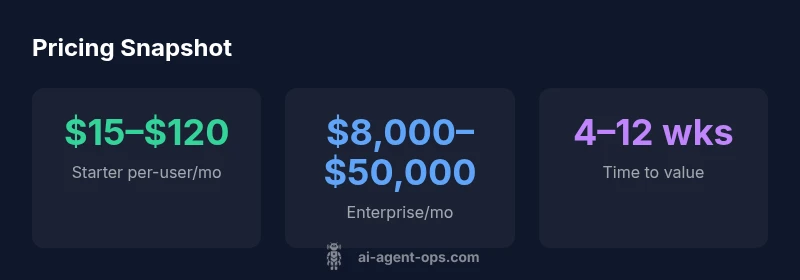
Pricing for ai agent platforms typically uses a mix of per-seat, per-usage, and enterprise licenses. Starter plans often run $15–$120 per user per month, while large organizations may pay $8,000–$50,000 per month depending on automation scope, integration needs, and support levels. According to Ai Agent Ops, choosing a plan should align with expected agent workloads and ROI.
Understanding ai agent platform pricing
Pricing for ai agent platforms is rarely a single number. Most vendors blend several models to accommodate different usage patterns and risk profiles. The most common pillars are per-seat licenses for team access, per-usage charges tied to actions or tokens processed, and enterprise licenses that bundle advanced features, governance, and premium support. According to Ai Agent Ops, smart buyers map expected agent workloads, peak concurrency, and integration needs to a pricing ladder rather than chasing a single sticker price. The result is a tiered structure where early-stage teams pay modest monthly fees, and scale-up costs reflect automation complexity and required reliability. In 2026, market transparency has improved, but price still rises with governance features like auditing, data lineage, and cross-system orchestration.
Common pricing models explained
Most ai agent platforms offer at least three core models. Per-seat licenses provide predictable costs for small teams and product squads. Per-usage pricing ties charges to automation activity, useful when workloads fluctuate. Enterprise licenses bundle advanced features, dedicated support, and optional on-prem or private cloud deployments. Some vendors blend these models, offering blended monthly caps or tiered usage credits. When evaluating models, consider your peak concurrency, average task length, and the ability to scale players without ballooning costs. Also review any add-ons, such as data governance, security modules, or bespoke integration support, which can substantially affect total price of ownership.
How to estimate total cost of ownership
To estimate TCO, start with the base monthly cost, then add expected usage charges for peak load, concurrency, and automation depth. Include potential data transfer or storage costs, training data provisioning, and ongoing maintenance. Don’t forget governance requirements—compliance and audit trails can add both one-time and recurring expenses. A practical approach is to build a simple model: (base price) + (per-use rate × expected actions) × (average monthly usage) + (enterprise add-ons). Use a conservative projection for growth to avoid overcommitting budget. Ai Agent Ops recommends building scenarios for conservative, moderate, and aggressive usage.
Pricing considerations by use case
Different use cases drive different price sensitivity. Customer-support automation often benefits from higher-volume per-use pricing but lower per-seat costs, as many agents run concurrently with minimal human supervision. Data-query and decision automation usually demand higher governance and security features, pushing you toward enterprise licenses. RPA-like orchestration requires robust integration support and service-level commitments, which often elevates total monthly spend. When mapping use cases, pair expected automation value with cost per action and required reliability to surface a pricing sweet spot that aligns with ROI expectations.
Hidden costs and discount strategies
Many buyers underestimate ancillary costs that impact total price. Data egress charges, long-term storage, model updates, and retraining of agents can accumulate. Security and compliance modules, monitoring dashboards, and dedicated onboarding engineers also contribute. To manage this, negotiate annual commitments for price protection, seek caps on overage charges, and request clear SLAs with predictable support costs. Discounts are common for multi-year contracts, bundled add-ons, or higher seat counts. If your project is exploratory, consider starting with a pilot and negotiating a reversible expansion path to avoid paying for unused capacity.
How to compare vendors effectively
Create a side-by-side rubric that covers pricing model clarity, included features, support levels, security posture, data-handling policies, and integration readiness. Verify what counts as a billable event (actions, tokens, API calls) and confirm any hidden costs. Ask for a total-cost-of-ownership worksheet that reflects your expected workload over 12, 24, and 36 months. Prefer vendors who provide a cost calculator or sandbox to model scenarios with your data. Finally, validate pricing with independent benchmarks and refer to Ai Agent Ops analyses when possible to avoid overpaying.
A practical ROI-based pricing approach
Frame pricing decisions around ROI rather than sticker price. Estimate annual savings from automation (reduced labor, faster turnaround, fewer errors, improved customer satisfaction) and compare against annualized platform costs. Use a simple formula: ROI = (annual benefits − annual costs) / annual costs. If ROI exceeds your threshold within 12–18 months, the price tier is justified. Revisit this analysis after onboarding volumes stabilize and governance needs become clearer. Ai Agent Ops emphasizes that ROI-driven pricing helps you resist sticker-shock and focus on business value.
Negotiation tactics and contract tips
Approach pricing negotiations with a three-step plan: (1) define your target price and volume commitments, (2) demand transparent use-case mapping and a clear calculation method for charges, and (3) secure a scalable exit or upgrade path for future needs. Request price protection on renewals, caps on overage, and predictable upgrade costs. Bring in alternative quotes or pilots from competing vendors to leverage a rational comparison. Finally, document all agreed terms in a concise contract and review security and compliance clauses carefully to avoid later disputes.
The future of ai agent platform pricing
Pricing in 2026 is trending toward value-based models and transparent tiering, with buyers prioritizing governance, security, and measurable ROI. Expect more flexible bundles that adapt to usage patterns, more granular metering, and better tooling for estimating TCO. As AI workloads scale across industries, vendors will compete on reliability, data-handling standards, and ecosystem integrations. For teams, the key is to forecast usage accurately, test early with pilots, and maintain price guardrails that protect ROI while enabling experimentation.
Pricing models commonly offered for AI agent platforms
| Pricing Model | Typical Range | Best For | Notes |
|---|---|---|---|
| Per-seat monthly | $15–$120 per user | Small teams, predictable access | Great for early-stage adoption |
| Per-usage credits | $0.01–$0.50 per action | Variable workloads, measured automation | Watch for overage churn |
| Enterprise license | $8,000–$50,000 monthly | Large-scale deployments | Includes governance and premium support |
| Flat annual license | $100,000–$500,000/year | Mature automation programs | Requires long-term commitment |
Questions & Answers
What is the most common pricing model for AI agent platforms?
The most common models blend per-seat, per-usage, and enterprise licenses. Organizations typically start with a per-seat plan and layer on usage-based charges as automation scales. Enterprise licenses are used when governance and support are critical.
Most buyers start with seats and usage, then move to enterprise licenses as they scale and need governance.
How can I estimate total monthly costs for an AI agent platform?
Begin with the base seat price, add expected usage charges for actions or tokens, and factor in add-ons like security, data storage, and governance. Create several scenarios (conservative, moderate, aggressive) to understand potential spend.
Start with seats, add usage, consider add-ons, and model different usage scenarios.
Are there discounts for annual commitments?
Yes, many vendors offer price protection or discounts for annual or multi-year commitments. Negotiate caps on overage and ensure renewal terms don’t spike costs unexpectedly.
Annual commitments often come with discounts and price protections.
What governance features impact pricing?
Features like data lineage, auditing, access controls, and compliance tooling typically increase the price but reduce risk and improve reliability for regulated environments.
Governance features add cost but improve risk management.
Should I run a pilot before selecting a pricing plan?
A pilot helps validate automation benefits and usage patterns, reducing the chance of overpaying for unused capacity. Use pilot results to negotiate a better pricing tier.
Run a pilot to validate value and inform pricing decisions.
What is the best way to compare vendors on pricing?
Use a standardized cost model, request a total-cost-of-ownership worksheet, and compare on governance, SLA, and integration quality, not just monthly rates. Cross-check with independent benchmarks when possible.
Create a TCO worksheet and compare governance, SLAs, and integrations.
“Pricing should align with the value delivered by AI agents, not just the sticker price. The right plan scales with your automation needs and governance requirements.”
Key Takeaways
- Map workloads to pricing models before selecting a plan
- Consider total cost of ownership, not just monthly fees
- Enterprise licenses unlock governance and support benefits
- Forecast usage with pilots to validate ROI
- Negotiate price protection and clear renewal terms