Paid AI Agent: Pricing, ROI, and Best Practices for 2026
An analytical guide to paid AI agents, covering pricing models, ROI benchmarks, governance, and practical implementation for 2026.


Paid ai agent options enable businesses to automate decision workflows with measurable ROI. In 2026, organizations typically assess total cost of ownership across licenses for a paid ai agent and account for integration effort. Pricing models commonly include monthly subscriptions, usage-based fees, and hybrid arrangements. This framing helps teams compare vendors and plan budgets.
What is a paid ai agent?
According to Ai Agent Ops, a paid ai agent is an autonomous software tool you license to perform defined business tasks within your tech stack. Unlike quick-and-dirty scripts, these agents combine machine learning capabilities with workflow logic and connectors to operate across apps, data stores, and APIs. The term 'paid ai agent' denotes a commercial, productized offering that includes ongoing updates, support, and governance options. For teams exploring agentic AI workflows, the distinction is that the agent is not merely a bot; it is a programmable agent designed to reason about tasks, choose actions, and learn from outcomes within constraints. In practice, the most valuable paid ai agent implementations automate repetitive processes, orchestrate data pipelines, and escalate anomalies to humans when needed. A balanced choice aligns capabilities with security, cost, and organizational readiness, ensuring the agent complements rather than disrupts critical systems. For developers, the design space spans orchestration layers, prompts, knowledge-base retrieval, and robust monitoring to prevent drift.
The key takeaway is that a paid ai agent is a scalable, vendor-supported capability, not a one-off script. It requires governance, observability, and clear success metrics to deliver sustained value.
Pricing models and what they mean for paid ai agents
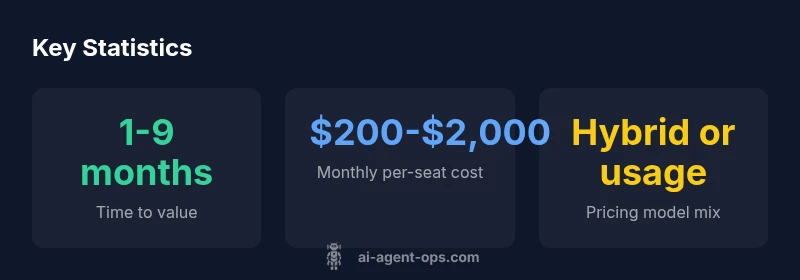
Pricing for paid ai agents generally falls into three broad paradigms: subscription, usage-based, and hybrid arrangements. Subscriptions offer predictable monthly fees but may cap usage or features. Usage-based pricing aligns cost with actual activity, which can be advantageous for variable workloads but harder to budget. Hybrid models blend both approaches, often including a base fee plus per-action or per-user charges. When evaluating these options, consider total cost of ownership (TOC) across licenses, data and infrastructure needs, and the cost of integration. Enterprise-grade options may include tiered pricing, premium support, and additional security features. In the end, the right model depends on workload, governance requirements, and long-term automation goals. For teams building agentic AI workflows, it’s common to start with a pilot and scale to a hybrid model as scope stabilizes. Remember to instrument usage to track value against expense—this is critical for justifying continued investment in a paid ai agent.
Careful scoping early helps align pricing with expected outcomes.
ROI drivers: what actually moves the needle with paid ai agents
ROI from paid ai agents hinges on how well the agent integrates with existing processes, data quality, and the ability to measure outcomes. High-impact use cases include end-to-end process automation, real-time data enrichment, and orchestration across disparate systems. To maximize ROI, map target tasks to specific time savings and error reductions, then translate those improvements into monetary terms. Establish a baseline, run controlled pilots, and track metrics such as cycle time, defect rate, and decision latency. Governance matters: strong data lineage, access controls, and monitoring reduce drift and maintain reliability. Ai Agent Ops analysis shows that ROI tends to improve when organizations invest in data preparation, clear escalation paths, and dashboards that translate automation results into business KPIs. In practice, expect a ramp-up period as teams adapt processes and refine prompts, but long-run returns can be substantial when value streams are well-defined.
The ROI story for paid ai agents is not one-size-fits-all; it grows with disciplined experimentation and disciplined governance.
Architecture, integration, and the tech stack
A successful paid ai agent implementation requires a lightweight yet robust architecture. A typical stack includes an orchestration layer to sequence actions, AI models for reasoning, connectors to ERP/CRM/BI tools, and a logging/observability plane. Data governance is non-negotiable: enforce access controls, data minimization, and auditing to satisfy regulatory and internal risk thresholds. Ensure the agent can surface decisions, request human input when needed, and escalate issues to owners with clear SLAs. Interoperability with existing platforms reduces friction and accelerates value capture. Plan for resilient deployment with fallback options and rollback capabilities. Finally, design with security in mind: encryption in transit, secure secrets management, and regular vulnerability assessments. A well-architected paid ai agent program yields reliable automation, easier upgrades, and smoother scaling as organizational needs evolve.
In sum, technical readiness and governance discipline are prerequisites for measurable benefits.
Risks, governance, and security considerations
As with any automation initiative, paid ai agents introduce risks related to data privacy, model drift, and vendor dependency. Establish governance frameworks that specify data handling, retention, and access rights; define who can approve or override automated decisions; and implement monitoring to detect anomalies early. Regularly update models and prompts to reflect changing business rules, and ensure you have an exit plan in case of vendor changes or performance issues. Security controls should cover identity and access management, secure API connections, and encryption. Build an oversight committee that reviews performance against KPIs and compliance requirements. Transparent reporting and auditable logs help demonstrate control to stakeholders and regulators. When governance and security are in place, paid ai agents can deliver reliable automation with manageable risk.
Evaluation framework and vendor due diligence
A structured evaluation helps avoid vendor lock-in and misaligned expectations. Start with a defined problem statement, success metrics, and a pilot scope that yields measurable outcomes. Create a shortlisting rubric that weighs capabilities (reasoning, integration depth, reliability) against cost and governance. Request reference customers and proofs of concept that demonstrate value under realistic workloads. Assess data handling policies, privacy protections, and compliance posture. Validate integration APIs, latency, and error handling; perform stress tests and failover simulations. Finally, plan for a staged rollout, with milestones for governance reviews, user training, and performance audits. A thorough due-diligence process reduces risk and increases the probability of sustained value from paid ai agents.
Implementation playbook: from pilot to scale
Begin with a focused pilot on a non-critical process that has clear success criteria and an accessible data source. Establish baseline metrics, monitor outcomes, and adjust prompts and workflows as needed. Use a staged rollout to expand to additional processes, collecting feedback from end users and refining governance controls. Invest in data quality improvements early, as better inputs drive better decisions from the agent. Align with IT and security teams to ensure compliance and security posture remains intact during scale. Regularly review ROI, update SLAs with vendors, and sunset or replace components that underperform. The key is to create a repeatable, auditable process for adding new paid ai agent capabilities while maintaining control over risk and cost.
Authoritative sources (for further reading)
- https://www.nist.gov/topics/artificial-intelligence
- https://www.science.org/doi/10.1126/science.abe4343
- https://mittechnologyreview.com/
Pricing and cost elements for paid AI agents
| Pricing element | Typical range | Notes |
|---|---|---|
| License model | Monthly subscription or usage-based | Costs scale with usage and seat count |
| Onboarding time | 2-8 weeks | Depends on data quality and system readiness |
| Total ownership cost | Varies widely | Includes licenses, infra, data prep, and governance |
| Support and updates | Included or addon | Depends on vendor tier and service level |
Questions & Answers
What is a paid ai agent?
A paid ai agent is an autonomous software tool that you license to perform tasks within your systems. It combines AI models with workflow logic and connectors to operate across apps and data sources, designed for repeatable automation and governance.
A paid ai agent is an autonomous tool you license to automate tasks across your systems, with governance and ongoing updates.
How do pricing models typically work for paid ai agents?
Most vendors offer a mix of monthly subscriptions, usage-based fees, or hybrid plans. Costs depend on the number of agents, task volume, data needs, and required integrations.
Pricing usually combines subscription, usage, or hybrid options, varying by workload and integrations.
What factors influence ROI when adopting a paid ai agent?
ROI depends on use-case fit, data quality, governance, and the ability to measure outcomes. Start with a pilot to quantify savings and drive improvements.
ROI hinges on use-case fit, data quality, and how well you can measure outcomes.
What governance is required for paid ai agents?
Establish data controls, access, auditing, and escalation rules. Define success metrics and ensure ongoing monitoring to manage drift and risk.
Set data controls, access rules, and ongoing monitoring to keep automation safe.
How long does implementation take?
Time varies with scope; simple automations can deploy in weeks, while complex workflows may take months. Use phased rollouts with clear milestones.
Implementation can take weeks to months depending on scope; plan for phased rollout.
What safeguards prevent drift and security issues?
Maintain data governance, model monitoring, and secure integration. Regular audits and a clear exit plan help manage vendor risk.
Use governance, monitoring, and security controls to prevent drift and protect data.
“Paid ai agents unlock scalable automation when aligned with clear workflows and governance. With good data hygiene and monitoring, organizations realize steady ROI; otherwise, drift and governance gaps erode value.”
Key Takeaways
- Define concrete use cases to measure ROI
- Prefer hybrid or usage-based pricing for flexibility
- Pilot early and track measurable outcomes
- Institute governance and data controls from day one