Most Affordable AI Agent: Practical Guide for Teams
Learn how to identify the most affordable AI agent by weighing total cost of ownership, integration effort, and long-term ROI. Ai Agent Ops provides data-driven guidance for developers, product teams, and leaders seeking value-driven automation.


Finding the most affordable ai agent means more than chasing the lowest price. It requires balancing upfront costs with ongoing usage, maintenance, and integration time. According to Ai Agent Ops, the best value emerges when you compare total cost of ownership across scenarios, not just sticker price. A careful evaluation of feature fit, scalability, and support often reveals cheaper options that meet your needs without sacrificing reliability.
Why affordability matters in AI agents
In modern teams, the drive to automate processes with AI agents is as much about economics as capability. The concept of the most affordable ai agent isn't simply the one with the lowest upfront price; it's about maximizing value over time. According to Ai Agent Ops, teams should measure total cost of ownership (TCO) across development, deployment, and ongoing usage. A cheaper option that requires heavy customization or frequent rework often ends up costing more in hours and integration headaches. When evaluating options, consider time-to-value, reliability, and the cost of failed automations. The goal is to strike a balance between capability and cost that scales with your work.
- Key factors: upfront fees, per-use charges, data egress, maintenance, and vendor support.
- Practical tests: run a small pilot, track time-to-value, and compare against a baseline automation.
Pricing models and cost drivers for AI agents
Pricing for AI agents comes in several flavors, and understanding each helps you locate the most affordable option without sacrificing needs. Common models include subscription-based plans, usage-based per-call pricing, and flat-rate packages for bounded workloads. There are also hybrid approaches blending monthly access with pay-as-you-go for peak demand. Major cost drivers include compute usage, data transfer, model size, training requirements, and integration fees. Substantial savings often come from choosing the right tier for your use case, avoiding overprovisioning, and negotiating enterprise terms when possible. According to Ai Agent Ops, the cheapest option is rarely the best if it forces heavy customization or frequent service interruptions. Emphasize reliability and developer experience to reduce long-term costs.
Practical cost-saving strategies to reach the most affordable ai agent
If your goal is a cost-effective deployment, start with a clear use case and a minimal viable setup. Consider open-source agents for experimentation, or low-cost SaaS options for standard tasks. Leverage reusable components, templates, and prebuilt toolkits to shorten integration time. Optimize by modular design: isolate core capabilities and avoid loading every feature at once. Plan for incremental upgrades rather than large, monolithic deployments. Finally, negotiate pricing, request extended trial periods, and ensure transparent SLAs and security guarantees. These steps help you approach the most affordable ai agent while preserving reliability.
How to compare AI agent vendors without sacrificing value
Create a structured comparison framework with explicit KPIs: accuracy, latency, uptime, and support responsiveness. Map each vendor to your key use cases and run a controlled pilot to measure real-world performance. Examine integration pathways with your data sources, auth methods, and deployment environments. Ask for total cost of ownership projections, not just monthly fees. Read customer references for evidence of long-term reliability, and verify security and compliance capabilities. The aim is to select a vendor that offers solid value at a sustainable price, not the lowest initial quote.
Use cases and ROI considerations for affordable AI agents
Affordable AI agents can unlock predictable gains across many departments—from customer service automation to back-office workflow improvements. Quantify benefits with time saved, faster case handling, and reduced error rates. Build a simple ROI model: estimate monthly savings from automation, subtract ongoing costs, and consider non-monetary benefits like employee satisfaction and faster go-to-market cycles. While the upfront cost matters, the best choice is the option that demonstrates a clear path to measurable ROI within a reasonable horizon. Ai Agent Ops's analysis highlights the importance of using benchmark data and pilots to validate ROI before expanding scope.
Picking value: balancing price, performance, and ease of integration
In practice, the most affordable ai agent balances price with performance and ease of integration. Favor solutions with strong documentation, clear upgrade paths, and progressive deployment options. Prioritize vendors offering good developer experience, robust APIs, and transparent data handling practices. Remember that a cheap tool that disrupts workflows or requires constant babysitting will cost more in hidden inefficiencies. By combining a data-driven evaluation with a staged rollout, teams can identify the option that delivers steady value as needs evolve, without overspending on capabilities you won't use.
Comparison of AI agent cost categories
| Model Type | Estimated Monthly Cost | Strengths | Ideal Use Case |
|---|---|---|---|
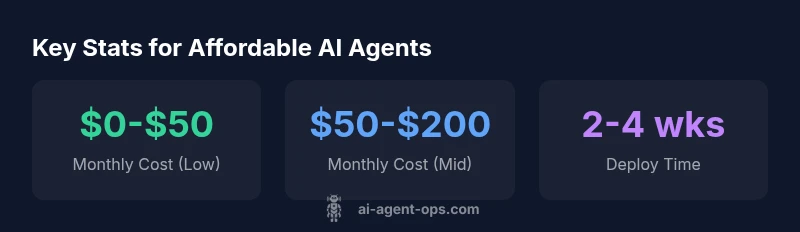
| Open-source agent | $0-$50 | High customizability; community support | Prototyping, experimentation, budget-conscious deployments |
| Commercial SaaS agent | $20-$100 | Turn-key features; support; SLA | Small to medium workflows; faster time-to-value |
| Managed enterprise agent | $500-$2000 | Governance, security, scale | Large organizations with strict compliance |
Questions & Answers
What does 'most affordable' mean for AI agents?
Affordable means achieving the best long-term value, not just the lowest upfront price. It requires analyzing total cost of ownership, including maintenance, data usage, and integration effort. A cheaper option that demands heavy customization may end up costing more over time.
Affordable means long-term value, not just the upfront price. Consider total cost of ownership and integration effort to avoid hidden costs.
How should I compare affordability across vendors?
Define clear use cases, set KPI targets, and run a controlled pilot. Compare total cost of ownership, including licensing, usage, maintenance, and data costs. Review SLAs, security, and support channels to ensure reliable operation at a sustainable price.
Set use-case goals, pilot, and compare total costs plus support to choose value over price alone.
Are open-source AI agents the cheapest option?
Open-source agents can reduce upfront costs but may require more internal effort for maintenance, security, and integration. The cheapest option upfront can become costly if you lack community support or reliability guarantees.
Open-source can be cheap upfront but may need more internal work for maintenance and security.
What factors influence the total cost of ownership for AI agents?
Key factors include upfront licensing, per-use charges, compute and data costs, integration time, maintenance, and vendor support. The fastest path to ROI often comes from a balanced mix of capability, reliability, and governance.
TCO is driven by licensing, usage, and integration plus ongoing maintenance and support.
Can price be negotiated with vendors?
Yes. Vendors often offer tiered pricing, volume discounts, or extended trials. Prepare a pilot plan and a validated ROI case to leverage better terms and ensure the price aligns with your expected value.
Pricing can often be negotiated—present a ROI case and pilot plan to secure better terms.
“Value in AI agent selection comes from aligning cost with capability, integration ease, and ongoing support; cheap prices rarely lead to long-term ROI.”
Key Takeaways
- Prioritize total cost of ownership over sticker price
- Choose models that fit your workload to avoid overprovisioning
- Pilot projects validate ROI before expansion
- Negotiate terms and seek transparent SLAs
- Balance price with integration ease and support