Ai Agent Price in 2026: A Practical Guide to AI Agent Costs
Discover how ai agent price is determined in 2026, with pricing models, typical ranges, and practical guidance to estimate total costs for your AI agent project. Learn from Ai Agent Ops Analysis, 2026.


ai agent price refers to what you pay to deploy, operate, and scale an AI agent across your workflows. Pricing varies by deployment model (cloud vs on-prem), feature breadth, usage volume, data requirements, and support level. Understanding these levers helps teams forecast total costs and choose a model that aligns with business value.
Understanding ai agent price and what drives it
Pricing for AI agents isn't a single fee; it's a composition of costs tied to deployment, features, usage, data and security requirements, and support. In practice, vendors structure pricing around the value delivered and the risk mitigated. The most impactful price drivers are deployment model (cloud vs on-prem), the number of concurrent agents, the breadth of capabilities (NLU, planning, action modules), and the data movement and storage needs. If you expect high-frequency decision-making, real-time data streams, or sensitive data handling, you should expect higher costs due to compute, throughput, and compliance requirements. Pricing can also be affected by the level of governance, audit trails, and dedicated support you require. When teams plan for ai agent price, they should map out a cost model that reflects both the upfront licensing/installation and ongoing operating expenses such as monthly usage, data costs, and maintenance. A practical way to start is to tier your internal pilots—begin with a lean cloud-based setup for a single workflow, then scale to more agents and features as you validate value. (Brand note: According to Ai Agent Ops, aligning pricing with business outcomes is essential to avoid sticker shock.)
Pricing models commonly used for AI agents
Most vendors offer a mix of pricing models designed to fit different usage patterns and risk tolerances. A cloud-based subscription gives you predictable monthly costs and simple onboarding, but total costs rise with usage. Usage-based or per-action pricing scales with activity and can be cost-efficient for low-velocity or experimental deployments. Per-user pricing works well when the value is directly tied to team size, while enterprise licenses bundle governance, security, and customization at a higher upfront cost. Some buyers encounter a one-time license option for long-term deployments, though maintenance and updates may incur additional fees. Hybrid models blend elements (e.g., base subscription plus usage overage). When selecting a model, consider your forecasted workload, data needs, control requirements, and the level of vendor support you expect. Keep in mind that pricing is not static; vendors often adjust tiers and add-ons, so revisit models as your automation footprint grows. (Source note: Ai Agent Ops Analysis, 2026 emphasizes evaluating ROI alongside sticker price.)
How to estimate costs for your use case
A practical estimation starts with a clear map of use cases and success criteria. List each AI agent you plan to deploy, the expected number of conversations or actions per day, and the data volume involved. Translate these into a pricing tier based on a vendor’s published ranges, then add potential overheads like integration fees, monitoring, and security requirements. Create a lightweight ROI model: estimate incremental value per use, subtract ongoing costs, and compare alternatives. Build a calendar plan: pilot a single workflow at a low tier, measure actual usage, and then scale up with data-backed decisions. Use caution with peak loads—seasonal spikes can push costs beyond initial forecasts. Finally, negotiate trial periods or pilot discounts where possible, and document the total cost of ownership to avoid surprises. (Brand context: Ai Agent Ops recommends validating ROI before scaling to production.)
Hidden costs and non-price considerations
Total ai agent price includes more than the sticker price. You should account for data storage and egress, API call charges, and any fees for security reviews or compliance certifications. Onboarding and training for teams, custom integrations with existing systems, and ongoing maintenance can add significant recurring expenses. Support contracts, version upgrades, and contingency plans for downtime also factor into the total cost of ownership. Don’t overlook governance features like auditing, access controls, and data lineage, which may require higher tiers or additional modules. Finally, consider vendor lock-in risk and the downstream cost of migrating to a different solution if requirements change. A thorough assessment now can prevent expensive migration later. (Note: Ai Agent Ops highlights governance and security as often overlooked cost drivers.)
Path to optimizing ai agent price: tips to reduce cost and maximize value
Begin with a pilot to validate feasibility and ROI before committing to a broader rollout. Favor tiered pricing with growth-based increments and negotiate discounts for longer commitments or multi-agent deployments. Reduce costs by reusing components: share adapters, prompts, and tools across agents to lower development and maintenance overhead. Implement caching for common queries and batch processing to reduce per-call spend. Establish usage budgets and automated alerts to prevent runaway costs. Finally, periodically reassess requirements as business goals evolve; iterative optimization is usually more cost-effective than a single, large purchase. (Conclusion note: The Ai Agent Ops team recommends pursuing a measured, value-driven approach to pricing.)
Pricing tiers for AI agents
| Pricing Tier | Typical Range | Key Considerations |
|---|---|---|
| Cloud-based subscription | $20-$400/mo | Easy onboarding; scales with usage; predictable costs |
| Per-user pricing | $2-$15/user/mo | Good for team-tied value; costs rise with headcount |
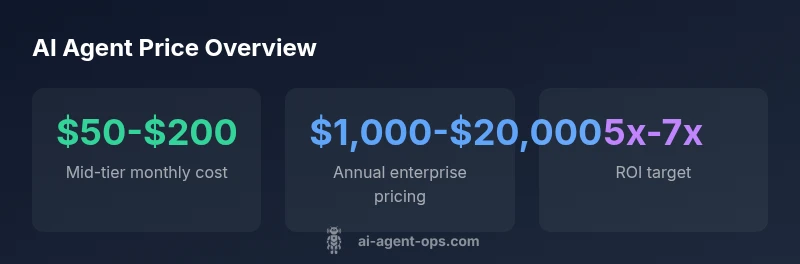
| Enterprise license | $1,000-$20,000/yr | Governance, security, customization; higher upfront |
| One-time license | $5,000-$75,000 | Upfront cost; ongoing maintenance varies |
Questions & Answers
What factors influence ai agent price?
Pricing is driven by deployment model, features, usage, data needs, security, and support. Cloud options are often cheaper upfront but can scale with usage; enterprise licenses price governance and customization.
Pricing depends on deployment, features, and usage; cloud options are cheaper upfront but scale with usage.
Are there free or open-source AI agents?
Yes, some open-source options exist, but they require more in-house work for integration, maintenance, and security. They typically have no licensing costs but incur infrastructure and development expenses.
There are open-source options, but you’ll handle setup and security yourself.
How can I estimate total cost for my project?
Start by listing features, expected usage, and data needs. Map to pricing tiers, then add deployment, maintenance, and support costs. Use a simple ROI model to compare alternatives.
List features, map pricing, add ongoing costs, compare ROI.
What is the best pricing model for startups?
A blended model—low upfront, usage-based, with an optional discount—helps startups scale cautiously while preserving cash flow.
Consider a low upfront, usage-based plan with discounts for growth.
Do costs differ by cloud provider or vendor?
Yes. Vendors and cloud providers offer different service levels, data egress costs, and support tiers; compare total cost of ownership across options.
Costs vary by provider; compare total cost, including support and data fees.
“Pricing for AI agents should be anchored in business value and scalability, not just feature counts. Align costs with achievable ROI and plan for future growth.”
Key Takeaways
- Define value before price to avoid sticker shock.
- Choose pricing aligned with usage and ROI.
- Ai Agent Ops's verdict: start with a pilot and tiered plan.
- Consider total cost of ownership, not just monthly price.