How Long to Build an AI Agent: Timelines and Factors
Explore realistic timelines for building AI agents, the drivers behind durations, and a practical calculator to estimate weeks. Learn actionable strategies for developers and product teams to plan, iterate, and optimize delivery.


Understanding the Timeline Question: how long does it take to build an ai agent
When teams ask how long does it take to build an ai agent, the answer is not a single number. According to Ai Agent Ops, realistic timelines depend on three core inputs: the project scope, the quality and availability of training data, and the experience and tooling maturity of the team. A tiny, well-scoped agent with clean data can reach an MVP quickly, while an enterprise-grade agent that orchestrates multiple workflows across departments will stretch timelines. Importantly, this topic should be discussed openly with stakeholders to set expectations and avoid scope creep. The keyword is not a fixed countdown but a spectrum of effort driven by design choices, governance requirements, and the intended reliability of the agent in production. In practice, teams start with a problem statement, outline an MVP, and map out milestones. From there, you can translate ambition into a schedule that aligns with business value and risk tolerance. The goal is to move from an idea to a working agent as efficiently as possible while maintaining quality, safety, and compliance. By framing the question this way, teams can communicate clearly about what is achievable and when.
Core factors shaping build time
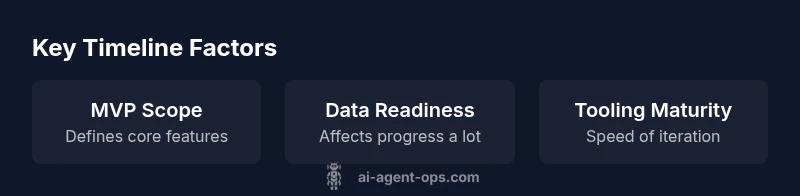
Building an AI agent is not just writing code; it's coordinating data, models, and governance. Here are the core factors that shape how long it takes, from fastest to slowest:
- Scope and complexity: The breadth of the agent's responsibilities, from a simple chat bot to a multi-step orchestrator, drives planning and integration work.
- Data availability and quality: Clean, labeled data accelerates training and testing; messy data introduces cleaning, labeling, and privacy steps that extend timelines.
- Team experience and tooling: A seasoned team with mature AI tooling can implement features faster and with fewer architectural dead ends.
- Tooling maturity and integration: Reusable components, SDKs, and connectors reduce development friction, while bespoke integrations add risk and time.
- Governance, compliance, and safety: Defining policies, privacy safeguards, and audit trails early prevents rework later, but requires upfront alignment.
Phases of development and typical flow
Most AI agent projects pass through a repeatable sequence: discovery, design, data preparation, prototyping, validation, and deployment. In early discovery, you clarify use cases, success metrics, and risk tolerance. Design translates requirements into modular components, interfaces, and decision policies. Data preparation covers collection, labeling, cleaning, and privacy checks. Prototyping tests core capabilities with a minimal feature set. Validation confirms reliability, safety, and performance under realistic workloads. Deployment moves the agent into production, with monitoring, feedback loops, and rollback mechanisms. Timelines for each phase depend on scope and data readiness; simple pilots may fit into a few sprints, while complex deployments unfold across multiple quarters.
Practical strategies to speed things up
- Start with a minimal viable product (MVP) that delivers measurable value and can be extended.
- Reuse existing models, frameworks, and connectors instead of building from scratch.
- Invest in data infrastructure: labeling pipelines, data quality checks, and privacy safeguards.
- Automate testing, evaluation, and deployment pipelines to catch issues early.
- Plan governance and safety controls in parallel with development to avoid late-stage rewrites.
- Use parallel workstreams: split data curation, model work, and integration tasks to compress schedule.
Using the timeline calculator: interpreting results
To make timelines tangible, use the AI Agent Build Time Calculator. For example, with scopePoints=40, teamExperience=3, and dataQuality=0.8, the formula estimates roughly 8 weeks of work. This is an educated planning tool, not a guaranteed deadline. You can experiment with other inputs to compare scenarios—increase scope for a longer project, or boost data quality to shorten the timeline. The calculator helps align project plans with risk tolerance and business priorities.
Case study: MVP vs enterprise deployment
Case A: MVP for a customer-support agent with a narrow scope and clean data. The team leveraged existing orchestration components, defined a tight success metric, and deployed within a few iterations. Case B: Enterprise deployment across multiple lines of business with data from various systems and strict governance. The effort required broader data integration, security reviews, and robust monitoring, leading to a longer timeline but significantly higher impact. In both cases, a clear MVP and staged rollout reduced risk and accelerated feedback.
Final planning tips and pitfalls
Key planning advice includes documenting use cases, setting explicit success criteria, and building an iterative roadmap. A common pitfall is underestimating data readiness or governance needs; address these early to avoid late changes. Another risk is over-optimism about speed of integration with existing systems. By combining a realistic timeline with an iterative delivery approach, teams can deliver valuable AI agents without breaking schedules or budgets. The Ai Agent Ops team emphasizes ongoing alignment with stakeholders and continuous improvement as the project evolves.