5 Day AI Agent: Practical Step-by-Step Guide for Teams
A comprehensive, 5-day guide to designing, prototyping, and deploying an AI agent. Learn daily milestones, core components, risk controls, and evaluation strategies to deliver a functional agent within a workweek.


Goal: design a practical 5 day ai agent workflow that moves from problem framing to deployment, with basic memory and orchestration. You’ll need a clear objective, access to data or APIs, a lightweight runtime, and a testing plan. The guide covers daily milestones, core components, risk controls, and a simple evaluation strategy.
What is a 5 day ai agent?
A 5 day ai agent is a compact, sprint-based approach to designing an autonomous assistant that can complete a defined task within a workweek. It blends problem framing, architecture design, data strategy, and risk-aware deployment into five deliberate days. According to Ai Agent Ops, this cadence helps teams learn quickly, constrain scope, and build measurable value without overcommitting to a long cycle. The emphasis is on tangible milestones, testable outputs, and governance that protects data and users. In practice, you set a single objective for the agent, outline the inputs and outputs, and establish a simple evaluation plan before you write a line of code. The model architecture is deliberately small at first: a memory window that captures relevant context, a few core tools the agent can call, and prompts that guide behavior without hidden tricks. By focusing on a crisp daily goal, teams avoid parallel streams of work that lead to feature creep. The term “5 day ai agent” signals a commitment to feedback loops, rapid experimentation, and documented decisions. It also aligns with the AI governance norms many organizations follow in 2026, when Ai Agent Ops’s analyses emphasize safety, reproducibility, and auditable prompts. As you walk through the days, you’ll progressively upgrade realism: from a sketchy prototype to a working workflow that passes basic user tests, and finally to a deployable module with basic monitoring.
Why a 5-day learning cycle matters for AI agents
The five-day cadence enforces discipline, clarity, and feedback that longer sprints often miss. Short cycles encourage teams to define success criteria early, test assumptions quickly, and pivot when results reveal new constraints. This structure reduces risk by avoiding large, untested bets and creates a living record of decisions that can be audited. For developers, product teams, and leaders, the 5-day cycle turns theoretical concepts into practical, auditable outcomes. It also aligns with governance expectations in 2026, where Ai Agent Ops highlights reproducibility, safety, and responsible deployment as non-negotiables. You’ll notice that the day-by-day plan forces memory, tool usage, and prompt design to co-evolve. Each day’s deliverable tests a concrete aspect of the agent—input handling, context retention, decision quality, or action execution—so you can measure progress before moving forward. The approach also makes it easier to manage cross-functional teams: data engineers, ML engineers, and product managers can own distinct days while maintaining a shared objective. In short, a 5-day cycle converts learning into a measurable, maintainable product sooner rather than later.
Day-by-day milestone overview
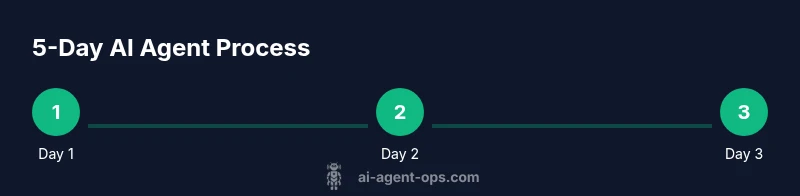
In a 5 day ai agent sprint, teams follow these milestones to keep momentum and ensure quality:
- Day 1: Problem framing, objective definition, and success criteria. The team agrees on a single task for the agent, the expected outputs, and how success will be measured. This day ends with a one-page spec and a demo plan.
- Day 2: Data access and memory strategy. Identify required data sources, how data will be fetched, stored, and purged, and how memory will be bounded to prevent drift. Establish initial prompts and tool bindings that support the task.
- Day 3: Architecture and tool integration. Build a lightweight agent skeleton, wire up a minimal toolset, and implement a simple orchestrator that can route prompts to tools.
- Day 4: Pilot run and incremental testing. Use sandbox data or synthetic inputs to validate behavior, capture latency, and identify failure modes.
- Day 5: Evaluation, governance, and deployment planning. Review metrics, document decisions, and prepare a deployable module with monitoring and rollback options. Each day ends with a brief live demo for stakeholders.
Core components of a 5-day workflow
A successful 5-day AI agent combines four core elements: problem framing, memory and context, a toolset, and a lightweight orchestrator. Problem framing defines the task and success metrics. Memory and context handling ensure the agent retains relevant state without bloating prompts. The toolset represents external capabilities the agent can call, such as APIs, data services, or computation. The orchestrator coordinates interactions, routing prompts to the right tool calls and stitching results back into a coherent response. You should design prompts to be explicit about goals, constraints, and failure modes, while keeping prompts modular to enable quick replacements. Also establish guardrails: input validation, rate limits, and error handling that preserve user trust. In practice, you’ll keep memory bounded, avoid leaking sensitive details, and document all prompts and tools used for reproducibility. A small, well-structured memory schema—perhaps a memory log with timestamps, source, and decision rationale—helps in debugging and auditing later. Remember that a five-day sprint thrives on simplicity; start with a minimal viable product and grow complexity only when the core loop works.
Tools, data, and best practices
Prepare a toolkit that supports rapid prototyping without sacrificing safety. Essential components include a lightweight runtime (Python is common), access to a capable LLM via a controlled API, and a small library of reusable prompts. You’ll also need a memory model, a tool registry, and a simple evaluation harness. Data and API access should be provisioned with privacy in mind and with minimal data retention. Best practices include embedding clear prompt templates, avoiding hard-coded secrets, and logging tool usage for traceability. Use synthetic data during early pilots to limit risks, then validate with representative data in a controlled environment. Keep dependencies scoped and versions pinned to reduce drift. Finally, set up observability: basic metrics for latency, success rate, and error handling so you can quantify progress and detect regressions quickly.
Common pitfalls and mitigation strategies
A number of traps can derail a 5-day ai agent project. Scope creep is a frequent killer; maintain a single, well-defined objective and reject feature requests that drift from that objective. Memory drift from unbounded context can degrade reliability; implement bounded memory and prune stale data. Prompt instability and tool misbinding cause inconsistent results; use modular prompts and a clear tool registry. Data privacy and security risk rise when data crosses boundaries; implement access controls and sanitize data before use. Finally, pilot results can be misleading if metrics aren’t aligned with real-world value; choose metrics that reflect user impact and business goals, and revisit them at each iteration.
Case study: hypothetical deployment scenario
Imagine a team building a 5 day ai agent to triage customer support tickets. Day 1 defines the objective: automatically classify and route tickets based on urgency and topic, with a human-in-the-loop for high-risk cases. Day 2 links to the ticketing system API and establishes memory about recent tickets. Day 3 builds a minimal agent with a single tool: the ticket API, plus a prompt that summarizes ticket context and suggests routing. Day 4 runs a pilot on a controlled set of tickets, measuring classification accuracy and latency. Day 5 reviews results with stakeholders, documents decisions, and designs a deployment plan with monitoring and rollback. The outcome is a demonstrable, auditable agent that can support human agents and scale to more categories with careful governance.
Next steps and evaluation
With a successful 5 day ai agent prototype in hand, plan a staged deployment: start with a limited user group, monitor key metrics, and implement safety controls. Establish a governance cadence: review prompts, memory usage, and tool integrations on a regular schedule. Document all changes and maintain a living playbook that details decisions, data sources, and evaluation results. The 5-day sprint isn’t the end state; it’s a repeatable process you can institutionalize to accelerate future AI agent projects. As Ai Agent Ops notes, this cadence supports rapid learning while upholding safety and accountability.
Tools & Materials
- Python 3.x runtime(Recommended latest LTS)
- OpenAI API access(For LLM calls)
- Local development environment(IDE or editor)
- Git/version control(Track changes)
- Secrets management tool(Secure storage for API keys and tokens)
- Data access (APIs or datasets)(Ensure privacy and compliance)
- Prompt templates and memory schema(Optional but recommended)
- Observability/monitoring tooling(Logging, tracing, metrics)
Steps
Estimated time: 5 days total
- 1
Define objective & success criteria
Clarify the problem the agent will solve and how you will measure success. Establish constraints and non-goals to prevent scope creep. Document acceptance criteria in simple, testable terms.
Tip: Write a 1-page objective and 3-5 measurable metrics before coding. - 2
Map data, memory, and tools
Identify the data the agent will access, how memory will be stored, and which tools it will call. Keep memory scope tight to avoid context bloat.
Tip: Use a memory window of 200-500 tokens for initial runs. - 3
Prototype minimal agent architecture
Create a lightweight prompt and a small set of tools that cover the core task. Build a basic orchestrator to route prompts and tool calls.
Tip: Start with a single tool and expand only after the baseline works. - 4
Sketch Day-by-Day milestones
Design skeleton tasks for Day 1–Day 5. Align each day with concrete deliverables and tests along the way.
Tip: Treat each day as a mini-sprint with a built-in demo. - 5
Run a safe pilot and collect metrics
Test with sandbox data or synthetic inputs. Capture performance, latency, and error rates; adjust prompts and memory accordingly.
Tip: Enable strict data privacy during pilots. - 6
Review, iterate & plan deployment
Analyze results, document decisions, and prepare a deployment plan with monitoring and rollback options.
Tip: Create a living document recording prompts and tool usage.
Questions & Answers
What is a 5 day ai agent, and why use it?
A 5 day ai agent is a sprint-based approach to designing an AI assistant that completes a defined task within a workweek. It emphasizes rapid framing, prototyping, testing, and governance to deliver tangible value without overextending resources.
A 5 day ai agent is a week-long sprint to build and test a focused AI assistant. It focuses on quick wins and safe deployment.
What prerequisites are needed for a 5-day AI agent project?
You need a concrete objective, access to data or APIs, a lightweight runtime, development tooling, and a plan for testing and governance. Establish access controls and ensure data privacy from day one.
Think: a clear goal, data access, and a safe testing setup before you start.
How do you measure success in the 5-day cycle?
Use 2-4 simple metrics (e.g., task completion rate, latency, error rate, user satisfaction) and a minimal demonstration on Day 5. Keep measurements repeatable and tied to the objective.
Use a few clear metrics and a quick demo to show results.
How should memory be managed in the agent?
Implement a bounded memory window and explicit context management to prevent drift. Persist only necessary state and purge outdated data after evaluation.
Keep a small memory window and tidy up after tests.
What are common risks and how to mitigate them?
Risks include data leakage, biased prompts, and scope creep. Mitigate with access controls, prompt testing, and a clearly defined success envelope.
Watch for data leaks and ensure prompts stay within the defined scope.
Can this framework scale to larger tasks?
The 5-day framework scales by iterating on architecture, expanding tool sets, and refining governance. For larger tasks, segment work into multiple sprint cycles.
Yes, you can expand the process in stages with larger goals.
Watch Video
Key Takeaways
- Define a clear, testable objective.
- Build incrementally with a 5-day cadence.
- Prioritize safety, governance, and data privacy.
- Evaluate with simple, repeatable metrics.