5 Day AI Agent Course: A Practical Blueprint
A complete, educator-focused guide to designing and running a 5 day AI agent course that builds fundamentals, hands-on labs, and real-world agent workflows for developers and product teams.


Goal: design and run a complete 5 day ai agent course that delivers fundamentals, practical agent tasks, and real-world workflows. You’ll define daily objectives, curate hands-on labs, and align assessments with concrete outcomes. This quick answer previews the structure, required materials, and key milestones you’ll implement to launch a high-impact program.
What is a 5 day ai agent course?
According to Ai Agent Ops, a 5 day ai agent course is a structured, hands-on program that guides participants from foundational concepts to real-world agent workflows in a compact workweek. Learners explore what agentic AI means, how to chain tools and models (LLMs, planners, and environment interfaces), and how to measure impact in a controlled setting. The days are designed to build confidence with practical tasks, such as simulating a simple agent that can gather information, reason about a goal, and execute actions in a sandbox. This approach emphasizes practical outcomes over theory, blends demonstrations with labs, and prepares teams to deploy agent-like automation in real projects. The Ai Agent Ops team highlights that real-world readiness comes from applied practice, not just theory.
As you progress, you will encounter core concepts like agent orchestration, sandboxed environments, and agent-safe behaviors. Throughout the course, you’ll link theory to practice by building tiny agents that solve focused problems, then scaling those solutions to more complex workflows. The emphasis is on actionable outcomes—participants finish with a working, testable agent prototype and a clear plan for deployment in their own organization.
Day-by-day curriculum overview
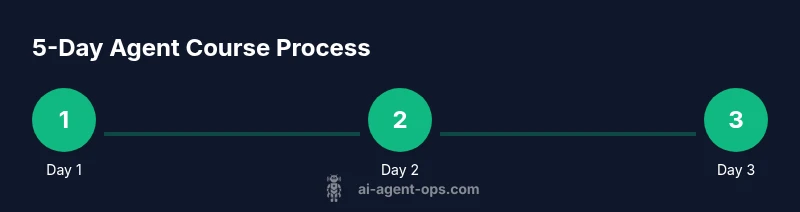
This section outlines a practical day-by-day progression you can reuse or tailor for your audience. Each day blends short lectures with hands-on labs, code reviews, and reflective exercises. Day 1 establishes foundations for understanding AI agents and agentic AI; Day 2 focuses on tool integration and environment setup; Day 3 tackles planning, reasoning, and multi-step tasks; Day 4 centers on execution, monitoring, and error handling; Day 5 ends with evaluation, deployment, and real-world case studies. The goal is to ensure learners leave with functional fluency in agent principles and the confidence to apply them in real projects.
- Day 1: Foundations, goals, and risk awareness
- Day 2: Tooling stack and environment setup
- Day 3: Planning, reasoning, and complex task handling
- Day 4: Execution, monitoring, and resilience
- Day 5: Evaluation, deployment strategies, and case studies
Learning outcomes and competencies
By completing a 5 day ai agent course, learners gain tangible competencies in designing, building, and evaluating agent systems. You’ll be able to articulate the difference between autonomous agents and scripted bots, implement basic agent-to-agent coordination, and draft a practical deployment plan. You’ll also develop critical thinking around safety, ethics, and governance when automating decision-making, as well as the ability to communicate results to non-technical stakeholders. The emphasis is on measurable outcomes that map directly to business value, such as faster decision cycles, improved automation throughput, and clearer governance of AI-driven actions.
Tools, environments, and data considerations
Successful delivery requires a careful blend of tools, environments, and data governance. You’ll provision a lightweight sandbox for running small agents, provide starter notebooks and prompts, and ensure learners have access to an LMS for assignments and feedback. Emphasize data provenance, privacy, and reproducibility, and offer a safe set of public datasets and prompts that illustrate real-world constraints. The course should remain tool-agnostic where possible, enabling learners to apply their preferred stacks while preserving core concepts like prompts, reasoning, and action selection. Ai Agent Ops notes that a well-chosen toolset accelerates learning, but the focus must stay on understanding agent behavior, not chasing the latest gadget.
Assessment design and feedback loops
Assessments should be frequent, transparent, and aligned with Day-by-Day goals. Include hands-on labs, short prompts, peer reviews, and a capstone project that demonstrates an end-to-end agent workflow. Use rubrics that measure clarity of goals, sound reasoning, correct action selection, and robust error handling. Feedback loops should be rapid, with actionable suggestions that guide iteration. Incorporate reflective prompts to help learners internalize lessons and document lessons learned for future teams. Ai Agent Ops suggests pairing learners with mentors for real-time feedback and to model best practices.
Practical design patterns for agent orchestration
A practical 5 day course should cover core design patterns such as sequential reasoning, plan-and-execute loops, failure handling and fallback strategies, and safe shutdown triggers. Emphasize modular design so learners can swap components (prompts, tools, or environments) without reworking the entire system. Include demonstrations of agent orchestration across simple workflows and then extend to multi-step tasks with backtracking and monitoring. The patterns you teach should be transferable to real projects, enabling participants to implement agent-based automation with confidence.
Real-world projects and outcomes
Concluding with real-world projects helps learners translate theory into impact. Propose capstones like building a customer support agent that accesses a knowledge base, or a data-gathering agent that compiles competitive intelligence with ethical safeguards. Emphasize documentation, explainability, and governance to ensure the solutions are maintainable post-course. The Ai Agent Ops team believes that projects anchored in real business problems deliver the deepest learning and are most likely to drive long-term adoption of agent-based automation.
Next steps and customization strategies
After the initial run, customize the curriculum for different audiences—developers, product managers, or executives—by adjusting depth, tools, and success metrics. Consider running parallel cohorts focusing on specific domains (e.g., customer service, analytics, or operations) and reuse the core 5 day skeleton with domain-specific labs. Finally, build a joint feedback loop with real stakeholders to continuously improve the course and increase organizational value. Ai Agent Ops recommends starting with a pilot cohort and iterating on it based on concrete outcomes.
Tools & Materials
- Course platform (LMS or course website)(Moodle/Canvas or equivalent; ensure support for assignments and discussions)
- Code editor and notebook environment(Python or your preferred language; include clean starter templates)
- Sandbox environment for AI agents(Isolated environment to run simple agents without risking production systems)
- Sample datasets and prompts(Public datasets or mock datasets suitable for agent tasks)
- Starter notebooks and templates(Prompt templates, evaluation rubrics, and lab guides)
- Rubric templates and feedback forms(Clear criteria for activities, labs, and capstone projects)
- Collaboration tools(Channels for discussions, reviews, and mentoring (e.g., Teams/Slack))
- Documentation and governance guidelines(Safety, privacy, and ethics policies for AI agent use)
Steps
Estimated time: 40-60 hours
- 1
Define course goals and success metrics
Clarify what participants should be able to build or demonstrate by the end of day 5. Establish measurable outcomes using SMART criteria and align them with business value. Create a lightweight success rubric to guide assessment.
Tip: Start with 3–5 concrete outcomes that map to real-world use cases. - 2
Design the day-by-day curriculum
Draft the five-day plan with a balance of lectures, labs, and feedback. Ensure each day builds on the previous one and culminates in a tangible artifact, such as a working agent prototype.
Tip: Keep Day 1 foundational to enable confident tackling of later days. - 3
Assemble the tooling and environment
Choose an environment-agnostic stack whenever possible. Prepare starter notebooks, prompts, and a sandbox that learners can access from their devices.
Tip: Provide a minimal viable toolset to avoid tool fatigue. - 4
Create hands-on labs for days 1–5
Develop labs centered on a single theme per day—prompt design, tool integration, reasoning, execution, and evaluation. Include checklists to guide students and reduce cognitive load.
Tip: Include a reproducible starter workspace for every lab. - 5
Develop assessments and feedback loops
Design rubrics for labs and a capstone project. Plan rapid feedback windows and peer reviews to reinforce learning.
Tip: Offer two amplification paths: quick wins and deep dives. - 6
Pilot the course with a small cohort
Run a dry-run to surface friction points in content, tooling, and pacing. Collect qualitative and quantitative feedback for iteration.
Tip: Use a short, structured survey to capture actionable insights. - 7
Iterate on the curriculum
Refine prompts, adjust timings, and replace tools that hinder learning. Ensure governance and safety considerations remain central.
Tip: Document changes so future cohorts benefit from improvements. - 8
Prepare for deployment and scale
Create a deployment plan with maintenance windows, support channels, and a knowledge base. Plan future iterations and domain adaptations.
Tip: Document best practices and common pitfalls for scale.
Questions & Answers
What is a 5 day ai agent course?
A 5 day ai agent course is a concise, structured program that guides learners from foundational concepts to practical deployment of AI agents within five days. It blends lectures, labs, and projects to build hands-on proficiency.
A five-day course teaches learners to design, test, and deploy AI agents through hands-on labs and guided projects.
Who is this course for?
The course targets developers, product teams, and business leaders who want practical familiarity with AI agents and agentic AI workflows. It’s suitable for teams exploring automation and orchestration in real projects.
It’s ideal for developers, product teams, and leaders exploring AI agents in real projects.
What prerequisites are recommended?
Familiarity with basic programming and AI concepts helps, but the course emphasizes fundamentals and hands-on labs, so beginners can learn with guided prompts and starter templates.
Basic programming and AI concepts help, but the course covers fundamentals with guided labs for beginners.
What tools are typically used?
A lightweight sandbox, an LMS for assignments, starter notebooks, prompts, and a core set of prompts/tools that can be replaced with alternatives by learners.
A small set of starter tools and notebooks power the hands-on labs, with flexibility for substitutes.
How is learner progress measured?
Progress is tracked via labs, a capstone project, and a final presentation, evaluated against a rubric that covers goals, reasoning, actions, and safety.
Progress is measured with labs, a capstone project, and a rubric-based evaluation.
Can the course be adapted for domains like customer support or analytics?
Yes. The core five-day skeleton can be customized with domain-specific labs, prompts, datasets, and case studies to fit different business needs.
Absolutely—adapt the labs and datasets to fit domains like support or analytics.
Watch Video
Key Takeaways
- Define clear, measurable goals for a 5-day course
- Design a day-by-day progression that builds skills
- Use hands-on labs to translate theory into practice
- Align assessments with real-world outcomes
- Iterate curricula based on pilot feedback