Build AI Agent Course: A Practical Guide for 2026
Create a practical, hands-on AI agent course with modular labs, assessments, and deployment drills. A comprehensive guide for developers, product teams, and leaders in AI agent workflows.


Goal: you will learn how to design, build, and deliver a practical AI agent course that enables teams to ship agentic AI workflows quickly and safely. The quick path covers defining scope, selecting hands-on labs, and building scalable modules that align with real-world tasks. You’ll also learn how to establish assessment rubrics, governance practices, and deployment considerations to ensure measurable outcomes. This guide helps you build ai agent course with practical templates.
Why a Structured 'build ai agent course' Matters
According to Ai Agent Ops, a structured, hands-on approach to teaching AI agents accelerates practical understanding and reduces the time teams spend re-inventing the wheel. If your goal is to enable developers to design, build, and deploy reliable agentic AI systems, you need a coherent blueprint that ties concepts to concrete labs. This article explains how to build ai agent course that cuts through jargon and delivers measurable outcomes for engineers, product leaders, and executives. You will see how to frame learning objectives, select representative use cases, and set up experiments that mirror real-world deployments. By emphasizing clarity, iteration, and safety, this guide helps you craft a curriculum that scales from bootstrapped teams to enterprise programs. Expect a practical, repeatable process rather than a one-off lecture series, with templates, rubrics, and hands-on labs that reinforce mastery.
Core Learning Outcomes of the Course
After completing the course, learners will be able to map business problems to agent tasks, sketch simple agent architectures, implement a baseline agent, and evaluate performance through concrete metrics. They will demonstrate risk-aware design, select appropriate toolkits, and apply governance practices to keep deployments compliant. A key outcome is the ability to translate user needs into measurable tasks that an AI agent can autonomously execute. Additionally, students will practice documenting decisions and iterating on prototypes, ensuring that every artifact supports collaboration across engineering, product, and operations teams. Ai Agent Ops analysis shows that aligning learning outcomes with real-world tasks enhances transfer.
Curriculum Architecture: Modules and Milestones
A well-structured curriculum centers on modular units that build on each other. Begin with a foundational module on agent fundamentals, then add modules for task decomposition, tool use, and safety guardrails. Milestones should include a working prototype, a lab demonstration, and a peer-reviewed assignment. Throughout, integrate reflective exercises that prompt students to justify design choices and to critique potential failure modes. This section sketches a skeleton you can adapt to different domains, from customer service to software automation, while maintaining a consistent pedagogy and assessment approach.
Hands-On Projects: From Idea to Agent
Learning by doing is essential for building practical expertise. Students start with a small, domain-specific task (for example, summarizing customer inquiries) and evolve toward a fully capable agent that can handle a structured workflow. Each project includes a rubric, datasets, evaluation criteria, and a release plan for the agent to be deployed in a sandbox. Emphasize iteration: students should test, measure, and revise their agents based on real user feedback. This block shows how to convert abstract concepts into tangible artifacts that stakeholders can review and trust.
Assessment, Feedback Loops, and Certification
Assessment should be formative and summative. Use rubrics that address correctness, robustness, user experience, and safety. Implement peer reviews and instructor feedback that focus on design decisions and traceability. A certificate or badge should reflect mastery of core competencies: designing agents, integrating tools, evaluating performance, and deploying responsibly. Provide templates for quizzes, lab reports, and portfolio artifacts so learners can demonstrate progress across modules. Building credibility through consistent feedback loops is essential for long-term adoption.
Tooling and Environment Setup for Developers
Create a repeatable development environment that mirrors production constraints. Provide starter templates for agent skeletons, tool integrations, and evaluation harnesses. Ensure access to sandboxed APIs and mock data for safe experimentation. Document coding standards, version control practices, and CI/CD checkpoints so students can collaborate on projects with confidence. Finally, include security and privacy guidelines that learners can apply during every lab.
Pedagogy for Agentic AI: Educational Techniques
Adopt active learning strategies, such as pair programming, code reviews, and rapid prototype cycles. Encourage students to articulate design decisions through diagrams and written notes. Use case-driven instruction that ties theory to real-world scenarios, allowing students to defend their choices during presentations. Instructors should model responsible AI practices, including testing for bias, robustness, and failure handling, to prepare learners for enterprise deployments.
Real-World Deployment: Safety, Governance, and Ethics
A critical component is understanding how to deploy agents without compromising safety or privacy. Teach risk assessment, access control, and logging practices that enable governance on every stage of the agent lifecycle. Discuss ethical considerations and legal constraints, and provide checklists to help teams avoid common missteps. Conclude with a field-ready deployment plan that includes monitoring, escalation paths, and rollback strategies in case of agent failure.
Scaling Your Course: From Solo Instructor to Team-Based Program
Once a solid model exists, scale can be achieved through a blended learning approach, mentorship programs, and batch commissioning. Define playbooks for instructors, create reusable content packs, and establish a feedback loop with industry partners. This section outlines governance structures, sponsorship strategies, and curriculum updates that keep the program current as AI agent technology evolves. The aim is to transition from a single course to an evergreen program used across teams and departments.
Roadmap to Launch Your Course in 90 Days
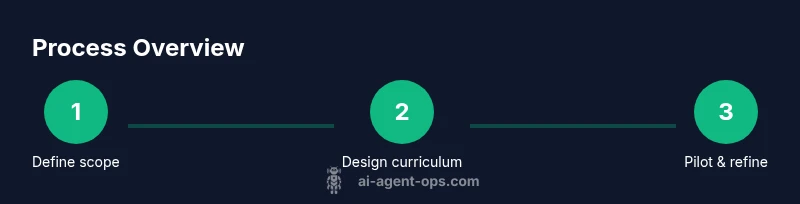
A practical launch plan emphasizes 3 parallel tracks: content development, platform readiness, and community building. Week 1–2: finalize scope, identify pilot participants, and draft learning outcomes. Week 3–6: develop modules, labs, and rubrics; configure hosting and access controls. Week 7–10: run a pilot, collect feedback, and iterate on content. Week 11–12: prepare marketing touchpoints, scale support, and establish ongoing governance. This roadmap provides a concrete path from concept to a live course, with room for iteration based on user feedback.
Tools & Materials
- Laptop or workstation with internet access(Modern browser, terminal access, and code editor)
- Code editor or IDE(VS Code, PyCharm, or equivalent)
- Access to a sandboxed AI platform(OpenAI, Vertex AI, or equivalent for experiments)
- Git / version control(For collaboration and versioning of labs)
- Cloud workspace or project repository(Shared workspace with access controls)
- Lab datasets or synthetic data generator(For hands-on labs and evaluation)
- Ethics and governance guidelines(Checklists and policy templates)
Steps
Estimated time: 8-12 weeks
- 1
Define scope and audience
Clarify who the course is for, what problems it solves, and what success looks like. Establish learning objectives that map to concrete tasks learners will perform with AI agents.
Tip: Align the scope with real-world workflows your audience already cares about. - 2
Map outcomes to milestones
Break learning goals into measurable milestones with clear evaluation criteria. Create rubrics for labs, code reviews, and final projects.
Tip: Use a lightweight scoring model so instructors can provide actionable feedback quickly. - 3
Design modular curriculum
Create foundational modules (agent basics, tool integration, safety) plus advanced modules (scaling, governance, deployment). Ensure each module builds on the previous one.
Tip: Prototype at least two modules before full-scale development. - 4
Set up environment templates
Provide starter templates for labs, agent skeletons, and evaluation harnesses. Document setup steps so learners can reproduce environments.
Tip: Include a one-click setup script to reduce onboarding friction. - 5
Create hands-on labs
Develop labs around real tasks, with synthetic data and sandboxed APIs. Each lab should culminate in a demonstrable artifact.
Tip: Pair labs with a minimal viable product narrative to boost motivation. - 6
Incorporate safety and governance
Embed guardrails, data privacy considerations, and auditing requirements into every lab. Teach risk assessment and escalation procedures.
Tip: Make governance decisions visible in lab artifacts (diagrams, notes, decisions). - 7
Pilot with a small cohort
Run a closed pilot with a representative user group. Collect structured feedback on content clarity, lab difficulty, and perceived impact.
Tip: Use a simple survey plus lab performance metrics for feedback. - 8
Iterate content based on feedback
Refine modules, rubrics, and labs. Update documentation and templates to address common pain points revealed by the pilot.
Tip: Keep a changelog and communicate updates to learners. - 9
Plan for scale and launch
Prepare marketing, onboarding, and support structures. Create governance playbooks to sustain the program as it grows.
Tip: Develop an instructor guide to enable rapid scaling across teams.
Questions & Answers
What is an AI agent course and why teach it now?
An AI agent course trains developers to design, implement, and deploy autonomous AI agents that execute tasks in real-world workflows. It covers fundamentals, tool integration, governance, and deployment considerations to ensure responsible, effective agent performance.
An AI agent course teaches developers to design and deploy autonomous AI agents with governance and safety in mind.
Do I need to be an AI expert to teach this course?
You should have a solid foundation in AI concepts, software development, and system design. The course can be designed for advanced beginners if you provide guided labs and extensive templates.
A solid software background helps, but you can scaffold toward beginners with clear labs and templates.
What prerequisites should learners have?
Learners typically benefit from basic programming knowledge, familiarity with APIs, and an understanding of data privacy concepts. Provide a pre-course primer to level-set expectations.
Basic programming and API familiarity help learners start strong, with a pre-course primer to fill gaps.
How should I assess learner progress?
Use a mix of labs, code reviews, and a capstone project. Rubrics should address correctness, robustness, user experience, and governance.
Combine labs, reviews, and a capstone with clear rubrics for each area.
What deployment challenges should learners know?
Expect challenges around data drift, tool compatibility, and security. Teach monitoring, escalation, and rollback procedures as part of the labs.
Be prepared for drift and tool changes; teach robust monitoring and rollback.
How long does it take to build such a course?
A practical course typically requires several weeks to months for content, labs, and pilots. Use a staged plan to minimize risk and accelerate time-to-launch.
Plan for several weeks to a few months, depending on depth and pilot scope.
Watch Video
Key Takeaways
- Define clear learning outcomes up front.
- Use modular, building-block curriculum design.
- Prioritize hands-on labs and real-world tasks.
- Pilot early and iterate based on structured feedback.
- Scale with templates, playbooks, and governance.