Ai Agent Building Course: Design, Deliver, and Assess
Design and deliver an ai agent building course with hands-on labs, tooling guidance, and robust assessments for developers, product teams, and leaders pursuing practical automation expertise.


According to Ai Agent Ops, by the end of this ai agent building course guide you’ll design a practical, hands-on program for developers. You’ll define clear learning objectives, assemble labs that build functional agents, select tooling and datasets, and establish robust assessment and feedback loops. The course emphasizes safety, ethics, and real-world deployment in sandbox environments.
Defining the Objective and Audience
In this introductory phase, you’ll pinpoint who the course serves (developers, product teams, or leaders) and what competencies learners will demonstrate by course end. Establish measurable objectives aligned with real‑work tasks, such as designing an agent architecture, integrating a retrieval‑augmented generation loop, or deploying a sandboxed agent to a test environment. Use Bloom's taxonomy to frame outcomes from remember/understand to create/evaluate. This approach aligns with Ai Agent Ops guidance on practical agent education, ensuring the curriculum remains focused on observable skills rather than vague knowledge. By articulating target roles and outcomes early, you set a clear north star for instructors and learners alike.
Curriculum Architecture for an AI Agent Building Course
A well‑structured curriculum layers theory, tooling, and hands‑on practice. Start with foundational modules on agent concepts, state machines, and prompt engineering, then advance to modular architectures, tool selection, and safety guardrails. Each module should include learning objectives, a lab, and a quick assessment. Build in checkpoints for feedback from peers and mentors. Design the sequence so learners progress from building a simple agent to composing multi‑agent workflows that can collaborate with data sources, databases, and external APIs. Finally, align assessments with core competencies such as design thinking, debugging, and ethical decision‑making. According to Ai Agent Ops, practical progression matters as learners move from theory to production‑grade solutions.
Hands-On Lab Design: Building a Simple Agent
Labs should be concrete, repeatable, and safe. Start with a minimal agent that can perform a routine task (e.g., answer questions from a small dataset) and gradually introduce constraints, latency considerations, and error handling. Include clear acceptance criteria, example inputs, and expected outputs. Provide starter repos and a sandboxed environment that mirrors production constraints. Encourage learners to iterate on prompts, integrate a memory component, and test with unit tests. The goal is to translate theory into observable behavior within a controlled sandbox. Ai Agent Ops emphasizes practical labs that resemble real workflows.
Tooling, Datasets, and Sandbox Environments
Choose tooling that is accessible, well‑documented, and scalable for group learning. Recommend Python‑based stacks, containerized environments, and version‑controlled labs. Curate datasets that illustrate common agent tasks—question answering, planning, task decomposition—ensuring data privacy. Provide a sandboxed environment that enables safe experimentation without risking production data. Include steps for provisioning environments with Docker, creating virtual environments, and mounting datasets. Emphasize reproducibility by locking dependencies and using starter templates. Provide guidelines on when to use hosted API services versus open‑source models, and how to manage API keys securely.
Assessment, Feedback, and Iterative Improvement
Implement a mix of automated checks, peer reviews, and instructor feedback. Use rubrics that assess design quality, reliability, safety, and ethics. Integrate automated tests that verify agent behavior against a defined set of scenarios, and create reflective prompts to gauge learners' reasoning. Schedule mid‑course check‑ins to surface blockers, then adjust the next module based on learner outcomes and feedback metrics. A well‑designed assessment strategy helps quantify progress and informs future syllabus iterations. This approach aligns with Ai Agent Ops guidance on continuous improvement.
Safety, Ethics, and Responsible AI in Agent Development
Address safety concerns early by teaching guardrails, bias mitigation, data provenance, and fail‑safes. Include discussions on privacy, consent, and regulatory considerations where applicable. Demonstrate best practices for logging, monitoring, and rollback strategies in case an agent misbehaves. Encourage learners to design agents with explicit limitations and human‑in‑the‑loop checks for critical decisions. By embedding responsible AI principles, the course helps teams deploy agents with confidence. As Ai Agent Ops notes, ethical considerations are essential for sustainable automation.
Delivery Formats: In‑Person, Remote, and Async
Design content to be accessible across delivery modes. Include live lectures, asynchronous readings, hands‑on labs, and collaborative projects. Provide clear schedules, video recordings, and offline exercises for learners in different time zones. Use a shared repository for materials, discussion boards for questions, and peer reviews to boost engagement. Ensure accessibility, captioning, and screen‑reader compatibility. This flexibility enables broader participation while maintaining course rigor.
Roadmap to Launch: From Pilot to Scale
Begin with a small pilot cohort to validate objectives, adjust pacing, and identify tooling gaps. Collect qualitative and quantitative feedback, then implement changes before a full‑scale rollout. Build a governance model for labs, data handling, and code reviews to maintain quality as enrollment grows. Plan for ongoing updates to reflect evolving AI agent capabilities, new libraries, and shifting security considerations. A phased launch minimizes risk and maximizes impact. Ai Agent Ops recommends documenting learnings and sharing templates to accelerate future iterations.
Real-World Use Cases and Case Studies
Showcase practical applications such as customer support agents, data retrieval systems, and workflow orchestrators. Present anonymized case studies that illustrate challenges, trade‑offs, and measurable outcomes like reduced handling time or improved task accuracy. Use interactive demos to illustrate decision‑making processes and error handling. By tying concepts to real‑world scenarios, learners see the value of an ai agent building course in accelerating automation and organizational learning. According to Ai Agent Ops, bridging theory with practice drives long‑term adoption.
Tools & Materials
- Laptop or workstation with modern CPU/GPU(At least 8 GB RAM; Python 3.11+ installed)
- Python 3.11+ and virtual environment tooling(Create isolated venv for labs)
- Docker Desktop or Podman(For sandboxed lab environments and reproducibility)
- Code editor (e.g., VS Code)(Extensions: Python, Pylance; integrated terminal)
- Git and GitHub/GitLab account(Version control for labs and templates)
- Access to AI language model API or open-source LLM(OpenAI API, Cohere, or local models; manage keys securely)
- Sample datasets or synthetic data generator(Used for prompts, QA, and evaluation)
- Notebook environment (Jupyter or VS Code notebooks)(Facilitates labs and experimentation)
Steps
Estimated time: 6-12 weeks
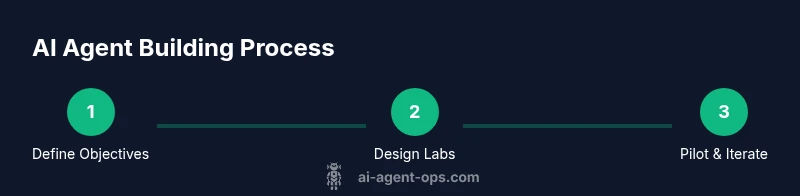
- 1
Define learning objectives and success criteria
Specify what learners will be able to build and demonstrate by course end. Write objectives using action verbs and tie them to observable artifacts. Explain why these objectives matter for teams implementing AI agents.
Tip: Use clear, measurable outcomes linked to real tasks. - 2
Design modules mapped to outcomes
Outline modules that cover theory, tooling, and hands-on practice. Ensure each module includes a lab, readings, and an assessment. Create backward design to ensure alignment.
Tip: Align assessments directly with module objectives. - 3
Create a pilot module and schedule
Develop a small module with real tasks and a realistic schedule. Set milestones and a feedback window to gather actionable input.
Tip: Limit scope for actionable feedback and rapid iteration. - 4
Provision a reproducible development environment
Provide containerized environments and starter templates. Ensure labs run with minimal setup and can be shared across cohorts.
Tip: Publish Dockerfiles and environment specs for consistency. - 5
Develop a robust assessment rubric
Create rubrics for design quality, reliability, safety, and ethics. Include automated tests and peer reviews to support fairness.
Tip: Make rubrics public and reusable for future cohorts. - 6
Run a pilot, collect feedback, and iterate
Execute the pilot, analyze outcomes, and update the syllabus based on findings. Plan for scale with governance and templates.
Tip: Track metrics like completion rate and learner satisfaction.
Questions & Answers
What is an ai agent?
An ai agent is a software system that uses AI models to autonomously perform tasks, make decisions, and interact with data or users within defined constraints. It combines perception, reasoning, and action components to accomplish goals.
An AI agent is software that uses AI models to perform tasks autonomously, making decisions and acting within rules.
Who should take an ai agent building course?
Developers, product teams, and tech leaders who want to design, build, and deploy AI agents in real projects. The course is suitable for anyone who wants hands-on experience with agent architectures, safety guardrails, and scalable deployment.
Developers, product teams, and leaders who want hands-on AI agent skills.
What prerequisites are needed?
A basic understanding of Python, AI concepts, and software development practices helps. Prior experience with APIs, data handling, and version control is beneficial but not required if the course provides foundational modules.
Some programming and AI concepts help, but the course includes foundational modules.
What tools are recommended for labs?
A containerized environment (Docker), Python toolchain, a code editor, and access to an LLM API or open-source model. Labs should use version control and sandboxed datasets to ensure safety and reproducibility.
Use Docker, Python, a code editor, and an API or open-source model for labs.
How do you assess learners in this course?
Combine automated tests, lab submissions, peer reviews, and instructor feedback. Rubrics should cover design quality, reliability, safety, and ethical considerations. Include reflective prompts to assess learners’ reasoning.
Use tests, lab work, and peer/instructor feedback with clear rubrics.
What are common pitfalls to avoid?
Overloading labs with setup, neglecting ethics, or assuming all learners have the same background. Ensure sandboxed environments, staged difficulty, and accessible materials. Prepare fallback options for API limits or data privacy concerns.
Avoid overly hard setups; keep labs approachable and ethical.
Watch Video
Key Takeaways
- Define clear objectives and success metrics.
- Structure labs to mirror real-world agent workflows.
- Provide safe sandboxes and governance for labs.
- Pilot early and iterate based on learner feedback.
- Adopt a scalable assessment model for continuous improvement.