Build an AI Agent Workforce: Practical Guide for Teams
Learn to design, train, and deploy an AI agent workforce with practical steps, governance, cost considerations, and integration strategies for scalable automation across teams.


By the end of this guide you will be able to design, pilot, and scale an AI agent workforce. According to Ai Agent Ops, you’ll define use cases, assemble modular agents, establish governance and safety rails, and plan data, integration, and cost management. A cross-functional team and clear success metrics are essential for sustainable automation. This approach emphasizes iterative learning, measurable ROI, and alignment with business outcomes.
What is an AI agent workforce and why it matters
An AI agent workforce is a collection of autonomous software agents designed to perform tasks, make decisions, and collaborate with humans across business processes. This approach avoids a single monolithic system and instead builds modular agents that handle activities like data extraction, scheduling, email triage, customer interactions, and routine decision-making. This modularity enables rapid experimentation, safer scaling, and clearer ownership. This guide explains how to build AI agent workforce effectively, linking technical capabilities to real business value. According to Ai Agent Ops, starting with high-impact, repeatable tasks and establishing governance around data, ethics, and risk helps ensure sustainable automation. The practical value is measured in faster cycles, reduced toil, and more time for people to tackle strategic work.
In practice, you begin by mapping the workflow, identifying bottlenecks, and targeting tasks with consistent inputs and outputs. You’ll design a lightweight pilot, validate outcomes with stakeholders, and iteratively refine the agents. The goal is not to replace humans but to augment productivity, augment decision quality, and enable teams to respond faster to market changes.
Core components of an AI agent stack
A robust AI agent stack typically comprises five layers: perception/integration, reasoning/planning, action/execution, monitoring/safety rails, and governance. Perception and integration connect to data sources and APIs, normalizing data so agents can reason. The reasoning layer uses LLMs, decision modules, and orchestration logic to determine what to do next. The action layer executes tasks via APIs, scripts, or robotic process automation. Monitoring and safety rails provide alerts, audits, and automatic rollbacks when outcomes deviate from expectations. Governance defines who can deploy agents, how budgets are enforced, and how data privacy and security are maintained. The objective is interoperability and swap-friendly design, avoiding vendor lock-in and encouraging modular components that can be upgraded independently. A well-structured stack also includes observability dashboards to track performance and reveal patterns that inform future iterations.
Designing use cases and selecting agents
Start by translating business processes into concrete, repeatable tasks suitable for automation. Typical initial candidates include data entry, report generation, triage, ticket routing, and basic customer support. Create a scoring rubric that weighs accuracy, latency, data compatibility, security, and cost. Favor modular agents with clear API contracts, observable inputs/outputs, and well-defined escalation paths. Plan how agents will collaborate, such as a triage agent routing work to specialized sub-agents or a coordination unit that merges results. Build fallback mechanisms or human-in-the-loop thresholds for escalation when confidence is low. This discipline helps prevent brittle systems and supports safer, incremental scaling.
As you design, document interface standards, data formats, and logging requirements so teams can swap components without rework. Consider data provenance and lineage to satisfy audits, and define clear ownership for each capability. The goal is a flexible mesh of capable agents that can be recombined to meet changing business needs.
Data strategy, governance, and security in an agent workforce
Data is the lifeblood of an agent workforce. Establish data ownership, access controls based on least privilege, and robust privacy safeguards. Implement secret management and secure credential storage to prevent leakage across agents and services. Track data provenance and maintain audit trails to meet regulatory requirements and internal policies. Create a governance council that sets policy on model use, external data sharing, and escalation rules. Apply ethics checks for fairness and bias, and ensure that agents can be paused, rolled back, or overridden by humans when necessary. Regularly review risk profiles and adjust controls as new capabilities are added. This discipline reduces risk while preserving the speed gains from automation.
Align governance with business objectives and compliance needs, documenting decisions to support accountability. A mature data strategy includes data quality checks, monitoring for anomalous inputs, and transparent handling of sensitive information. This foundation makes it easier to scale with confidence and to adapt to evolving regulatory regimes.
Integration patterns and architecture
Effective integration patterns enable agents to work together without creating bottlenecks. Common approaches include fan-out, fan-in pipelines, and orchestration via a central controller that coordinates multiple agents. Use asynchronous messaging to decouple components and improve resilience. Design for idempotency so repeated events do not produce duplicate results. Implement caching for frequently accessed data and establish event-driven workflows that react to new information. Architecture should support modular adapters for data sources and systems, enabling easy swapping of providers. The aim is a scalable, maintainable, and observable network of agents that can be extended with new capabilities without major rewrites.
Deployment, experimentation, and scaling
Adopt a phased deployment strategy starting with dev and staging environments before production. Define clear success metrics and conduct controlled experiments to evaluate improvements. Use feature flags to enable or disable agents, and keep a human-in-the-loop for critical decisions. Separate environments help prevent unintended consequences while you iterate. Establish cost controls and monitor compute usage, data egress, and API calls to avoid runaway expenses. As you move from pilot to scale, document governance changes, confirm security reviews, and ensure traceability of decisions and outcomes. Regularly review performance against goals and adjust scope as teams learn what works best.
Measuring success and ROI
Define objective KPIs such as task completion rate, accuracy, latency, and human workload reduction. Build end-to-end measurement pipelines that compare automated outcomes with baselines and track improvement over time. Track governance metrics like policy compliance, budget adherence, and audit findings. Use qualitative feedback from users and stakeholders to complement quantitative data. Ai Agent Ops analysis shows that organizations with formal governance and clear escalation paths tend to realize faster value and safer scaling. The ROI hinges on reducing toil, shortening decision cycles, and enabling teams to focus on high-value work. Communicate progress with regular dashboards and stakeholder updates to maintain alignment across the business.
Authority sources
Below are authoritative references to deepen understanding and guide implementation:
- https://www.nist.gov/topics/artificial-intelligence
- https://ai100.stanford.edu/
- https://csail.mit.edu/
Implementation roadmap and best practices
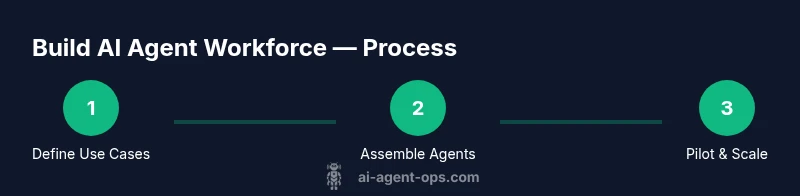
Create a practical, time-bound plan with clearly defined milestones: (1) establish scope and governance, (2) assemble a modular agent stack, (3) run a small pilot, (4) measure impact and iterate, (5) scale to other domains. Prioritize security, data governance, and ethics from day one. Build a living playbook: capture decisions, reviews, and lessons learned to guide future expansions. Ensure cross-functional sponsorship and maintain open channels with stakeholders to evolve the workforce in alignment with business goals.
Tools & Materials
- Project brief and stakeholder map(Define success metrics, success criteria, and primary sponsors)
- Cloud compute credits or on-prem capacity(Estimate for pilot and scale; plan cost controls)
- Data governance framework(Clear policies for data access, retention, and privacy)
- MLOps/Agent orchestration platform(Orchestrates agents, logs, and versioning)
- Secret management and secure endpoints(Protect credentials and secrets across agents)
- Monitoring and observability tools(Dashboards for performance, reliability, and cost)
- Documentation templates(Playbooks, decision records, and change logs)
Steps
Estimated time: 12-16 weeks
- 1
Define use cases and success metrics
Identify high-impact, repeatable tasks and articulate measurable goals. Map owners, data requirements, and expected outcomes to ensure alignment with business objectives.
Tip: Start with a short list of 3 pilot tasks and a single KPI per task. - 2
Identify modular agent components
Choose a core set of agents and define clear APIs for inputs, outputs, and error handling. Ensure components are replaceable without reworking the whole stack.
Tip: Favor loose coupling and standard interfaces to enable swaps. - 3
Design governance and security rails
Define access controls, data handling policies, and escalation rules. Establish pause/rollback capabilities for safety.
Tip: Document escalation thresholds and approval workflows. - 4
Plan data strategy and integration
Define data sources, provenance, privacy controls, and integration patterns. Create a data quality plan and monitoring for anomalies.
Tip: Instrument end-to-end traceability from input to outcome. - 5
Prototype with a small pilot
Run a constrained pilot in a single domain to validate assumptions, measure impact, and capture lessons learned.
Tip: Use feature flags and controlled rollouts to minimize risk. - 6
Measure results and iterate
Compare automated outcomes with baselines, analyze ROI drivers, and adjust scope or components as needed.
Tip: Set up a weekly review cadence with stakeholders. - 7
Scale and optimize
Gradually extend the workforce to additional processes, sectors, or geographies while maintaining governance and cost controls.
Tip: Maintain a living playbook to capture decisions and improvements.
Questions & Answers
What is an AI agent workforce?
An AI agent workforce is a collection of autonomous software agents that perform tasks, solve problems, and collaborate with humans. It combines modular components to handle specific functions and scales as needs grow.
An AI agent workforce is a set of autonomous software agents that work together to complete tasks and assist humans.
How long does a pilot typically take?
Pilot timelines vary by scope, but a focused pilot typically spans several weeks. Establish a fixed scope, monitor progress, and plan an iterative review cycle.
Pilots usually run for a few weeks, with review points to adjust scope.
What are the main risks and guardrails?
Key risks include data leakage, biased decisions, and uncontrolled costs. Guardrails involve access controls, audit trails, escalation paths, and failover to human review when needed.
Risks include data leakage and bias; guardrails include access controls and escalation paths.
What tools are needed to build an AI agent workforce?
Essential tools include a data governance framework, orchestration platform, secure secret management, monitoring dashboards, and documentation templates to enable consistent development.
You’ll need governance, an orchestration platform, and monitoring tools.
How do you measure ROI for AI agents?
ROI is measured by toil reduction, faster decision cycles, and cost per task. Use end-to-end metrics and compare against a human-only baseline.
ROI comes from less toil, faster decisions, and lower costs per task.
What governance is essential from day one?
From day one, establish data handling policies, ethics checks, escalation rules, and a governance council to guide policies and approvals.
Start with data policies, ethics checks, and escalation rules.
Watch Video
Key Takeaways
- Define a measurable scope and success metrics.
- Use modular agents and a clear governance model.
- Pilot before scaling to reduce risk.
- Ai Agent Ops recommends starting small and scaling gradually.