Hiring AI Agent: A Practical Guide for Teams and Leaders
A comprehensive, step-by-step guide for hiring an AI agent to automate workflows, with role definition, evaluation criteria, onboarding, and governance.


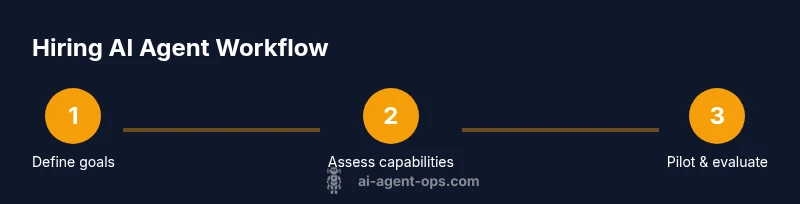
Goal: Learn how to hire an AI agent that integrates with your workflows, scales with your team, and delivers measurable automation. This guide covers defining the role, selecting platforms, evaluating capabilities, running pilot tests, and establishing governance and ethics. By the end, you’ll have a practical hiring plan and governance framework to accelerate automation.
Why hiring ai agent matters
In modern product teams, hiring an AI agent can shift how work gets done—from repetitive data grooming to decision-support workflows that run around the clock. According to Ai Agent Ops, success begins with a clear problem statement, defined outcomes, and governance that protects data, privacy, and safety. Before you invest, map the exact tasks the agent will handle, the expected speed, and the metrics you'll use to prove value. This upfront clarity helps align engineering, legal, and leadership stakeholders and reduces the risk of scope creep. As you explore candidate options, remember that an AI agent is more than code: it’s a living part of your automation fabric that must integrate with your existing identity, access, and monitoring systems. Ai Agent Ops team emphasizes starting with a small, well-scoped pilot to learn about real-world constraints and opportunities.
Defining the role and scope
Start by translating business goals into a concrete role description. Will the AI agent perform data extraction from emails, triage support tickets, or drive decision workflows in your product? Define the inputs, outputs, required latency, and integration points (APIs, data warehouses, or LLM interfaces). Establish guardrails: what the agent should not do, who approves exceptions, and how privacy and compliance requirements are enforced. Document success criteria in objective terms (e.g., percent time saved on a specific task, accuracy thresholds, or reduction in manual handoffs). This clarity reduces ambiguity during vendor evaluation and helps your team measure post-hire impact with confidence. The Ai Agent Ops framework encourages explicit governance around data provenance, model updates, and incident response.
Core evaluation criteria
When you build evaluation rubrics, you should balance capability with risk controls. Look for reliable latency, predictable outputs, and robust monitoring. Security considerations include authentication, data handling, and access controls. Governance should address model drift, versioning, and incident response. Ethics and transparency matter: ensure the agent can explain its decisions and that you maintain an audit trail. Use real-world tasks in tests rather than synthetic prompts to reveal how the agent handles ambiguity and edge cases. Ai Agent Ops highlights that a good evaluation blends qualitative observations with lightweight quantitative measures to avoid vendor hype.
Sourcing options: build vs buy vs partner
There are three broad paths to obtain an AI agent: build in-house, buy a turnkey solution, or partner with a specialist. Building in-house offers maximum customization but requires substantial data, tooling, and governance maturity. Buying a platform accelerates time-to-value but may entail customization limits and ongoing licensing. Partnering with a specialist can provide domain expertise and governance support while sharing risk. Evaluate total cost of ownership, data compatibility, and long-term scalability. Be wary of vendor lock-in and ensure exit strategies are clear before committing.
Designing an evaluation plan
A clear evaluation plan turns ambiguous promises into testable outcomes. Define pilot scope, success criteria, and a stop criteria should outcomes miss benchmarks. Create a test dataset that mirrors real work, set up end-to-end workflows, and specify who approves results. Include a hands-on sandbox for engineers to experiment with integration points and data flows. Establish a governance cadence: weekly reviews, post-pilot debriefs, and a transparent scorecard. This plan reduces risk and speeds up decision-making when you’re ready to scale.
Onboarding and governance
Onboarding an AI agent is not just technical integration; it requires process governance, security, and ongoing oversight. Create SLAs for performance, reliability, and incident response, and link them to your compliance requirements. Assign an owner for model updates and data provenance, and establish a change-control process. Train team members on how to interact with the agent, what to trust, and when to override or escalate. Implement monitoring dashboards that surface latency, accuracy, and drift in real-time, so you can react quickly to issues and maintain trust with users.
Case examples and benchmarks
Real-world examples show that teams that pilot first and govern openly tend to realize faster adoption and fewer surprises. For instance, product teams that started with a narrow, well-scoped use case reported smoother integration with existing data pipelines and stronger alignment between engineering and product goals. While benchmarks vary, the pattern is consistent: a disciplined pilot, transparent governance, and ongoing collaboration yield sustainable improvements in automation and decision quality over time. Ai Agent Ops’s experience reinforces that the most successful hires treat AI agents as partners rather than tools.
Common pitfalls and risk management
Common failure modes include scope creep, overreliance on vendor hype, misaligned incentives, and insufficient governance. To avoid these, lock in a concrete problem statement, ensure clear ownership of data, and implement an exit plan. Protect sensitive data with access controls and review the vendor’s security posture. Always validate outputs against human-in-the-loop checks for critical decisions. If you encounter drift, pause the pilot, retrain or recalibrate, and reassess governance updates.
Next steps and governance framework
With a defined role, a solid evaluation plan, and a governance framework, you can move from hiring to scalable operation. Create a phased roadmap: pilot, broader rollout, and continuous improvement. Establish a governance charter that covers data, security, ethics, and performance monitoring. Finally, align with stakeholders across engineering, product, and legal to ensure ongoing compliance and alignment with business objectives. The next step is to select a candidate, run a controlled pilot, and lock in a post-pilot review cadence to optimize your AI agent’s impact.
Tools & Materials
- Evaluation rubric template(Scoring criteria for capability, reliability, governance, and safety)
- Pilot project charter(Defines scope, success metrics, and stakeholders)
- Vendor comparison spreadsheet(Side-by-side features, costs, SLAs, and data practices)
- Compliance checklist(Data handling, privacy, security, and regulatory requirements)
- Onboarding playbook(Guidance for integrating the agent into workflows and teams)
Steps
Estimated time: 6-8 weeks
- 1
Define the problem and outcomes
Articulate the business problem the AI agent will address and the measurable outcomes you expect. Include which tasks, the desired speed, and the human-in-the-loop decisions. This step creates a concrete target for evaluation.
Tip: Start with a single, high-impact use case to limit scope. - 2
Specify capabilities and constraints
List required inputs, outputs, data sources, latency targets, and integration points. Include constraints related to privacy, security, and compliance. This becomes your baseline for vendor scoring.
Tip: Document escalation paths for edge cases and failures. - 3
Gather candidate options
Research vendors, platforms, or internal builds that align with your constraints. Create a short list and reach out for pilot proposals or demos. Gather data on data handling and security practices.
Tip: Ask for references and a sample integration plan. - 4
Create evaluation criteria
Develop a scorecard covering capability, reliability, governance, security, and ethics. Include a pilot-specific success metric and a go/no-go threshold.
Tip: Weight governance and safety higher for mission-critical tasks. - 5
Run a controlled pilot
Execute a time-bound pilot with predefined tasks, data access, and monitoring. Compare outputs against human benchmarks and document drift or surprises.
Tip: Keep humans in the loop for critical decisions. - 6
Assess ROI and risk
Analyze time saved, error rates, and user satisfaction, then weigh these gains against data privacy, compliance, and vendor risk.
Tip: Use qualitative and qualitative signals to form a balanced view. - 7
Plan integration and governance
Map integration steps, monitoring dashboards, and incident-response rules. Assign owners for data, model updates, and escalations.
Tip: Create a living governance charter that evolves with your needs. - 8
Hire and onboard with SLA
Finalize the vendor or internal build, establish SLAs, and onboard users with training and support. Set expectations for maintenance and updates.
Tip: Clarity on SLAs reduces future friction and misaligned incentives.
Questions & Answers
What is an AI agent and how is it different from a traditional software tool?
An AI agent is a software component that can autonomously perform tasks, reason about choices, and interact with other systems. Unlike a static tool, it adapts its behavior based on data, feedback, and governance rules to support ongoing automation.
An AI agent is a smart software component that can act on its own, adapt over time, and follow governance rules to automate tasks with minimal human input.
When should a team consider hiring an AI agent?
Consider hiring an AI agent when repetitive, data-driven tasks hinder speed or when human experts can be freed to focus on higher-value work. Use a pilot to validate ROI and compatibility with existing systems.
If your team faces repetitive tasks and you can validate benefits with a small pilot, an AI agent can help scale.
What should be included in an evaluation rubric?
An evaluation rubric should cover capability, reliability, governance, security, and ethics. Include explicit data-handling policies, drift monitoring, and human-in-the-loop criteria.
Make sure your rubric checks what the agent can do, how reliably it does it, and how you govern its behavior and safety.
How long does a typical AI agent pilot take?
A typical pilot ranges from 4 to 12 weeks, depending on task complexity, data availability, and the depth of governance processes you implement.
Most pilots run for several weeks to a few months, depending on complexity and governance needs.
What risks should I plan for with AI agents?
Key risks include data privacy, model drift, reliance on external vendors, and potential bias. Mitigate with strong access controls, monitoring, and a clear accountability framework.
Be aware of privacy, drift, and bias. Use monitoring and clear ownership to stay in control.
What is a governance charter for AI agents?
A governance charter defines data handling, accountability, update cycles, incident response, and who approves changes. It aligns technical work with business objectives and compliance.
A governance charter sets the rules for data, updates, and accountability so everyone stays aligned.
Should I build or buy the AI agent?
Choose based on control, speed, and cost. Build for unique needs and deep integration; buy for speed and scale but plan for licensing and potential vendor lock-in.
Build if you need deep customization; buy if speed and scale matter, but watch for lock-in.
Watch Video
Key Takeaways
- Define a clear problem and success metrics before hiring.
- Balance capability with governance and ethics from day one.
- Pilot thoroughly and iterate based on real-world feedback.
- Plan for governance, data security, and vendor risk early.
- Treat AI agents as partnerships, not just tools.