How to Hire AI Agent Developers for Smarter Automation
Learn how to hire ai agent developers who can design, build, and govern agentic AI workflows. This guide covers roles, evaluation, sourcing, onboarding, governance, and ROI considerations for 2026.


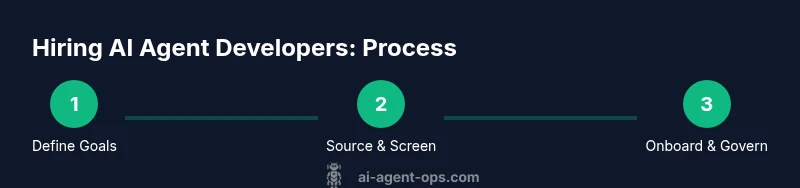
Goal: You will be able to hire AI agent developers who can design, build, and maintain agentic AI workflows. This guide covers defining outcomes, sourcing candidates, evaluating skills (LLMs, agent orchestration, tool use), negotiating contracts, and onboarding for fast ramp-up. According to Ai Agent Ops, successful teams align governance with product strategy and ensure measurable ROI when you hire ai agent developers.
Why hiring ai agent developers matters
In 2026, the operating reality for product teams and enterprises is increasingly defined by agentic AI workflows that automate decision making, tool use, and multi-step tasks. Hiring experienced ai agent developers lets you move from proof-of-concept pilots to scalable, reliable automation that interoperates with your data sources, APIs, and business rules. The Ai Agent Ops team has seen that organizations with clearly scoped agent projects ship features faster, with fewer rework cycles, and with clearer governance. When you hire ai agent developers, you gain specialists who understand how to balance autonomy with oversight, ensure safety, and drive measurable outcomes across domains like customer support, workflow automation, and data processing.
Key takeaway: skilled developers translate abstract agent concepts into production-ready pipelines, keeping speed and reliability in balance.
Essential skills and roles for AI agent developers
Successful ai agent developers combine deep software engineering with specialized knowledge of agentic AI principles. Look for capabilities in: (a) agent orchestration and tool use across multiple APIs; (b) memory management and state handling for long-running goals; (c) robust error handling and fallback strategies; (d) security, privacy, and data governance; (e) testing strategies for prompt engineering and tool reliability; and (f) observability, monitoring, and metrics to prove ROI. Roles often span two tracks: core engineering (integration, scalability, deployment) and product coaching (defining outcomes, risk management, and governance). When hiring, assess prototypes or portfolios that demonstrate end-to-end agent workflows, not just code snippets. This alignment matters because the most successful teams build reusable patterns and governance hooks that scale.
Ai Agent Ops emphasizes looking for demonstrable experience with edge cases like tool latency, partial failures, and hot-swapping providers, which often determine production reliability.
Crafting a compelling job description to attract top talent
A winning JD for ai agent developers should clearly describe the problem space, expected outcomes, and collaboration model. Start with a concise summary of the agent use case (for example, order routing via an intelligent agent that coordinates between CRM, ERP, and a special data store). List required skills (LLMs, tool-competent, API integration, and security), plus preferred experience in agent orchestration frameworks. Include concrete projects candidates can reference, such as past agent-based automation or decision-reasoning challenges. Also define governance expectations (safety reviews, logging, and compliance) and the expected collaboration with product, data, and security teams. Finally, specify engagement model (full-time, contract, or fractional) and growth opportunities. A focused JD helps you filter noise and identify candidates who can quickly align with your business objectives.
Remember to embed the keyword hire ai agent developers in a natural way to reinforce the search intent and improve discoverability.
Sourcing channels and how to screen candidates
Sourcing ai agent developers requires a mix of active and passive recruiting, plus targeted outreach to communities where agentic AI work is discussed. Prioritize platforms that host AI-focused engineers, machine learning researchers, and experienced software engineers who have shipped agent-based projects. Screening should combine portfolio review with live assessments and structured interviews. Capture evidence of: (1) system design for agent orchestration, (2) robust testing methodologies for prompts and tools, (3) security practices around data handling, and (4) evaluation of trade-offs between autonomy and control. Use structured rubrics to compare candidates and avoid biases. As Ai Agent Ops notes, hiring decisions are strongest when you pair technical tests with governance discussions to surface alignment with your organization’s risk posture.
Hands-on evaluation tasks you can use
Practical tests are essential for assessing a candidate’s readiness to deliver real-world agent workloads. A strong task might require building a simple agent that uses a tool (e.g., a weather service) to fetch data, reason about responses, and respond to prompts with correct formatting. Include constraints such as latency targets, fallback behavior, and logging requirements. Provide sample prompts and ensure the task ends with a concise, testable deliverable (code, tests, and a brief design note). This helps you compare approaches and surface differences in approach, robustness, and documentation. Always pair the task with a security and privacy review checklist to gauge safe design choices.
Contracting models and onboarding plans
Engagement models vary from full-time hires to contractors and fractional contributors. For ai agent developers, clear onboarding is critical because agent systems cross product boundaries. A strong onboarding plan includes access control setup, sandbox environments, architecture overview, and a starter project with defined milestones. Craft a ramp-up plan that includes governance training, security briefings, and access to code reviews. Align compensation and incentives with project outcomes while maintaining clarity about IP rights and confidentiality. By designing onboarding with governance in mind, you reduce risk and accelerate value creation.
Governance, security, and ethics in agent workflows
Governance for agentic AI is foundational. You’ll want to establish data handling rules, audit trails, prompt containment strategies, and monitoring dashboards. Ensure your hires understand privacy requirements, compliance standards, and risk mitigation techniques. Build a review cadence for model updates and tool changes, and implement guardrails to prevent unintended actions. The Ai Agent Ops team emphasizes documenting decision processes and safety constraints in a living artifact that grows with your product.
Also consider external guidelines and industry standards for AI safety and security, including review of access controls, data minimization, and transparent accountability. A proactive governance approach helps you avoid regulatory surprises and keeps product goals aligned with user trust.
Real-world use cases and ROI considerations
Real-world use cases for AI agents range from customer support automation to complex internal workflows that coordinate multiple systems. When you hire ai agent developers, define measurable outcomes such as reduced cycle time, increased first-contact resolution, or improved data quality. ROI is influenced by how quickly you can deploy reliable agents, the ease of extending capabilities, and your ability to monitor and improve. Ai Agent Ops analysis shows that teams with strong governance, robust testing, and clear success metrics tend to outperform those who treat agent projects as experimental add-ons. Use a living metrics plan that captures speed, reliability, and business impact.
Common pitfalls and guardrails to avoid
Common pitfalls include over-automation without guardrails, underestimating the importance of data governance, and treating agent developers as a black box. Guardrails include explicit failure modes, observational logging, and verifiable safety constraints. Ensure you have a robust review process for tool selections, prompt changes, and data flows. Align incentives with responsible AI use, not just speed. The Ai Agent Ops team would recommend prioritizing auditable processes, incremental rollouts, and clear ownership for every agent-based capability to prevent drift and maintain quality.
Tools & Materials
- Laptop or workstation with modern IDE(For local development, debugging, and code reviews)
- Access to code repositories and project management(GitHub/GitLab, Jira/GitFlow for workflow)
- Dedicated sandbox/development environment(Isolated environment to test agent interactions safely)
- Sample data and evaluation prompts(Synthetic datasets and prompts for hands-on tests)
- Contract templates and NDA(Standard agreements to protect IP and data)
- Security and governance guidelines(Documented policies for data handling and access)
- References materials (API docs, datasheets)(Optional but helpful for familiarization)
Steps
Estimated time: 4-6 weeks
- 1
Define outcomes
Clarify the business problem you want the AI agent to solve and set measurable goals. Identify the systems the agent will interact with and the desired user experience. Document success criteria and risk boundaries to guide later decisions.
Tip: Start with 2-3 concrete use cases and a go/no-go decision checklist. - 2
Map required capabilities
List the technical capabilities the role must have, such as tool use, API integration, prompt engineering, and monitoring. Define the level of autonomy vs. human oversight needed for each capability.
Tip: Prioritize capabilities that unlock the most business value first. - 3
Draft the job description
Write a focused JD that highlights agent orchestration skills, security practices, and past agent-based projects. Include governance expectations and the collaboration model with product and security teams.
Tip: Attach a sample task and a short portfolio brief to attract relevant candidates. - 4
Choose hiring model
Decide between full-time, contract, or fractional engagement based on project scope, risk tolerance, and budget. Document IP rights, data ownership, and confidentiality terms.
Tip: For early pilots, start with a contract or fractional hire to test fit. - 5
Source candidates
Leverage AI-focused communities, engineering networks, and specialized agencies. Use targeted outreach that highlights your agent use cases and governance posture.
Tip: Ask for a portfolio of agent-based projects and a short design proposal. - 6
Run a hands-on evaluation
Provide a realistic task where the candidate builds a small agent workflow end-to-end. Include tool usage, logging, and a security review.
Tip: Pair the task with a live code review to surface reasoning and approach. - 7
Conduct interviews
Assess problem-solving, collaboration, and adherence to governance. Use behavioral questions tied to your risk framework and a technical panel for fairness.
Tip: Use a standardized rubric to compare candidates objectively. - 8
Onboard and govern
Provide onboarding with architecture context, access controls, and a starter project with milestones. Establish monitoring dashboards and review cadences from day one.
Tip: Set up a governance guardrail review in the first 30 days. - 9
Measure and iterate
Track progress against success criteria, collect feedback, and adjust goals or scope as needed. Plan for ongoing maintenance, testing, and upgrades.
Tip: Create a 90-day review plan to show tangible progress.
Questions & Answers
What is an AI agent developer?
An AI agent developer designs and builds software agents that autonomously perform tasks by interacting with tools, data sources, and APIs. They focus on orchestration, reliability, and governance to deliver production-ready agent workflows.
An AI agent developer builds autonomous software agents that work with your data and tools, with a focus on reliability and governance.
What qualifications are essential to hire ai agent developers?
Essential qualifications include strong software engineering skills, experience with LLMs and tool use, familiarity with agent orchestration patterns, and a demonstrated ability to design secure, auditable workflows. Portfolio projects should show end-to-end agent implementations.
Look for strong software engineering, experience with LLMs and tools, and projects showing end-to-end agent workflows.
How long does the hiring process typically take?
The timeline varies by engagement model and scope, but a structured process from defining outcomes to onboarding usually spans several weeks. A clear evaluation task and governance alignment can accelerate decision-making.
Typically several weeks; a clear evaluation and governance plan helps speed things up.
How do I ensure governance and security with AI agents?
Establish guardrails, audit trails, data handling policies, and a review cadence for prompts and tool usage. Ensure access control and regular security assessments are part of the onboarding process.
Set guardrails, audits, data rules, and regular security checks as part of onboarding.
Full-time vs contract: which is better for AI agents?
Full-time hires work well for long-term agent initiatives with ongoing governance needs; contracts can be ideal for pilots or specialized sprints. Align the model with project goals, budget, and risk tolerance.
Choose full-time for long-term work or contract for pilots; align with goals and budget.
What metrics should I track for agent initiatives?
Track throughput, reliability, latency, error rates, and user impact. Establish baseline measurements and a plan to review metrics regularly to demonstrate value.
Monitor throughput, reliability, latency, and user impact on an ongoing basis.
Watch Video
Key Takeaways
- Define concrete agent goals first.
- Balance autonomy with governance from day one.
- Use hands-on tests to prove real-world capability.
- Governance and security are foundational, not afterthoughts.