Hire an AI Agent: A Practical Step-by-Step Guide
Discover a practical, step-by-step approach to hire ai agent that fits your team, data, and governance needs. Compare vendors, run pilots, and scale safely with governance-backed planning.


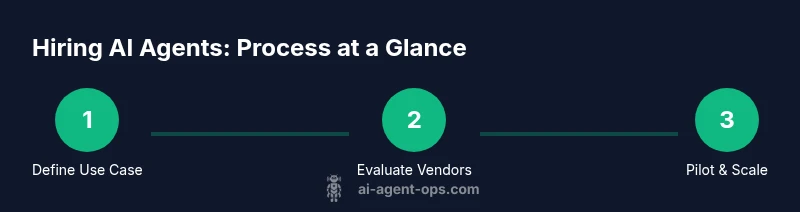
To hire ai agent, define the use case, scope, and success metrics; evaluate vendors or open-source options; run a controlled pilot; integrate with governance and security policies; and plan onboarding with clear ownership. According to Ai Agent Ops, a phased, risk-aware approach reduces misalignment and speeds value realization.
How to hire ai agent: overview
Hiring an AI agent is about more than selecting a tool. It requires aligning the agent's capabilities with concrete business use cases, setting measurable success criteria, and building governance around data, security, and ethics. This approach helps teams avoid scope creep and ensure the agent can operate within existing workflows. By treating the hire as a product initiative, you create clear owner accountability, milestones, and a plan for integration with the rest of your tech stack. The goal is to enable faster, smarter decision-making without sacrificing governance or user trust.
Key decision factors when hiring ai agent
When evaluating whether to hire ai agent, you need to consider multiple factors beyond raw capability. First, align the agent's task scope with measurable outcomes—what problem is it solving, and how will you quantify success? Second, assess data access and privacy constraints: what data is needed, who can access it, and how will it be secured? Third, examine governance features such as audit trails, explainability, and override mechanisms. Fourth, consider integration points with existing systems (CRM, ERP, data warehouses) and the required latency. Finally, compare pricing models, support levels, and vendor roadmaps to ensure long-term viability for your team.
Sourcing options: vendors, platforms, or in-house
There are three primary routes to hire ai agent: vendor-backed turnkey solutions, platform-based agents that you customize, or in-house development with an agent framework. Vendors offer faster time-to-value with support and SLAs, but less customization. Platform approaches provide flexibility with modular components; they require more integration work. In-house development offers maximum control and privacy but demands significant talent and governance. Ai Agent Ops emphasizes evaluating trade-offs against your strategic priorities and data governance requirements.
Evaluation framework: how to assess candidates and vendors
Create a standardized evaluation rubric that captures technical fit, data alignment, governance readiness, and total cost of ownership. Use scoring sheets that rate capabilities like natural language understanding, memory and context handling, safety controls, and monitoring dashboards. Include a live demo or sandbox environment to test real workflows with representative data. Finally, check for security certifications, data residency options, and your organization’s compliance requirements.
Data privacy, security, and compliance considerations
Security and privacy are foundational when hiring ai agent. Ensure data minimization: only the data necessary for the task is exposed to the agent. Enforce strong access controls, encryption at rest and in transit, and robust incident response plans. Require vendors to provide audit logs, change control processes, and clear data ownership terms. Align with applicable regulations (e.g., data protection laws, industry-specific standards) and define a formal data governance policy before deployment.
Onboarding, governance, and workflow integration
Onboarding should start with a pilot that targets a narrow workflow and includes clear ownership, success criteria, and fallback plans. Establish governance by defining decision rights, monitoring strategies, and escalation paths. Integrate the AI agent with existing tools using open APIs and secure data pipelines. Document responsibilities for model updates, data stewardship, and incident handling to prevent drift and ensure accountability.
Pilot programs and phased scaling strategy
A phased pilot lets you validate value while controlling risk. Start with a single, well-scoped use case, monitor performance, and gather user feedback. Use iterative sprints to refine prompts, data flows, and guardrails. As confidence grows, broaden scope and increase governance checks, ensuring that scaling preserves reliability, security, and user trust.
Tools & Materials
- Job description template for AI agent roles(Include expectations, metrics, and security/compliance requirements)
- Vendor evaluation scorecard(Categories: capability, data governance, security, price, road map)
- Data access and security policy(Define data inputs, access controls, and retention rules)
- Pilot plan template(Describe use case, success metrics, timeline, and rollback plan)
- Contract and SLA templates(Templates for vendor agreements and service levels)
- Governance and ethics checklist(Include bias checks, explainability, and auditability criteria)
Steps
Estimated time: 3-6 weeks
- 1
Define use case and success metrics
Articulate the specific business problem the AI agent will address and establish measurable outcomes. Create a status quo baseline and target KPIs to track value over time.
Tip: Start with a narrowly scoped use case to minimize risk during early validation. - 2
Map data sources and governance constraints
Identify required data inputs, access permissions, and privacy constraints. Establish data handling rules, retention timelines, and auditability requirements.
Tip: Draft a data flow diagram to visualize how data moves through the agent. - 3
Shortlist vendors and request demos
Create a comparison list and gather live demonstrations with representative data. Assess how each option handles your use case and governance needs.
Tip: Ask for reference customers in your industry to gauge real-world performance. - 4
Run a controlled pilot with guardrails
Deploy the agent in a safe, limited environment. Monitor outputs, collect user feedback, and establish rollback criteria in case of failures.
Tip: Define explicit override and containment mechanisms for unsafe behavior. - 5
Define integration architecture and deployment plan
Map integration points with your data systems and apps. Decide on deployment model (cloud, on-prem, or hybrid) and set up monitoring dashboards.
Tip: Use standardized APIs and documented data contracts to simplify future updates. - 6
Monitor, iterate, and scale responsibly
Review performance against metrics, adjust prompts, and refine data pipelines. Expand scope only after meeting governance and security thresholds.
Tip: Schedule regular governance reviews to prevent drift and ensure accountability.
Questions & Answers
What is an AI agent and how does it differ from traditional automation?
An AI agent acts autonomously in decision-making and can adapt to changing contexts, whereas traditional automation follows static, pre-defined rules. AI agents rely on machine learning, natural language understanding, and decision policies to perform tasks with less human intervention.
An AI agent can make decisions and adjust to new situations, unlike fixed-rule automation that always does the same thing.
How long does it typically take to hire an AI agent?
The timeline depends on scope and governance maturity. A well-scoped project with a pilot can be completed in a few weeks to months, while larger programs may require longer planning and integration.
Timelines vary with scope and governance readiness; start with a focused pilot before broader rollout.
What costs are involved in hiring an AI agent?
Costs vary by vendor model, data needs, and support. Consider upfront setup, ongoing usage, data processing, and governance-related expenses rather than only software license fees.
Expect a mix of setup, usage, and governance-related costs; plan for ongoing investment.
What governance and security considerations are essential?
Define access controls, data retention, auditability, and risk management policies. Ensure third-party security certifications and clear incident response plans are in place before deployment.
Set up strict access controls and audit trails, with clear incident response plans.
Should I build my own agent or buy a turnkey solution?
It depends on control needs, data sensitivity, and time to value. Turnkey solutions offer speed and support, while in-house builds provide maximum customization and privacy.
Choose based on control needs, data sensitivity, and how quickly you need value.
Watch Video
Key Takeaways
- Define clear use cases and success metrics.
- Evaluate data governance and security upfront.
- Pilot with guardrails before scaling.
- Choose a phased, governance-first hiring approach.
- The Ai Agent Ops team recommends a structured, risk-aware strategy.