Recruiting AI Agents: A Practical How-To
Learn a step-by-step approach to recruiting AI agents, evaluating pilots, and onboarding responsibly. Ai Agent Ops guides developers and leaders through governance, metrics, and integration for agentic workflows.


According to Ai Agent Ops, recruiting an AI agent begins with clear goals, governance, and a measurable pilot. This quick answer previews 6 essential steps to source, test, and onboard an AI agent that aligns with your product needs, data policies, and team workflows. You’ll learn how to define success metrics, choose candidate approaches (LLM-based vs rule-based hybrids), run pilot tasks, and set up ongoing monitoring.
What is recruiting ai agent?
Recruiting an AI agent means identifying, evaluating, and integrating an autonomous software construct that can act on your behalf to perform tasks, make decisions, or augment human work. This process blends talent acquisition with agent design, because the ‘candidate’ is not a human alone but a software system or composite that can learn, adapt, and operate in your environment. When recruiters talk about AI agents, they mean curated agentic workflows—systems that can perceive inputs, reason, and act with governance controls. For teams, the core goal is to pair a capable agent with clear objectives, safe data access, and measurable outcomes. In practical terms, recruiting ai agent is about choosing a tested architecture, an appropriate governance model, and a pilot plan that proves value before full-scale deployment.
This article emphasizes a practical, pragmatic approach rather than speculative hype. It aligns with the emphasis Ai Agent Ops places on real-world guidance for developers, product teams, and business leaders exploring AI agents and agentic AI workflows.
Why recruiting ai agent matters for modern teams
AI agents can dramatically accelerate decision cycles, automate repetitive tasks, and unlock new capabilities at scale. When done well, recruitment of an AI agent complements human expertise, reduces time-to-value, and improves consistency across workflows. Yet poor selection or weak governance can introduce data risks, legal concerns, and brittle performance. The recruitment process should therefore balance capability with safety, maintainability, and clear accountability. Ai Agent Ops notes that a well-executed recruiting effort produces a repeatable process—one you can adapt as technologies evolve and as your team’s needs shift. This is not a one-off hire; it’s a governance-aware architecture decision that shapes your automation strategy.
Defining success criteria for AI agents
Before you recruit, define what success looks like for the agent within your use case. Establish quantitative metrics (e.g., task completion rate, latency, error rate, data leakage incidents) and qualitative indicators (e.g., user satisfaction, explainability, auditability). Map each criterion to a pilot task and a decision threshold. Consider governance requirements such as access control, data minimization, and compliance with internal policies. In practice, success criteria for the recruiter should be explicit and testable, ensuring you can demonstrate ROI and risk posture over time. As you craft criteria, keep in mind the need for transparency and reproducibility in agent decisions.
Sourcing candidates: where and how
Candidate sources for AI agents range from platform vendors offering managed agents to in-house solutions built by your team. Decide whether you want a turnkey LLM-based agent, a hybrid system, or an entirely custom agent built around your data and workflows. Start with a bias-aware sourcing plan that includes vendors, open-source options, and internal prototypes. When evaluating external candidates, request reproducible pilot tasks and code or configuration access to review architecture, data handling, and safety controls. If you’re developing in-house, outline a rigorous development and testing plan, including version control, experiment tracking, and blue/green deployment strategies. The recruitment approach should align with your organization’s risk tolerance and architectural goals.
Evaluation frameworks and pilot tasks
A robust evaluation framework translates specifications into observable outcomes. Design pilot tasks that mimic real-world scenarios and require the agent to perform end-to-end tasks with measurable outputs. Include failure modes to test how the agent handles unexpected inputs, data privacy constraints, and escalation rules. Scenarios should test integration with other systems, such as CRM, data stores, or workflow orchestration layers. Use rubrics to score performance on accuracy, reliability, latency, safety, and explainability. Ensure pilots have a clear start and end, with success criteria that are easy to communicate to stakeholders. This stage is where you build confidence in the agent’s ability to deliver value at scale.
Onboarding, governance, and integration
Onboarding an AI agent requires more than giving it access to data. It demands a governance framework that documents ownership, decision rights, monitoring, and risk controls. Define data access policies, audit trails, and incident response procedures. Plan for ongoing monitoring, retraining needs, and version updates. Integration considerations include compatibility with existing tools, API contracts, and observability pipelines. Establish a rollout plan with staged exposure, rollback options, and containment measures for potential failures. A well-governed onboarding process reduces operational risk and accelerates adoption across teams.
Common challenges and risk management
Recruiting ai agent comes with risks: data leakage, misaligned incentives, overfitting to pilot data, and brittle behavior in production. To mitigate these, implement strict data governance, sandboxed environments, and explicit escalation rules. Beware biases in data or in the agent’s training prompts, and build explainability into decision paths. Plan for security reviews, vulnerability assessments, and compliance checks. Regularly revisit performance against your success criteria and adapt the pilot plan as needed. Proactively addressing these risks helps ensure long-term value rather than short-term wins.
Example workflow: from hiring to deployment
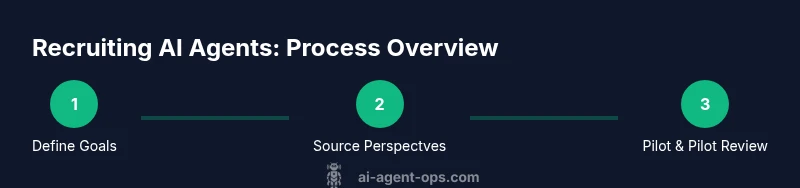
A practical workflow starts with defining goals and success metrics, followed by sourcing candidates, launching pilots, evaluating outcomes, and finalizing governance. During pilots, document environment configurations, data access scopes, and monitoring dashboards. If a candidate meets criteria, proceed to a staged rollout with guardrails and rollback strategies. Throughout, maintain artifacts: architecture diagrams, pilot results, risk register, and governance policies. This concrete process keeps recruiting ai agent grounded in reality and primed for scale.
Tools & Materials
- Job description template for AI agents(Include scope, data boundaries, success metrics)
- Candidate evaluation rubric(Score across capability, safety, governance)
- Pilot-task harness or sandbox environment(Provide reproducible tasks and datasets)
- Security and data-access checklist(Document access levels, encryption, and logging)
- Integration blueprint(API contracts, dependencies, and SLAs)
- Governance and compliance policy(Data usage, retention, and auditability)
- Rollout plan with staging gates(Define go/no-go criteria)
- Pilot result templates(Standardized reporting formats)
Steps
Estimated time: 2-6 weeks
- 1
Define goals and success metrics
Articulate the problem you want the AI agent to solve and set measurable success criteria. Include both quantitative targets (accuracy, latency, throughput) and qualitative goals (user satisfaction, explainability). Establish governance boundaries from day one.
Tip: Document acceptance criteria and align with stakeholders to avoid scope creep. - 2
Identify required capabilities and constraints
List the core tasks the agent must perform, the data it can access, and any constraints (privacy, compliance, security). Decide between an off-the-shelf LLM agent, a hybrid, or a bespoke solution.
Tip: Create a capability map that links tasks to required data sources and safety controls. - 3
Source candidates and vendors
Pull from multiple channels: vendors offering managed agents, open-source options, and internal prototypes. Request architecture, data-handling plans, and reproducible pilots.
Tip: Ask for a demo and a small pilot task to compare approaches fairly. - 4
Run pilot tasks with defined success criteria
Launch pilots in a sandboxed environment using realistic inputs. Collect outputs, evaluate against rubrics, and record learnings for each candidate.
Tip: Ensure pilots include failure modes to test resilience. - 5
Governance and security review
Perform risk assessments, privacy reviews, and access-control checks. Validate audit trails, data usage policies, and incident response plans.
Tip: Engage legal and security early to avoid downstream delays. - 6
Onboard, monitor, and scale
Proceed with staged rollout, define monitoring dashboards, and plan for retraining or updates. Set expectations for ongoing governance and performance reviews.
Tip: Implement a rollback plan and clear owners for each monitoring metric.
Questions & Answers
What is a recruiting AI agent?
A recruiting AI agent is a software system designed to automate or augment hiring-related tasks. It can perform data gathering, screening, and decision support within governance constraints. The process focuses on selecting, testing, and integrating an agent that fits your needs.
A recruiting AI agent is a software system that helps with hiring tasks, designed to fit your needs while staying within governance rules.
What should be included in a pilot task?
Pilot tasks should mirror real-world workflows, include representative data, define success criteria, and test edge cases. They should measure performance, safety, and explainability while remaining isolated from production data.
Pilot tasks should mimic real work, include representative data, and have clear success criteria.
How long does recruitment for an AI agent typically take?
Timelines vary by scope, but a structured process often spans 2-6 weeks from goal setting to onboarding. Factors include pilot complexity, governance reviews, and integration readiness.
Typically, you should plan two to six weeks for a structured process from goals to onboarding.
What governance considerations matter most?
Key concerns include data access control, audit trails, decision explainability, safety controls, and incident response. Formalize these in policies and review them during pilots.
Prioritize data access, auditability, safety, and incident response in governance policies.
How do I measure ROI when hiring AI agents?
ROI comes from task efficiency, error reductions, and faster decision cycles. Use a baseline, track improvements over time, and quantify impact with defined metrics aligned to business goals.
Measure ROI by tracking efficiency, accuracy, and time-to-value against a baseline.
What are common pitfalls of AI agent recruitment?
Pitfalls include misaligned goals, data leakage, vague pilot criteria, and insufficient governance. Address these with clear criteria, sandbox testing, and ongoing reviews.
Watch out for misaligned goals, data leaks, and weak governance; pilot with clear criteria and ongoing reviews.
Watch Video
Key Takeaways
- Define goals and governance before recruitment
- Use structured pilots to compare candidates fairly
- Prioritize data security and compliance from day one
- Choose between LLM-based, hybrid, or bespoke agents based on tasks
- Plan staged rollout with clear ownership and metrics