How to Get Started with AI Agents
A practical, step-by-step guide to starting AI agents: define objectives, pick platforms, build a pilot workflow, and scale safely with governance.


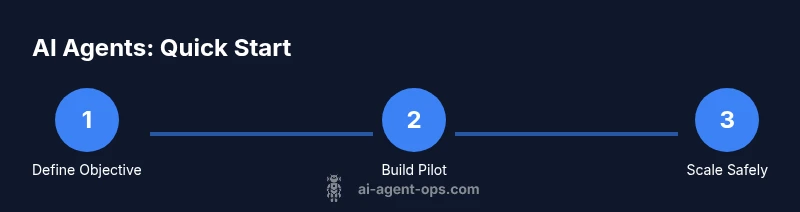
To learn how to get started with ai agents, define a clear objective, select a minimal platform, and launch a small pilot workflow. Gather a simple data source, specify basic agent behavior, and implement guardrails for safety and monitoring. The Ai Agent Ops team emphasizes starting small, measuring results, and iterating before scaling.
Why AI agents matter for modern teams
AI agents are reshaping how teams automate knowledge work, triage tasks, and scale decisions. According to Ai Agent Ops, adopting agented workflows can reduce time-to-decision and free human experts for higher-value work. In practice, an AI agent acts as a cognitive teammate that can fetch data, run analyses, propose options, and execute routine actions under governance. For developers and product teams, the most important starting point is not the most powerful model, but a well-scoped problem with measurable value. Start by mapping tasks you perform repeatedly, identify bottlenecks, and assess whether an AI agent can handle them at a human-competitive level. The goal is to augment human capabilities, not replace them. With the right guardrails, agent architecture, and clear objectives, teams can unlock rapid experimentation and faster iteration cycles.
Defining your first objective and scope
A clear objective acts as a north star for the entire project. Begin with a single, tangible outcome—such as 'reduce support ticket handling time by 30% in the first two weeks'—and specify success criteria. Use Ai Agent Ops’s framework to translate that outcome into actionable tasks: data inputs, expected actions, and measurable results. Document constraints, boundaries, and escalation rules so the agent knows when to hand off to a human. By anchoring the pilot to a concrete objective, you create a dependable baseline for learning and improvement. This disciplined start helps avoid scope creep and keeps stakeholders aligned from day one.
Choosing a lightweight architecture for speed
When starting, favor a modular, low-friction architecture over a monolithic system. A lightweight stack often means a cloud-based API or a local agent framework with clear data boundaries. Prioritize composability: the agent should plug into one data source, one decision point, and one trigger. This approach lets you test quickly, observe outputs, and iterate without overcommitting to a single vendor or platform. The goal is to reduce setup friction while preserving guardrails, versioning, and monitoring so you can learn without risk.
Data considerations for a successful pilot
Quality data is foundational. Use a sanitized or synthetic dataset to validate behavior before touching real customer data. Define data provenance, access controls, and retention policies from the start. Consider data drift—how inputs may change over time—and design the agent to detect and adapt to such changes. Keep an auditable trail of inputs, decisions, and outputs to support governance and debugging. Ai Agent Ops stresses transparency: the pilot should reveal not only outputs but also why the agent chose them.
Building a minimal viable workflow
Start with a single, repeatable interaction: fetch input, run a lightweight model or rule-based decision, perform a small action, and return results. Keep the logic simple: a lookup, a calculation, or a straightforward recommendation. Implement a basic feedback loop so you can compare results against expectations. Document the workflow graph, so teammates understand the flow and can reproduce it. As you gain confidence, gradually add complexity in controlled increments.
Safety, governance, and guardrails from day one
Guardrails are not optional; they are the backbone of responsible automation. Define escalation paths, data handling rules, and consent mechanisms. Implement rate limits, anomaly detection, and fail-safes to prevent runaway behavior. Establish an audit trail for decisions and maintain a changelog for model updates. Regularly review output quality and compliance with your organization’s policies. A proactive governance plan reduces risk and builds trust with stakeholders.
Evaluation, metrics, and learning loops
Define concrete metrics at the outset—accuracy, response time, ticket reduction, or cost per task. Track these metrics over a fixed window and compare against a human baseline. Use simple visualization dashboards to monitor drift, failures, and improvement trends. Schedule regular retrospectives with the team to discuss what worked, what didn’t, and what to test next. The feedback loop accelerates learning and drives better, safer iterations.
Scaling from pilot to production responsibly
Scaling is not about slamming more data at the same model; it’s about modularization, robust interfaces, and operational readiness. Break the workflow into independent components, version-control each part, and deploy with controlled canaries. Invest in monitoring, observability, and alerting so you can detect regressions quickly. Build a migration plan that phases in broader use cases, with clear success criteria and rollback procedures.
Real-world patterns and practical patterns you’ll notice
In practice, teams often adopt a pattern of 'prepare–decide–act' in short cycles. Start with data preparation to ensure input quality, then move to decision logic, and finally implement the action layer. Patterns like micro-agents, where several tiny agents collaborate, can yield greater resilience. Document common decision heuristics to facilitate future audits. By combining pattern-based design with disciplined governance, you reduce risk while unlocking value.
Common pitfalls and how to avoid them
Avoid over-engineering the initial pilot; keep scope small and measurable. Don’t skip data quality checks or governance; both are non-negotiable for reliable outputs. Be wary of dependency on a single platform and plan for portability. Finally, don’t confuse automation with intelligence—set realistic expectations and communicate limitations clearly to stakeholders.
Roles, teams, and collaboration
Successful AI agent initiatives rely on cross-functional collaboration. Product managers articulate problems and success metrics; data engineers prepare data and pipelines; software engineers implement integration and guardrails; and security or compliance teams validate governance. Establish a cadence for demos and feedback to keep everyone aligned. This teamwork is essential for turning a pilot into a scalable, safe product capability.
Next steps and resources to continue learning
After completing the pilot, consolidate learnings into a playbook that describes the objectives, data, architecture, guardrails, and metrics. Create a prioritized backlog of improvements and a clear timeline for incremental expansion. Seek ongoing learning opportunities and leverage expert guidance from Ai Agent Ops resources to accelerate adoption while staying aligned with best practices.
Tools & Materials
- Desktop or laptop computer(With at least 8 GB RAM and stable internet)
- Access to a lightweight AI platform or SDK(Trial API or local agent framework)
- API keys and credentials for target services(Use sandbox credentials)
- Sample dataset for pilot(Anonymized data)
- Basic scripting environment(Python, Node.js, or similar)
- Guardrails plan and monitoring dashboards(Define alerts and dashboards)
- Test environment / sandbox(Limit blast radius and isolate experiments)
- Documentation and learning resources(Links to Ai Agent Ops resources)
Steps
Estimated time: 2-3 hours
- 1
Define objective and scope
Identify a single, measurable outcome for the pilot. Translate it into concrete inputs, actions, and success criteria. Document constraints and escalation rules to prevent scope creep.
Tip: Keep the objective narrow and testable to get fast feedback. - 2
Choose a lightweight platform
Select a modular, low-friction stack that supports API access and easy integration. Prioritize clear boundaries for data and actions to simplify debugging.
Tip: Opt for platforms that allow incremental testing rather than a full-stack rebuild. - 3
Prepare data and environment
Assemble a sanitized dataset and establish provenance rules. Set up a sandbox environment with access controls to prevent accidental data exposure.
Tip: Anonymize sensitive fields and document data sources. - 4
Implement simple agent behavior
Code a basic decision path or rule-based logic that can be easily observed and audited. Keep the logic minimal and testable.
Tip: Start with a deterministic path before adding probabilistic elements. - 5
Run a controlled pilot and monitor outputs
Execute the pilot in a limited scope, closely watching accuracy, latency, and adherence to guardrails. Collect logs for inspection.
Tip: Set up alerts for failures or rule violations. - 6
Iterate and plan for scale
Review results, identify gaps, and incrementally add complexity. Prepare a production-ready plan with modular components and governance checks.
Tip: Document decisions and publish a playbook for future squads.
Questions & Answers
What is an AI agent?
An AI agent is a software component that uses AI models to perform tasks, make decisions, and take actions within defined rules and data boundaries. Agents can operate autonomously or semi-autonomously under guardrails and monitoring.
An AI agent is software that uses AI to act and decide, following rules and monitoring.
Do I need coding to get started with ai agents?
Not always. No-code or low-code platforms allow quick starts, while some scripting familiarity helps for customization and integration.
You can start with no-code tools, but learning a bit of scripting helps.
How do I measure the success of an AI agent pilot?
Define upfront metrics such as accuracy, speed, or cost savings, and track them over a fixed period against a human baseline.
Set clear metrics, track them, and compare to your baseline.
What governance should I implement for AI agents?
Establish guardrails, data policies, audit trails, and escalation paths to handle failures safely and transparently.
Put guardrails in place and document how you escalate issues.
Can AI agents scale to production?
Yes, but require modular components, proper monitoring, and a staged rollout to handle traffic and data growth.
Yes, with proper scaling and monitoring.
What are common pitfalls to avoid?
Avoid overcomplicating the initial pilot, neglecting data quality, and skipping governance or guardrails.
Don't skip data quality or guardrails.
Watch Video
Key Takeaways
- Define a clear pilot objective and success metrics.
- Choose a lightweight, modular architecture.
- Guardrails and governance are essential from day one.
- Measure, learn, and iterate before scaling.
- Foster cross-functional collaboration for success.