How to Find AI Agents: A Practical, Step-by-Step Guide
Learn how to locate, evaluate, and deploy AI agents for smarter automation. This comprehensive guide covers sources, criteria, pilots, and governance to help teams choose the right agents with confidence.


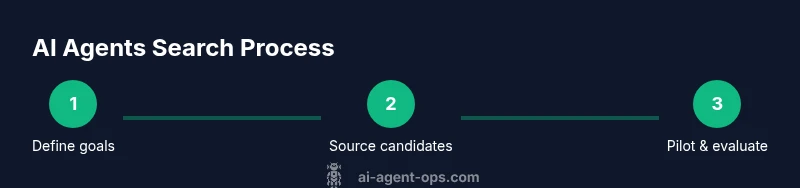
You can find AI agents by exploring marketplaces, open-source repositories, and vendor catalogs, then validating them against your goals, safety requirements, and integration needs. This guide offers a repeatable process: define goals, map requirements, search credible sources, shortlist candidates, pilot with a small task, and establish monitoring for ongoing success. According to Ai Agent Ops, interoperability and governance are key, not just raw capability.
Understanding AI agents and why finding them matters
AI agents are autonomous software systems that combine a language model with tools, memory, and decision policies to perform tasks with minimal human input. They can connect to APIs, databases, and applications to achieve goals such as data synthesis, decision support, or workflow automation. The real value of agents comes from their ability to plan, execute, and adapt over time, rather than simply executing a scripted sequence. For developers and leaders, finding the right agents means selecting those that harmonize with your tech stack, governance standards, and business objectives. It also means balancing capability with safety and control.
According to Ai Agent Ops, identifying the right AI agents early can accelerate automation maturity and reduce rework later by ensuring interoperability and clear ownership. In practice, you’ll encounter agents that specialize in data processing, automation orchestration, or decision support across industries. The goal is to evaluate agents against real-world constraints, such as latency requirements, data handling policies, and tool coverage. The rest of this article lays out a repeatable approach to locate, evaluate, and adopt AI agents that fit your workflows while maintaining guardrails and governance.
What follows is not a one-size-fits-all mandate but a framework you can tailor to your organization’s risk tolerance, regulatory context, and product strategy.
Framing goals, constraints, and success metrics
Starting with clear goals anchors your search and prevents scope creep. Begin by outlining the specific tasks you want the agent to perform, the expected outcomes, and the constraints it must respect (e.g., data privacy, latency, cost). Translate these into measurable success criteria such as completion rate, accuracy, response time, and human-in-the-loop thresholds. Identify non-negotiables like auditability, explainability, and access controls. Map your existing tech stack to establish the required integrations, APIs, and data formats. Create a lightweight requirements document that captures use cases, data flows, risk considerations, and governance expectations. This document becomes your north star for evaluating candidates and for stakeholder alignment.
A practical tip is to separate “must-have” capabilities from “nice-to-have” features. This helps when you encounter candidates that excel in one area but lack in another. Clear scoring rubrics tied to your success metrics enable objective comparisons and quicker buy-in from leadership. If you’re unsure where to start, model your goals after a few representative workflows and simulate how an agent would handle them end-to-end.
When forming goals, consider long-term maintenance: how will you monitor drift, how will you update tools or policies, and who owns the agent’s lifecycle? Framing governance early reduces surprises later and supports scalable deployment. Ai Agent Ops emphasizes tying governance to product outcomes, not just compliance, to maintain momentum while staying secure.
Sourcing AI agents: where to look and what to compare
The hunt for AI agents begins in three principal arenas: marketplaces, open-source repositories, and vendor catalogs. Marketplaces curate a wide range of agent implementations, often including documentation, safety features, and integration guides. Open-source repositories offer transparency and adaptability, enabling you to customize agents to your unique context. Vendor catalogs provide enterprise-grade solutions with support, service levels, and governance controls. As you explore, map each candidate to your goals and evaluation criteria. Look for signals such as modular architecture, clear data handling practices, tool interoperability, and documented safety mechanisms. For many teams, the fastest path is to start with a small set of well-supported candidates that cover core capabilities (planning, tool use, and memory), then expand as needed. Ai Agent Ops analysis highlights the importance of governance features, safety controls, and transparent integration options when choosing agents—these factors often predict long-term success more reliably than raw capability alone.
In practical terms, you’ll want to audit each candidate’s documentation for: supported tools, data sources, access controls, testing guidelines, licensing terms, and update cadence. Prepare a simple comparison matrix that captures these attributes, then populate it as you gather information. A staged approach—shortlist, pilot, then expand—helps you learn quickly while keeping risk in check.
As you evaluate sources, beware of hype cycles and vendor lock-in. Favor agents that expose standard interfaces, have active communities or support, and provide safe defaults. You are aiming for a balance between speed (the ability to deploy quickly) and resilience (robust governance and fault tolerance).
Evaluating agent capabilities, safety, and integration readiness
Once you’ve identified candidates, you’ll assess them against a multi-dimensional rubric. Capability evaluation covers core functions like planning quality, tool usage breadth, adaptability to different tasks, and fault tolerance. Safety assessment examines how the agent handles sensitive data, whether it supports access controls, auditing, and explainability, and how it mitigates risk such as data leakage or unintended actions. Governance evaluates licensing, provenance, model updates, and the agent’s behavior under policy constraints. Integration readiness checks whether the agent can connect to your existing systems, authenticate securely, support your data formats, and align with your monitoring and observability requirements.
A practical method is to score each candidate on a 5-point scale for each dimension, then compute an aggregate score to compare overall readiness. Document any gaps and decide whether you can close them via configuration, custom adapters, or a controlled prototype. In this step, it’s valuable to involve cross-functional stakeholders—security, privacy, engineering, product, and legal—to obtain a holistic view. Ai Agent Ops notes that alignment across teams is a strong predictor of successful adoption, because it reduces friction during integration and operation.
Finally, consider total cost of ownership and ROI, including licensing, compute, data transfer, and ongoing maintenance. While not all costs are monetary, you should quantify time saved, error reduction, and the impact on customer outcomes to justify the investment. When done well, this evaluation creates a transparent, defendable path from discovery to deployment.
Prototyping and testing: a safe, iterative path to learning
Draft a minimal pilot plan that isolates a single representative task, uses synthetic data where possible, and includes clear success criteria. The pilot should run in a controlled sandbox with limited access to production data and a rollback option if outcomes are unsatisfactory. Collect metrics on completion time, accuracy, and any user feedback. Use predefined guardrails to halt the pilot if safety thresholds are breached (for example, if confidential information is accessed inappropriately or if the agent produces unsafe outputs). The pilot phase is your opportunity to learn how the agent interacts with your tools, how reliable its actions are, and where governance gaps exist.
As Ai Agent Ops emphasizes, pilots are not just about proving capability; they are about validating interoperability, safety, and governance in a real-world context. After the pilot, compile lessons learned into a concise evaluation report, update your requirements if needed, and re-run the cycle with refined candidates or configurations. This disciplined approach reduces risk and accelerates progress toward a production-ready solution.
Deployment planning: governance, monitoring, and maintenance
Moving from pilot to production requires a disciplined deployment plan. Establish clear ownership for ongoing monitoring, policy enforcement, and incident response. Define service levels for uptime, latency, and data handling, and implement robust logging and auditing to support accountability. Create dashboards that track key metrics such as task success rates, drift indicators, and user-reported issues. Put in place change management processes for model updates, tool integrations, and policy adjustments to prevent unexpected behavior.
Operational governance should cover privacy, security, and compliance considerations, including data minimization, access controls, data retention, and export controls. Build a governance playbook that defines decision rights, escalation paths, and review cadences. Consider a staged rollout with feature flags or gradual exposure to new capabilities, so you can observe behavior in production with minimal risk. Ai Agent Ops suggests establishing a routine for periodic reviews of agent behavior, updating safety controls, and revalidating integration points as your environment evolves.
Finally, plan for lifecycle management: how you will handle decommissioning, retirement of tools, and migration to newer agents. A well-documented lifecycle plan reduces technical debt and keeps teams aligned as technology and business needs change.
Guardrails and common pitfalls to avoid
Even with a solid plan, many teams fall into avoidable traps. Common mistakes include over-optimizing for performance at the expense of safety, neglecting data governance, assuming a single agent fits all tasks, and failing to involve security and privacy teams early. Guardrails such as permissioning, sandbox testing, explainability requirements, and written incident response playbooks help prevent incidents and reduce risk. Ensure you have a clear contract that defines responsibilities, support, and update cycles with any vendor or open-source contributor. Finally, maintain a culture of continuous learning: what works today may need revision tomorrow as your workflows evolve and new agents enter the market.
Common pitfalls and guardrails (summary)
- Pitfall: Overreliance on a single vendor or tool without governance.
- Guardrail: Establish clear ownership and incident response.
- Pitfall: Underestimating data privacy and compliance needs.
- Guardrail: Enforce auditing and access controls from day one.
- Pitfall: Skipping pilot validation in production-like environments.
- Guardrail: Use stage gates and measurable success criteria.
Tools & Materials
- Clear requirements document(Use cases, business outcomes, constraints, and governance expectations.)
- Access to a safe testing environment (sandbox)(Isolate pilots from production data; implement rollback capability.)
- Evaluation rubric template(Scales for capability, safety, governance, and integration readiness.)
- Secure credentials and access control(Manage least-privilege access; rotate keys; audit trails.)
- Pilot data (synthetic datasets)(Use synthetic or anonymized data to minimize risk.)
- Collaboration and documentation tools(Shared docs, versioning, and issue-tracking for transparency.)
- Prototype plan and success criteria(Define what constitutes a successful pilot and exit criteria.)
Steps
Estimated time: Total time: 2-4 weeks
- 1
Define goals and constraints
Articulate the tasks you want the AI agent to handle, the expected outcomes, and the constraints (privacy, latency, cost). Create a one-page requirements doc that ties to business metrics.
Tip: Keep must-haves and nice-to-haves separate to simplify prioritization. - 2
Identify candidate sources
List potential marketplaces, open-source repos, and vendor catalogs that align with your tech stack and governance needs. Build a sourcing scorecard to compare sources.
Tip: Prioritize sources with clear documentation and safety features. - 3
Create an objective shortlist
Apply your criteria to filter candidates into a short list. Document why each candidate qualified or failed based on your rubric.
Tip: Limit the shortlist to a manageable number (3–5) to keep evaluation rigorous. - 4
Deep-dive candidate profiles
Review capabilities, integration options, data handling, and governance controls. Note any gaps and potential mitigations.
Tip: Ask for testable demos or sandbox access to verify claims. - 5
Design a safe pilot
Choose a representative task and a controlled dataset. Establish success criteria, monitoring, and rollback triggers.
Tip: Use synthetic data to minimize risk and ensure reproducibility. - 6
Run the pilot and collect data
Execute the pilot in a sandbox, measure outcomes, and gather stakeholder feedback. Capture logs for auditing.
Tip: Set up dashboards to visualize progress and drift indicators. - 7
Evaluate pilot results
Compare outcomes against KPIs, assess safety and governance readiness, and decide on adjustments or go/no-go.
Tip: Document lessons learned and update the requirements if needed. - 8
Plan integration and rollout
Draft an integration plan, alignment with data pipelines, and a rollout schedule with feature flags and gradual exposure.
Tip: Develop a rollback plan in case of unexpected issues. - 9
Establish ongoing governance
Define ownership, monitoring cadence, incident response, and change management for life-cycle maintenance.
Tip: Schedule periodic reviews to adapt to evolving workflows.
Questions & Answers
What is an AI agent?
An AI agent is an autonomous system that uses AI to perform tasks, often leveraging tools, APIs, and memory. It can plan, decide, and execute actions with minimal human input, while adhering to governance policies.
An AI agent is an autonomous system that uses AI to perform tasks, often with tools and policies, capable of planning, deciding, and acting with limited human input.
Where can I find AI agents?
Look in marketplaces, open-source repositories, and vendor catalogs. Use a clear evaluation framework to compare candidates based on capabilities, safety, and integration readiness.
Search marketplaces, open-source repositories, and vendor catalogs, then compare candidates with a consistent evaluation framework.
How do you assess safety in AI agents?
Assess data handling, access controls, auditing capabilities, explainability, and guardrails. Ensure there are explicit policies for failure modes and incident response.
Check data handling, access controls, auditing, explainability, and clear failure policies to ensure safe operation.
What constitutes a good pilot test?
A pilot should use representative tasks, controlled data, predefined success criteria, and observability. It should be safely isolated from production systems with a rollback option.
Run a safe, controlled pilot with clear goals and a rollback plan to learn before full deployment.
What governance considerations matter in AI agents?
Governance should cover licensing, provenance, data retention, access control, monitoring, and incident response. Establish clear ownership and review cycles.
Make sure you have licensing, provenance, data controls, and incident response in place, with clear ownership.
Watch Video
Key Takeaways
- Define clear goals before searching.
- Evaluate governance and safety first.
- Pilot with synthetic data and staged rollout.
- Document decisions and monitor continuously.