Tips for Picking AI Agents: A Practical Selection Guide
A practical, criteria-driven guide to choosing AI agents, with evaluation rubrics, pilots, and governance insights from Ai Agent Ops.


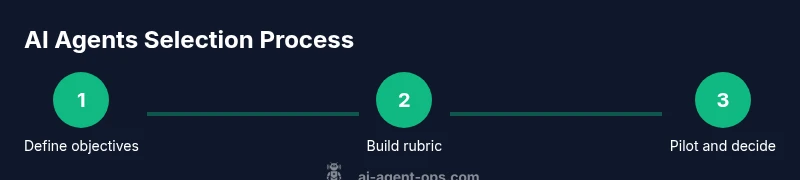
These tips for picking ai agents help you select solutions that actually fit your use case, not just hype. Begin with a precise objective, a transparent evaluation rubric, and a safe pilot before committing. By following a structured, evidence-based process, you’ll maximize ROI, governance, and safety while minimizing risk in real-world environments.
Understand your problem and objectives
Choosing the right AI agents starts with clarity. Define the specific business problem you want the agent to solve, the expected outcomes, and how you will measure success. Translate these goals into concrete, testable tasks that can be observed and quantified. This ensures that every subsequent evaluation emphasizes the signals that matter most to your organization. According to Ai Agent Ops, successful selection hinges on two things: a well-scoped objective and a decision framework that keeps evaluations consistent across vendors or implementations. Keep the language simple and anchoring metrics visible to all stakeholders, so teams don’t drift toward fashionable but misaligned features. As you draft your problem statement, include constraints like data accessibility, latency requirements, and governance needs. This upfront work saves time during vendor conversations and pilots and helps prevent scope creep later in the project. The resulting artifact should read like a brief you could hand to a vendor that explains exactly what success looks like in your environment. Your goal with this section is to crystallize what success looks like in terms anyone in the room can validate. This is also where you begin to anticipate the kinds of evidence you’ll demand during your evaluation.
Keywords: tips for picking ai agents, objectives, success metrics, governance, problem statement
noteableFieldContentStart":1},
Tools & Materials
- Computer with internet access(Updated browser and privacy settings for secure testing)
- Clear use-case inventory(Document business goals, constraints, and expected outcomes)
- Evaluation rubric template(Define scoring rubric across capabilities (accuracy, latency, reliability, governance, security, integration))
- Pilot environment(Isolated sandbox or test workspace for safe experiments)
- Data governance policy(Define data handling, privacy, security, and retention rules)
- ROI calculator (template)(Optional but helps quantify cost and benefits)
Steps
Estimated time: 3-6 weeks
- 1
Clarify objectives and success criteria
Articulate the exact outcome you want the AI agent to achieve and how you’ll measure success. List 3-5 measurable metrics and define what a successful pilot would look like. This alignment prevents drift during evaluation and procurement.
Tip: Document 3 top metrics before you begin vendor outreach. - 2
Inventory data, roles, and governance needs
Map data inputs, sources, access controls, and regulatory constraints. Identify ownership for decisions and the approvals required to deploy or adjust the agent. This reduces later friction in integration and auditing.
Tip: Create a data access matrix and an initial risk checklist. - 3
Design a transparent evaluation rubric
Develop a scoring framework that covers accuracy, latency, reliability, safety, governance, security, integration ease, and total cost of ownership. Weight criteria by business priority and predefine pass/fail thresholds to avoid bias.
Tip: Assign explicit weights and publish the rubric to all stakeholders. - 4
Compile a shortlist and collect evidence
Reach out to vendors or research teams; request architecture diagrams, safety policies, case studies, and references. Validate each claim against your rubric and consider third-party safety assessments where possible.
Tip: Ask for objective benchmarks and customer references in similar contexts. - 5
Run controlled pilots in a sandbox
Set up experiments that simulate real workflows using representative tasks. Use synthetic data first, then begin with limited live data under strict safeguards to observe behavior and edge cases.
Tip: Define stop conditions and a rollback plan for the pilot. - 6
Quantify ROI, TCO, and risk exposures
Estimate licensing, integration, maintenance, and potential downtime costs. Compare projected benefits against the risk budget, considering data privacy, security, and regulatory exposure.
Tip: Document a payback horizon and a risk-adjusted ROI scenario. - 7
Plan integration, governance, and escalation
Outline how the agent participates in existing systems, how you monitor performance, and who can override or pause operations. Ensure auditable logs and clear escalation paths are in place.
Tip: Define SLAs for monitoring and a clear override mechanism. - 8
Make a decision, implement, and iterate
Select the best-fitting option and deploy in staged increments. Establish a cadence for reviews and continuous improvement, treating the rollout as an ongoing program.
Tip: Schedule quarterly reviews and have a sunset plan for underperforming agents.
Questions & Answers
What is the most important criterion when selecting AI agents?
Alignment with your use-case and governance requirements should drive the decision. Without alignment, even technically capable agents fail to deliver business value.
Focus first on aligning the agent with your needs and governance rules.
How long should a pilot test last?
Aim for a pilot period that’s long enough to observe behavior in real workflows, typically several weeks, with clear stop conditions.
Give the pilot enough time to reveal reliable patterns and risks.
Open-source vs. commercial AI agents: which is better?
Open-source offers flexibility and transparency but may require more maintenance; commercial options provide support and SLAs. Weigh total cost of ownership and risk tolerance.
Consider both flexibility and support when choosing between open-source and commercial options.
How can I measure ROI for AI agents?
Use a total cost of ownership model and track business metrics such as time savings, accuracy improvements, and throughput against the costs.
Track concrete business outcomes to justify the investment.
What governance considerations are essential?
Data privacy, access controls, audit trails, and escalation procedures are essential to keep deployments compliant and controllable.
Put governance and auditing in place from day one.
What are common pitfalls to avoid?
Overpromising capabilities, underestimating data requirements, and skipping pilots can lead to misaligned deployments and wasted effort.
Avoid hype; validate capabilities with real tests.
Watch Video
Key Takeaways
- Define objectives before evaluating
- Use a formal rubric to compare options
- Pilot safely in a sandbox environment
- Governance and ROI drive selection
- Plan for iteration and sunset if needed