Best Way to Invest in AI Agents: A Practical Guide
A comprehensive, governance-first blueprint for investing in AI agents. Learn how to pick use cases, design governance, pilot effectively, and scale with measurable ROI across AI agent orchestration.


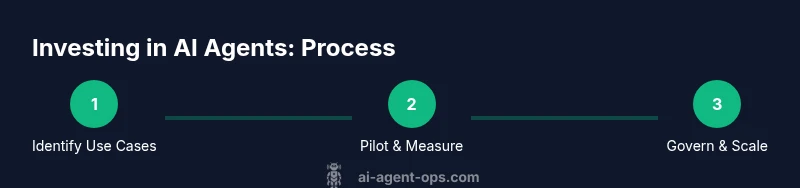
The best way to invest in AI agents is to follow a governance-first, use-case driven plan: identify high-value workflows, define success metrics, run a controlled pilot, and scale with reusable agent templates. This approach balances risk, cost, and speed, with a focus on agent orchestration and measurable ROI. According to Ai Agent Ops, start with a structured blueprint and a practical pilot program.
Why investing in AI agents matters for modern organizations
Investing in AI agents is no longer a fringe capability; it’s becoming a core driver of efficiency, consistency, and strategic decision-making at scale. AI agents, when designed to operate autonomously within guardrails, can perform repetitive tasks, aggregate insights from disparate systems, and trigger actions across your tech stack with minimal human intervention. The payoff isn’t just speed; it’s reliability and the ability to redeploy human capital to higher-value work. The Ai Agent Ops team highlights a shift toward agent orchestration and governance as organizations seek repeatable, auditable automation. As teams adopt agentic AI concepts, they gain a framework for delegating decisions to trusted agents while preserving essential human oversight. This means moving from isolated tools to an integrated ecosystem where agents interoperate, share context, and learn from outcomes, all under a policy-driven control plane.
Define high-value use cases for AI agents
To identify where AI agents can deliver the most impact, start with processes that are high-frequency, data-intensive, and prone to human error. Map end-to-end workflows, collect baseline metrics, and storyboard the agent’s decision points. Prioritize use cases with clear return on investment, scalable data sources, and well-defined failure modes. Examples include triaging customer inquiries using intelligent routing, automated data extraction and synthesis from multiple systems, and proactive monitoring that triggers corrective actions. In this phase, collaboration between product teams, data engineers, and operations leads to a shared understanding of goals, constraints, and success criteria. Ai Agent Ops’s guidance emphasizes that the first wave of investments should build reusable agent templates that can be adapted across teams, reducing duplication and accelerating value delivery.
Establish governance, risk, and compliance for AI agents
Governance is the backbone of any responsible AI initiative. Establish a lightweight but robust model that defines roles (owners, operators, reviewers), decision rights, and escalation paths. Create data handling policies, privacy safeguards, and security controls that align with regulatory requirements and corporate standards. Implement auditing and logging to track agent actions, prompts, and outcomes for accountability. A governance framework should also include risk assessment practices, failure-mode analyses, and a cadence for reviewing agent performance. By codifying governance early, you reduce rework later and increase trust among stakeholders who rely on agent-driven decisions.
Choose a scalable architecture and tooling approach
A scalable architecture for AI agents typically includes modular agents, a central orchestration layer, and shared services (authentication, logging, monitoring). Favor platforms that support plug-and-play adapters for enterprise data sources, clear versioning of prompts and policies, and observable metrics. Define standards for data schemas, prompt libraries, and decision criteria so agents can operate consistently across teams. Consider governance-leaning tools that provide audit trails, access controls, and rollback capabilities. The goal is to build an ecosystem where agents can be wired together to form end-to-end workflows without brittle custom integrations.
Build a pilot that proves value with tight scope
A well-scoped pilot is essential to demonstrate feasibility and ROI before full-scale investment. Limit the pilot to one or two high-value processes, with explicit success criteria such as reduced cycle time, improved accuracy, or decreased manual effort. Establish a fixed evaluation period, and ensure data quality and access controls are in place. During the pilot, collect qualitative feedback from users and monitor operational metrics to identify bottlenecks, misconfigurations, and governance gaps. The pilot should produce an actionable blueprint for broader rollout, including template agents, integration points, and governance checkpoints. Ai Agent Ops recommends treating the pilot as a learning loop rather than a production deployment.
Measure ROI and economic impact of AI agents
ROI for AI agents should be framed in both direct and indirect benefits. Direct benefits include time savings, error reduction, and faster decision cycles. Indirect benefits cover improved customer satisfaction, better utilization of expert resources, and the ability to scale operations without linear headcount growth. Use a simple framework to estimate cost-to-serve, time-to-value, and throughput improvements, then translate these into a business case with tiered scenarios. Ensure metrics are tracked consistently from the start, so you can demonstrate value to leadership and justify future investments. The Ai Agent Ops approach emphasizes that ROI is best evaluated through a combination of quantitative metrics and qualitative outcomes.
Plan for scaling: from pilot to production
Scaling AI agents requires more than replicating a pilot. Develop a phased rollout plan with milestones, expanded data sources, and additional agent templates. Strengthen monitoring and alerting, ensuring you can detect drift and intervene when needed. Establish a change-management process to handle updates to prompts, policies, and data schemas. As you scale, maintain alignment with governance, security, and compliance requirements, and invest in ongoing knowledge sharing so teams can reuse patterns and avoid reinventing the wheel. A scalable strategy reduces risk and accelerates value realization.
Vendor evaluation and cost considerations for AI agents
Choosing the right vendor is a critical decision that shapes speed, cost, and long-term flexibility. Compare platforms on data compatibility, ease of integration, governance features, and the breadth of pre-built agent templates. Consider total cost of ownership, including licensing, support, and the cost of customizing prompts and integrations. Beware vendor lock-in; favor solutions that support open standards and easy migration paths. Build a decision framework that rates vendors against your strategic goals, risk tolerance, and required governance capabilities. Align procurement decisions with your organization’s broader AI strategy.
Operational best practices and success factors for AI agents
Successful AI agent programs emphasize people, process, and platform. Invest in cross-functional training so teams understand how to design prompts, monitor agents, and interpret results. Maintain a living knowledge base with patterns, failed experiments, and best practices. Establish regular reviews of agent performance, governance compliance, and risk controls. Encourage a culture of experimentation balanced with responsible use, ensuring that agents augment human work rather than replace critical expertise. Finally, document lessons learned and standardize best practices to accelerate future deployments.
Tools & Materials
- Laptop or desktop computer with reliable internet(Capable of running browser-based tools and basic local AI workloads)
- Access to an AI agent platform or sandbox(Use a corporate sandbox or vendor-provided trial environment)
- Project planning and governance templates(Templates for roles, policies, decision logs, and review cadences)
- Data access policies and documentation(Clear guidelines for data handling, privacy, and security)
- ROI calculation workbook(A simple sheet to track time savings, costs, and potential gains)
- Vendor evaluation checklist(Criteria for platform capabilities, governance features, and support)
- Stakeholder alignment materials(Slides or documents to align executives and teams on goals)
Steps
Estimated time: 6-8 weeks
- 1
Identify target processes
Map candidate workflows that are repetitive, data-driven, and high-impact. Gather baseline metrics and collect stakeholder input to define success criteria. Ensure data availability and access controls are feasible for experimentation.
Tip: Choose processes with well-defined inputs and outputs to minimize scope creep. - 2
Assemble a cross-functional team
Form a team with product, data engineering, security, and operations. Define clear roles for ownership, testing, and governance. Align on success metrics and how outcomes will be measured.
Tip: Create a shared vocabulary for prompts, policies, and outcomes to avoid miscommunication. - 3
Define success metrics
Establish quantifiable KPIs such as time-to-decision, error rate, and user satisfaction. Include a plan for how data will be collected and analyzed across the pilot.
Tip: Tie metrics to business goals to make ROI evaluation straightforward. - 4
Choose an AI agent platform
Evaluate platforms for integration, governance, scalability, and support. Prioritize platforms with modular agents, versioning for prompts, and robust monitoring.
Tip: Prefer solutions with open standards to reduce future migration risk. - 5
Design a focused pilot
Limit the scope to one or two high-value processes. Define data sources, integration points, and a fixed evaluation period. Prepare a rollback plan in case of issues.
Tip: Keep the pilot small but representative to avoid biased results. - 6
Launch pilot and monitor
Run the pilot with defined thresholds for success. Track performance, collect user feedback, and log agent decisions for auditing. Identify governance gaps early.
Tip: Set up alerting to catch drift or unexpected prompts quickly. - 7
Plan rollout and governance
If the pilot succeeds, draft a production rollout plan, expand data sources, and formalize governance with policies and reviews. Prepare scaling targets and resource planning.
Tip: Document all changes to prompts and policies for future reference.
Questions & Answers
What qualifies as a high-value use case for AI agents?
A high-value use case is repetitive, data-rich, and directly linked to measurable outcomes such as time savings or improved accuracy. It should be easy to pilot and scalable across teams.
A high-value use case is repetitive, data-rich, and tied to measurable outcomes; it should be easy to pilot and scalable.
How do I measure ROI for AI agents?
ROI is best measured through a mixed approach: quantify time saved, error reductions, and throughput gains, then attach these to business outcomes like cost per unit and customer satisfaction.
ROI is measured by combining time saved, fewer errors, and higher throughput tied to business outcomes.
What governance structures are recommended?
Establish an AI governance board with clear roles, data policies, audit trails, and escalation paths. Include change-control for prompts and policies and regular reviews of performance and risk.
Set up a governance board with clear roles, data rules, and regular reviews of performance and risk.
What are common risks when investing in AI agents?
Risks include data privacy concerns, prompt drift, governance gaps, and over-reliance on automated decisions. Mitigate with guardrails, logging, and ongoing human oversight.
Common risks are privacy, drift, governance gaps, and over-reliance; mitigate with guardrails and oversight.
How long should a pilot run?
A pilot should run long enough to capture variability in data and user interactions, typically several weeks, with a fixed evaluation window and clear exit criteria.
Run the pilot for several weeks with fixed evaluation criteria and an exit plan.
How do I select an AI agent platform?
Select a platform with modular agents, strong governance features, data integration capabilities, and clear upgrade paths. Prioritize open standards to avoid lock-in.
Choose a platform with modular agents, good governance, and open standards.
Watch Video
Key Takeaways
- Identify high-value use cases with clear ROI.
- Establish governance and safety rails early.
- Pilot with a well-scoped scope and defined success metrics.
- Measure ROI using both quantitative and qualitative outcomes.
- Plan scaling from pilot to production with governance in place.