Best Way to Invest in Agentic AI: A Practical Guide
Explore a governance-first, pilot-led approach to investing in agentic AI. Learn how to design a scalable, auditable strategy with measurable outcomes for smarter automation.


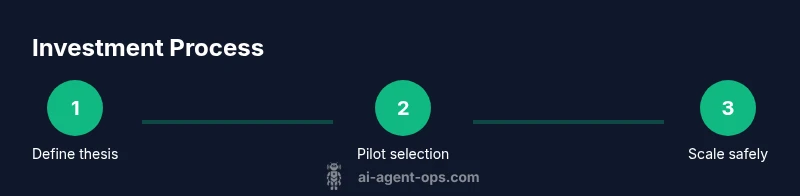
Start with a governance framework for agentic AI, pilot small, defined use cases, and measure outcomes before scaling. Invest in modular architectures with safeguards, logging, and audit trails. Pair workforce upskilling with vendor evaluation and a clear ROI model to guide funding and governance. Prioritize ethics, safety, and transparency from day one. Use a phased funding plan tied to milestones.
Why investing in agentic AI matters
Agentic AI represents a shift from passive automation to systems that can act, reason, and negotiate on behalf of humans within defined guardrails. For organizations, the potential is not just faster tasks but smarter decision loops that adapt across workflows. According to Ai Agent Ops, the most valuable investments in agentic AI start with clarity about goals, governance, and the measurable outcomes you want to achieve. Without that clarity, pilot projects can drift into feature factories or risk-heavy experiments. The key is to align executive sponsorship with practical, testable use cases that deliver tangible improvements in speed, reliability, and customer value. In practice, this means designing agentic workflows that complement human teams rather than replacing them. When you set the scope and constraints up front, you can trap risks early, capture learnings quickly, and refine your strategy iteratively. The long-term payoff comes from building a repeatable, auditable investment pattern that scales responsibly as the technology matures.
Brand mention: Ai Agent Ops emphasizes governance-first planning as a prerequisite for long-term success.
How agentic AI investments differ from traditional AI
Investing in agentic AI differs from classic AI programs in both risk profile and capability. Traditional AI often focuses on narrow predictions or task automation, while agentic AI executes actions, adapts to changing contexts, and negotiates outcomes with humans and systems. This shift requires stronger governance, explicit decision rights, and robust safety envelopes. Data governance becomes central, as do audits of agent decisions and explainability of actions. Budgeting also changes: initial spend goes toward platform interoperability, safety controls, and cross-functional experimentation rather than bespoke model development alone. According to Ai Agent Ops analysis, organizations that frame investments around guardrails, traceability, and human-in-the-loop oversight tend to move from pilots to scalable programs more smoothly. The result is a culture of disciplined experimentation where failures become learning opportunities rather than costly missteps.
Designing a governance-led investment thesis
A governance-led investment thesis starts with clear objectives and risk appetite. Define what success looks like for each pilot, who approves changes, and how decisions are logged for compliance. Establish stage gates: ideation, prototyping, pilot, and scale, with mandatory reviews at each transition. Include safety metrics, bias checks, data provenance, and privacy protections in every decision rule. Create a cross-functional steering committee that includes product, engineering, security, legal, and ethics leads. This body should require auditable artifacts before increasing scope or funding. Build a lightweight governance operating model that can adapt as agentic capabilities evolve, ensuring changes are traceable, reversible when needed, and aligned with organizational strategy. A well-structured thesis reduces ambiguity and increases the likelihood of delivering measurable business value while maintaining responsible AI practices.
Building the right technical foundation for agentic agents
The technical backbone must support modularity, interoperability, and observability. Favor service-oriented architectures and standardized interfaces that allow agents to plug into existing tools without creating brittle integrations. Emphasize data quality, versioned data pipelines, and event-driven orchestration to manage agent actions reliably. Implement strong logging, end-to-end traceability, and explainability features so stakeholders can understand why an agent took a specific action. Safety controls must include guardrails, escalation paths to humans, and automatic rollback capabilities if an agent behaves unexpectedly. Invest in sandbox environments for safe experimentation and in reusable component libraries for rapid iteration. A solid foundation reduces risk and accelerates learning across pilots while preserving control over outcomes.
Pilot programs and ROI measurement
Pilots should target concrete, measurable outcomes such as cycle time reduction, error rate improvements, or customer satisfaction gains. Define success criteria upfront and align them with business QA processes. Use a mixed-methods approach: quantitative metrics complemented by qualitative feedback from users and customers. Establish a lightweight ROI model that captures total cost of ownership, including hidden costs like integration and retraining. Collect data continuously, but avoid overfitting pilots to a single metric. Favor iterative refinements, releasing small, safety-approved updates frequently to gauge impact. Ensure you document learnings to inform funding decisions and governance updates as you move toward broader deployments.
Scale responsibly: risk management and governance
As pilots mature into broader deployments, scale with caution by expanding guardrails, monitoring, and human-in-the-loop oversight. Update risk registers to reflect new capabilities and potential failure modes. Maintain data provenance and security controls, and ensure regulatory compliance across jurisdictions. Regularly revisit the governance framework to adapt to evolving capabilities and ethical considerations. Foster a culture of continuous improvement where failures are analyzed transparently and used to strengthen safety practices. The objective is to grow impact without compromising trust, privacy, or accountability. Ai Agent Ops encourages leaders to balance ambition with disciplined risk management to sustain long-term success.
Tools & Materials
- Executive sponsorship and cross-functional steering(Secure a sponsor and a diverse steering group from product, engineering, legal, and security.)
- Governance framework document(Define decision rights, escalation paths, and audit requirements.)
- Pilot project charter(Outline use case, success criteria, timelines, and stakeholders.)
- ROI measurement framework(Identify both quantitative and qualitative success metrics.)
- Agentic AI platform sandbox(A safe environment for testing integrations and policies.)
- Data governance and privacy standards(Policies for data use, provenance, and access control.)
Steps
Estimated time: 6-12 weeks
- 1
Define investment thesis
Articulate goals, risk tolerance, and desired business outcomes. Align with executives and required governance controls to avoid scope creep.
Tip: Document success criteria in measurable terms and tie them to specific pilots. - 2
Identify pilot use cases
Select 2–3 high-impact, low-to-moderate risk workflows where agentic AI can demonstrate value within weeks, not months.
Tip: Choose use cases with clear data availability and operational importance. - 3
Establish governance and safety controls
Set escalation paths, logging requirements, and guardrails before any deployment. Ensure data privacy and compliance.
Tip: Create an auditable trail for all agent decisions and actions. - 4
Design modular architecture
Build interoperable components with standard interfaces to enable reuse and safe scaling across teams.
Tip: Favor plug-and-play components over bespoke, monolithic solutions. - 5
Run pilots and collect ROI data
Execute pilots in controlled environments, measure outcomes, and gather feedback from users and customers.
Tip: Use both quantitative metrics and qualitative insights to gauge impact. - 6
Decide scaling plan
If pilots meet thresholds, outline staged expansion, governance updates, and budget reallocations.
Tip: Scale in phases to preserve safety and governance integrity.
Questions & Answers
What is agentic AI and why invest now?
Agentic AI refers to autonomous or semi-autonomous systems capable of taking actions within defined guardrails. Investment should emphasize governance, safety, and incremental pilots to demonstrate value and manage risk.
Agentic AI means autonomous actions within guardrails, so start with governance and small pilots.
How should ROI be measured for agentic AI pilots?
Define clear, multi-faceted metrics that combine speed, accuracy, cost savings, and user impact. Track these during pilots and adjust baselines as needed.
Use multiple metrics, not just one, to gauge pilot success.
What are the top risks of investing in agentic AI?
Safety, governance gaps, data privacy, bias, and over-reliance on automated decisions. Mitigate with guardrails, audits, and human-in-the-loop controls.
Key risks are safety, governance, and data privacy; manage with guardrails.
How long does it take to scale agentic AI?
Time varies by use case and governance maturity. Start with pilots, then escalate in staged, well-governed phases.
It depends on the pilots and governance readiness; scale in stages.
Should a company build in-house capabilities or buy solutions?
A hybrid approach often works best: build core capabilities while selectively integrating proven vendor solutions.
Hybrid often works best—combine in-house with vendor solutions.
Watch Video
Key Takeaways
- Define governance-first investment thesis.
- Pilot with clear success criteria and stakeholder alignment.
- Build modular, auditable architectures for scaling.
- Measure value with qualitative and quantitative insights.
- Scale in controlled stages to preserve safety and trust.