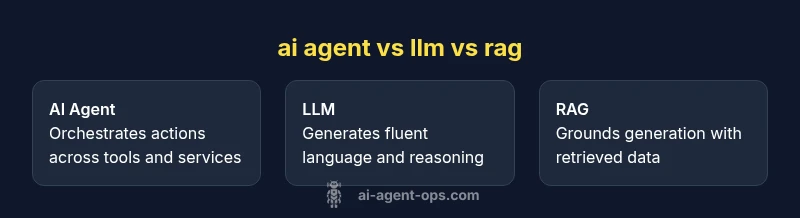
ai agent vs llm vs rag: a practical comparison for builders
An analytic, practical comparison of AI agents, LLMs, and Retrieval-Augmented Generation (RAG) to help developers and leaders choose the right approach for AI agent workflows.


AI agent vs llm vs rag is a three-way choice for building agentic AI systems. AI agents orchestrate actions and tools to automate workflows, LLMs excel at fluent language tasks, and RAG grounds generation with retrieved data. The best fit depends on task type, data freshness, and governance needs.
Context: what ai agent, llm, and rag mean in practice
In modern AI engineering, three concepts are often discussed in tandem: ai agent, llm, and rag. An ai agent is a system that can observe, decide, and act—often interfacing with tools, databases, and external services to accomplish objectives. A large language model (LLM) is a neural network that excels at understanding and generating natural language text from prompts. Retrieval-Augmented Generation (RAG) pairs an LLM with a retrieval layer that fetches relevant documents before producing an answer. Understanding how these three fit together is crucial for designing reliable, scalable agentic AI workflows. According to Ai Agent Ops, the best outcomes come from clear role delineation: decide what to automate, what to generate, and where to ground responses in real data. This article uses the keyword ai agent vs llm vs rag to anchor definitions and guide practical decisions for developers and product leaders.
Core capabilities and key differences
- AI agents are action-oriented. They can issue commands, call APIs, and coordinate tools to achieve goals. They operate in environments where state, side effects, and timing matter.
- LLMs are knowledge and language engines. They excel at drafting text, answering questions, and reasoning through prompts, but they don’t inherently execute external actions unless integrated with additional components.
- RAG bridges the gap by grounding text generation in retrieved content. The retrieval layer provides context from a knowledge base or live data stream, while the generator composes the final answer.
- The differences matter when you design a system: do you need automation, pure language capability, or both with reliable grounding? In many cases, teams combine these capabilities, creating layered architectures where an agent triggers actions, an LLM handles language tasks, and a RAG module keeps outputs anchored to sources.
Data handling, memory, and context management across approaches
- AI agents rely on stateful context to make sequential decisions. They maintain internal or external state and adapt behavior as they observe outcomes.
- LLMs depend on prompt design and context windows. There is a limit to how much information can be retained per invocation, so long-running tasks require orchestration, caching, or chunking strategies.
- RAG introduces a retrieval layer that fetches documents or structured data at query time. This reduces hallucinations and enriches responses but adds latency and complexity.
- Designing a hybrid system requires careful data handling: where to fetch, how to cache, how to verify sources, and how to reconcile conflicting signals across tools, documents, and prompts. Ai Agent Ops emphasizes explicit data contracts and traceable provenance to minimize risk.
When ai agents shine: concrete use cases and patterns
- Workflow automation: agents manage end-to-end processes, orchestrating steps across services like databases, messaging queues, and external APIs.
- Decision-support with action: agents not only suggest what to do but can trigger actions (e.g., deploy a feature flag, trigger a test, or create tickets).
- Dynamic remediation: agents adapt to changing conditions, rerouting tasks when failures occur or when new information arrives.
- Best-practice pattern: pair agents with monitoring and alerting to detect drift, and provide a human-in-the-loop option for high-stakes decisions.
When LLMs are the right tool: language-forward tasks
- Text generation and editing: drafting emails, reports, documentation, or summaries.
- Complex reasoning and planning in natural language: scenario analysis, multi-step reasoning, or policy explanation.
- Prototyping interfaces: chat-based assistants, copilots for coding, or writing assistants embedded in apps.
- Best-practice pattern: use structured prompts, chain-of-thought controls, and guardrails to minimize errors and misinterpretations.
When RAG adds value: grounding and data freshness
- Knowledge-grounded Q&A: retrieve supporting documents before answering, especially for compliance or safety-sensitive topics.
- Data-intensive decision support: combine real-time data (or recent documents) with generation to produce timely insights.
- Compliance and traceability: sources and verifications can be surfaced alongside responses, improving auditability.
- Best-practice pattern: design robust retrieval pipelines, track source provenance, and implement fallback strategies if retrieval fails.
Architecture and integration patterns for scalable agentic AI
- Layered architecture: a frontend interface, a decision layer (ai agent), a language layer (LLM), and a grounding layer (RAG) with clear interfaces.
- Tooling and adapters: standardize how agents call tools, track outcomes, and handle errors; use idempotent actions where possible.
- Observability: instrument metrics around latency, success rate, and source trust; implement automated tests for end-to-end behavior.
- Security and governance: ensure data access controls, proper credential handling, and auditable decision logs.
- Hybrid patterns: many teams run ai agents with LLMs for language tasks and RAG for grounding to balance automation with factual accuracy.
Practical design patterns and anti-patterns
- Pattern: separation of concerns. Keep decision logic, language tasks, and data grounding in distinct modules that communicate through well-defined interfaces.
- Pattern: retry and fallback strategies. When a tool call fails, attempt a safe, user-transparent fallback instead of cascading errors.
- Anti-pattern: overloading a single component. Relying solely on an LLM for everything risks hallucinations; rely on someone or something to verify actions.
- Anti-pattern: neglecting data provenance. Without source tracking, users cannot verify or audit decisions.
- Ai Agent Ops notes: design for observable behavior and explainable outputs to support accountability and trust.
How to evaluate and compare in practice
- Define success criteria upfront: accuracy, latency, automation coverage, and governance requirements.
- Establish evaluation datasets that reflect real-world tasks, including edge cases and failure modes.
- Measure end-to-end impact: time saved, error reduction, and user satisfaction, not just model scores.
- Pilot in safe environments: use feature flags, canaries, and rollback plans when deploying agentic AI in production.
- Plan for hybrids: assess how you can combine ai agents, LLMs, and RAG to meet your goals without overengineering.
Authority sources and continued learning
- This section provides references to respected sources you can consult for deeper exploration. For AI governance and evaluation best practices, see NIST AI materials and Stanford AI research pages. For broader guidance on retrieval-augmented workflows, arXiv papers and industry reports are useful starting points.
Authority sources
- https://www.nist.gov/topics/ai
- https://ai.stanford.edu/research
- https://arxiv.org
Closing thoughts: leveraging the trio for resilient AI agent workflows
- The ai agent vs llm vs rag decision is rarely binary. The strongest systems combine automation with language capabilities and grounding to deliver reliable, scalable, and explainable solutions. Ai Agent Ops emphasizes architecture that separates concerns, validates data provenance, and builds observable end-to-end behavior.
Feature Comparison
| Feature | ai agent | llm | rag |
|---|---|---|---|
| Core function | Orchestrates actions and tool usage | Generates text and reasoning from prompts | Grounds generation with retrieved data and sources |
| Best use case | Automation and decision workflows | Language tasks, reasoning, and drafting | Knowledge-grounded Q&A and data-aware generation |
| Strengths | Actionable automation, tool integration, scalable orchestration | Fluent language generation, versatility across prompts | Grounded accuracy, transparency of sources, up-to-date content |
| Limitations | Requires integration, monitoring, and maintenance | Susceptible to hallucinations and context limits | Retrieval quality and latency depend on pipeline design |
| Data handling | Stateful, environment-aware decision making | Primarily prompt-driven with context management | Retrieval-backed data enhances grounding |
| Implementation complexity | High (integration-heavy) | Medium (prompt design and tooling) | Medium (deploying and tuning retrieval) |
| Cost considerations | Higher due to orchestration and tooling | Moderate per usage, depending on prompts | Moderate to high, driven by retrieval infrastructure |
Positives
- Enables modular, scalable architectures with clear separation of concerns
- Supports automation of complex workflows and decision-making
- RAG offers grounded outputs with provenance and up-to-date information
- Hybrid patterns can leverage strengths of all three approaches
What's Bad
- Increases system complexity and maintenance burden
- Requires robust data governance and monitoring to avoid drift
- Retrieval quality and latency can be bottlenecks in RAG
- Potential data leakage if not properly secured and audited
No single approach dominates; choose based on goals: AI agents for automation, LLMs for language tasks, and RAG when grounding and data freshness matter most.
In practice, most teams adopt hybrids that leverage each approach where it excels. Start with a clear architecture, test end-to-end impact, and iteratively optimize the balance between automation, language capability, and grounded data.
Questions & Answers
What is the difference between an ai agent and a large language model (LLM)?
An AI agent orchestrates actions and tool use to achieve goals in a real environment. An LLM specializes in generating and understanding natural language from prompts. Agents can be built around LLMs and augmentation components, while LLMs alone do not inherently perform external actions without an integrated layer.
An agent acts and decides; an LLM writes and explains. You often combine both to get automation plus language capability.
What is Retrieval-Augmented Generation (RAG)?
RAG combines a retrieval step with a generative model. The system fetches relevant documents, then the generator uses that content to produce grounded, source-backed outputs. This helps reduce hallucinations and improves accuracy for data-heavy tasks.
RAG uses live data to back up what the model says, making answers more trustworthy.
Can ai agents and llms be combined effectively?
Yes. A common pattern is to use an LLM for language tasks and an AI agent to perform actions or fetch information. RAG can be layered on top to ground the outputs. The combination often yields robust automation with high-quality language interaction.
Absolutely—you can mix them to get the best of both worlds.
What factors influence choosing between ai agent, llm, and rag?
Consider task nature (automation vs language vs grounding), data freshness needs, latency tolerance, cost constraints, and governance requirements. The strongest solutions often blend approaches rather than rely on a single mode.
Think about what you need to do, how fresh the data is, and how fast you must respond.
What are common pitfalls when building ai agent workflows?
Common issues include over-automation without safeguards, brittle tool integrations, insufficient monitoring, data leakage risks, and unclear provenance. Build with guardrails, observability, and human-in-the-loop when stakes are high.
Watch out for over-automation and weak monitoring.
Key Takeaways
- Define decision boundaries between automation and language tasks
- Ground outputs with RAG when data freshness and sources matter
- Adopt a layered architecture to enable hybrids
- Measure end-to-end impact, not just model metrics
- Plan for governance, security, and observable behavior