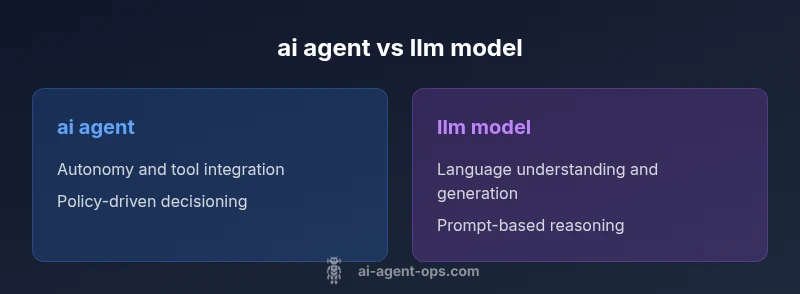
ai agent vs llm model: a practical, scalable comparison
An objective, in-depth comparison of ai agents and llm models, detailing definitions, use cases, integration patterns, and trade-offs to guide developers and decision-makers in choosing the right approach.


AI agents enable autonomous task execution using tools and policies, while LLM models excel at flexible language tasks with prompts. For enterprise, agents are better for workflow automation; LLMs shine in dialogue and reasoning. See the full chart for nuances.
What is the ai agent vs llm model?
The phrase ai agent vs llm model captures two foundational approaches in modern AI systems. An AI agent combines a decision-making component with tool-use capabilities to perform actions in the real world or digital environments. By contrast, a large language model (LLM) focuses on understanding and generating natural language through learned statistical patterns. In practice, many teams discover that the two are not mutually exclusive; instead, they’re complementary pieces in a broader architecture. According to Ai Agent Ops, the most effective setups often blend agentic capabilities with powerful language reasoning, leveraging each component where it fits best. The distinction matters because it influences how you design workflows, governance, and user experiences. In short: ai agent vs llm model is less about a single correct solution and more about a pragmatic balance of autonomy and language flexibility.
The term ai agent vs llm model should be understood as a spectrum rather than a binary choice. Entities operating in this space often start with an LLM-based interface for user interaction and layer on agentic components to handle long-running tasks, external system calls, and policy-based decisioning. This perspective is central to agent orchestration and agent-mode architectures, which Ai Agent Ops explores in depth. If you’re evaluating vendors or building a prototype, map your needs to two axes: “autonomy of action” and “scope of language tasks.” This helps determine when to deploy a true agent, when to rely on an LLM, and when a hybrid approach is most effective.
Comparison
| Feature | ai agent | llm model |
|---|---|---|
| Definition | Autonomous software that can initiate actions, call tools/APIs, and manage state to complete goals. | Statistical language model that generates text and performs reasoning based on prompts and context. |
| Primary strength | Autonomous action, tool integration, and workflow orchestration. | Language understanding, generation, and flexible reasoning from prompts. |
| Interaction pattern | Interacts with external systems via adapters, memories, and rule-based policies. | Responds to prompts; relies on context windows and pre-trained patterns unless integrated with tools. |
| Best use case | End-to-end automation, decision-making with policy constraints, and tool use. | Creative writing, classification, abstract reasoning, and conversational agents. |
| Data requirements | Runtime inputs, tool schemas, memory, and governance policies. | Prompt history, fine-tuning data, and access to context; external tools are optional. |
| Cost model | Compute and tool-usage costs for orchestration, hosting, and monitoring. | Licenses or API costs for model usage, plus hosting and prompt engineering resources. |
| Risk & governance | Policy enforcement, safety monitors, and observability of tool calls. | Hallucination risk, bias, prompt leakage, and governance of generated content. |
| Integration complexity | Moderate to high; requires adapters, tool integration, memory, and policy layers. | Low to moderate; easier to deploy as a standalone language model with prompts. |
| Performance metrics | Task completion rate, tool success rate, and end-to-end SLA adherence. | Accuracy of language outputs, coherence, and user satisfaction metrics. |
Positives
- Enables end-to-end automation and ongoing workflow optimization
- Improved consistency through policy-driven decisioning
- Can reduce human-in-the-loop work and scale across teams
What's Bad
- Higher upfront integration and governance overhead
- Complexity in testing, monitoring, and maintaining tool adapters
- Potential privacy and security considerations when tools access sensitive data
AI agents are best for autonomous automation; LLMs excel in language-heavy tasks. A hybrid approach often yields the strongest outcomes.
Choose AI agents when the goal is autonomous action with external tools. Favor LLMs for language-rich tasks and interaction. In many cases, a combined architecture delivers end-to-end automation with strong conversational capabilities.
Questions & Answers
What is the primary difference between an AI agent and an LLM model?
An AI agent executes tasks autonomously using tools and policies, while an LLM analyzes and generates language based on prompts. Agents act; LLMs respond. The two often complement each other, especially in endpoint automation and user-facing dialogue.
AI agents perform tasks and call tools automatically; LLMs generate language in response to prompts. They work best when used together in a hybrid setup.
Can an LLM operate autonomously without tools?
LLMs can appear autonomous when integrated with memory and context, but they typically require tooling or orchestration to perform actions beyond text generation. True autonomy usually comes from adding a tool layer and decision policies.
LLMs can act like they’re autonomous in text, but to truly act on tasks, you connect them to tools and rules.
Which should I choose for enterprise automation?
For automated workflows, an AI agent approach offers better control and reliability, especially with policy constraints. If the priority is complex language tasks and human-facing dialogue, an LLM-centric design may be preferred. A hybrid often delivers the best results.
If you need automation, go with agents; for rich language tasks, lean on LLMs. Many teams mix both for best results.
What are the main costs to consider?
Costs include compute for running agents, tool usage, and governance overhead for agents; for LLMs, licensing or API fees and hosting. In hybrids, you pay for both sides plus integration and maintenance.
Think about tooling, compute, and governance for agents, plus licensing and hosting for LLMs.
How do you measure success for ai agent vs llm model projects?
Use end-to-end metrics: task completion, latency, user satisfaction, and governance compliance. For LLMs, assess output quality, consistency, and hallucination rates. Hybrid setups should include integration health and policy adherence.
Look at end-to-end outcomes like task completion and user satisfaction, plus governance for both approaches.
Are there safety risks unique to agents?
Yes. Agent risk includes unintended tool calls, data leakage across adapters, and policy violations. Mitigate with strict access controls, auditing, and fail-safe policies that constrain actions.
Agents can call tools the wrong way. Use strong safety checks and audits.
What about data privacy when using agents?
Agents touch data across systems via tools. Ensure data minimization, encryption in transit and at rest, and clear data handling policies. Governance should mandate least-privilege access.
Protect data by minimizing exposure and enforcing strong controls when agents access tools.
Key Takeaways
- Define autonomy vs language focus early in the design
- Plan for governance and tool safety when deploying agents
- Invest in adapters and orchestration patterns for agents
- Evaluate with end-to-end metrics, not just model scores
- Consider a hybrid architecture to balance strengths