How to Prepare for a Career in AI: A Practical Roadmap
A practical, step-by-step guide to preparing for a career in AI, covering skills, projects, education paths, and networking for developers and leaders.


Whether you’re a developer, product leader, or aspiring researcher, this guide on how to prepare for a career in ai breaks down a practical, milestone-driven path. Start with core coding, math, and AI fundamentals, then build reliable projects and a standout portfolio. Ai Agent Ops emphasizes applying skills to real problems, documenting results, and pursuing steady, continuous learning.
Foundations: Why a deliberate prep matters for AI careers
The demand for capable AI professionals spans startups to enterprises, and the pace of change means smart preparation matters more than luck. If you want to make a real transition into AI, you need a roadmap that blends foundational skills with practical experience. According to Ai Agent Ops, success hinges on three pillars: solid technical competence, hands-on project execution, and an active professional network. When you approach your career as a series of measurable milestones, you reduce uncertainty and accelerate progress. In this guide to how to prepare for a career in ai, we’ll map a realistic path that balances learning with real-world application, so you can move from curiosity to impact faster. The goal is not to memorize everything, but to solve real problems using reliable methods, tools, and best practices.
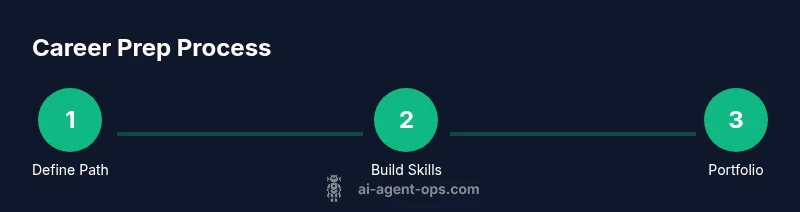
Define your AI career path
To prepare effectively, start by defining which AI domain you want to enter. Common entry points include data science, machine learning engineering, MLOps, AI research, and product-management-focused AI roles. Map each path to a core skill set: coding, statistics, data wrangling, model evaluation, and deployment. Understanding your target role helps you prioritize learning milestones, project ideas, and portfolio demonstrations. Throughout the journey, revisit your goals and adjust as the field shifts toward agentic AI, automation, and large-scale systems. This clarity reduces wasted effort and accelerates progress on how to prepare for a career in ai.
Core skills to acquire
Building a solid foundation is essential. Focus on Python and SQL for data workflows, statistics and probability for sound modeling intuition, and essential ML concepts (supervised/unsupervised learning, evaluation metrics, bias and variance). You should also learn data handling, feature engineering, and model deployment basics. Practical skills—coding fluency, debugging discipline, version control, and reproducible experiments—often matter as much as theory. Supplement learning with simple projects that show end-to-end thinking: data collection, cleaning, model selection, evaluation, and a clear business impact.
Education pathways
There are many routes into AI, and you don’t need one single path. Consider a blend of formal education and self-directed study. A software-focused CS degree can help, but bootcamps, online certificates, and structured self-study plans frequently lead to entry-level roles as well. The key is aligning coursework with hands-on projects that demonstrate capability. Look for programs that emphasize practical outcomes and portfolio-based assessment, not just exams. Regardless of route, you should accumulate a set of projects that prove you can turn data into decisions and deploy models responsibly.
Hands-on projects and portfolio
A compelling AI portfolio is the strongest signal to potential employers. Start with small, well-scoped projects and progressively tackle end-to-end problems. Include data collection or sourcing, cleaning, model selection, evaluation, and deployment. Document your process with clear notebooks, code, and visual dashboards. Public repositories, well-commented code, and reproducible experiments help. Seek feedback from mentors and peers, contribute to open-source, and narrate the business impact of each project. A strong portfolio demonstrates not only technical skill but problem-solving discipline and communication.
Tools and platforms to learn
Mastery comes from hands-on practice with key tools. Learn Python (with libraries like NumPy, pandas, scikit-learn) and SQL for data work. Gain familiarity with ML frameworks (TensorFlow, PyTorch) and experimentation tools (MLflow, Weights & Biases). Explore cloud platforms (AWS, Azure, GCP) for scalable training and deployment. Don’t neglect software engineering practices such as version control, testing, and CI/CD for ML. Building comfort with these tools accelerates the journey from learner to practitioner and demonstrates readiness for real-world AI projects.
Networking and community
Networking accelerates learning, exposes you to real-world problems, and unlocks opportunities. Join AI meetups, university clubs, and online communities. Attend talks on AI ethics, ML systems, and agentic AI to stay current and visible. Build relationships with mentors and peers who can review your projects, provide career guidance, and potentially refer you to openings. An intentional network also helps you understand industry needs, which informs your learning plan and portfolio decisions as you prepare for a career in ai.
Resume and interview prep for AI roles
Tailor your resume to highlight end-to-end AI projects, measurable impact, and the specific role you want. Emphasize data processing, model evaluation, deployment, and monitoring. Prepare for technical interviews by practicing data-structure problems, ML case studies, SQL tasks, and live coding sessions. Build a one-page portfolio summary that tells a cohesive story from data to decision, including the business value and outcomes. During interviews, demonstrate your problem-solving approach, explain trade-offs, and communicate clearly with both technical and non-technical audiences.
Practice problems and coding discipline
Regular coding practice accelerates fluency. Schedule weekly sessions focused on data processing, feature engineering, and small ML tasks. Use platforms that offer real-world datasets and practical problems. Write tests for your code and ensure your experiments are reproducible. Over time, you’ll develop a repeatable workflow for turning raw data into reliable insights, which is a valuable skill across AI roles.
Ethical and responsible AI considerations
Ethics and governance are integral to AI careers, not afterthoughts. Learn about bias, fairness, transparency, accountability, and privacy. Understand how to design systems that minimize harm and maximize beneficial impact. Demonstrating a principled mindset—along with technical competence—will distinguish you in the job market and prepare you for responsible AI work.
AI career roadmaps by role
Different AI roles reward different skill blends. A Data Scientist typically emphasizes statistics, experimentation, and storytelling with data. An ML Engineer focuses on scalable models and production systems. An MLOps engineer centers on reliability, monitoring, and automation. An AI Product Manager balances customer problems, metrics, and roadmap decisions. Each path requires a tailored combination of learning, projects, and networking to prove you can deliver value in your chosen role.
Actionable 12-month plan: turning learning into momentum
Month-by-month structure helps stay focused. Start with fundamentals (Python, math, ML basics), then move to hands-on projects that cover data, models, and deployment. Mid-year, deepen expertise in a niche (e.g., NLP, computer vision, or ML engineering). By months 9–12, polish your portfolio, prepare your resume, and begin targeted applications. Throughout the year, seek feedback from mentors, publish a few project write-ups, and participate in community events to sustain momentum.
Authoritative sources
For further reading and credibility, explore established sources such as: https://www.nsf.gov/ (National Science Foundation), https://cs.stanford.edu/ (Stanford Computer Science), https://www.nature.com/ (Nature, major publications). These resources provide foundational knowledge on AI education, research norms, and ethical considerations.
Tools & Materials
- Laptop with Python installed(Recent CPU; 8GB+ RAM; 256GB+ SSD recommended)
- Python 3.x(Install via official site or Anaconda)
- Git(Version control for projects and collaboration)
- Jupyter or VS Code(Environment for notebooks and development)
- Cloud account (AWS/GCP/Azure) with free tier(Useful for scalable experiments and deployment)
- Public datasets or data sources(For hands-on projects and portfolio)
Steps
Estimated time: 6-12 months
- 1
Define your AI career target
Clarify which AI role you want to pursue and set measurable goals for skills and projects. This focus will guide your learning path and portfolio decisions.
Tip: Write a 1-page career brief with target roles, required skills, and three portfolio projects. - 2
Build foundational tech skills
Develop proficiency in Python, SQL, and basic statistics. Practice data handling and simple modeling on real datasets to build intuition.
Tip: Allocate 3–4 weeks per topic and track progress in a learning journal. - 3
Create end-to-end projects
Design projects that cover data sourcing, cleaning, model building, evaluation, and deployment. Each project should tell a business story.
Tip: Aim for projects with measurable impact and clear write-ups. - 4
Curate a portfolio and code repo
Assemble a clean portfolio with project write-ups, readable code, and reproducible results. Include a short executive summary for each project.
Tip: Keep a README that explains business value and outcomes. - 5
Seek mentorship and feedback
Connect with mentors, join communities, and solicit feedback on your projects and resume. Iteration is essential.
Tip: Use a mentor-mentee schedule to review progress monthly. - 6
Practice interviews and problem-solving
Sharpen data-science and ML interview skills, including SQL, coding, and case studies. Practice explaining your decisions clearly.
Tip: Record mock interviews to improve communication and pacing. - 7
Apply strategically and iterate
Target roles aligned to your defined path. Customize resumes and cover letters to highlight relevant projects and outcomes.
Tip: Track applications and refine your materials after every interview.
Questions & Answers
What is the fastest path to an AI career?
There is no single fastest path; a combination of strong fundamentals, hands-on projects, and targeted applications yields the fastest progress. Focus on a defined role and build a portfolio that demonstrates end-to-end capabilities.
There’s no one fastest path, but a clear plan with fundamentals and hands-on projects speeds things up.
Do I need a computer science degree to work in AI?
A CS degree helps, but is not strictly required. Many roles accept bootcamps or self-taught candidates who demonstrate strong projects, practical skills, and a solid portfolio.
A degree helps, but strong projects and practical skills can also land AI roles.
Which projects best showcase AI skills for hiring managers?
End-to-end projects that include data sourcing, cleaning, modeling, evaluation, deployment, and impact metrics. Include docs that explain your approach and business value.
Choose projects that tell a complete story from data to decision with clear impact.
How long does it typically take to prepare for an AI role?
It varies by background, but many learners allocate several months to a year of focused effort, combining study with hands-on projects and portfolio building.
Many spend several months to a year on core learning and projects.
What are common entry-level AI roles?
Common entry roles include data scientist, ML engineer, and junior AI developer. Roles in AI product teams or research internships can also be accessible with a strong portfolio.
Entry roles include data scientist, ML engineer, or junior AI developer.
Watch Video
Key Takeaways
- Define a clear AI career path and align skills accordingly.
- Build a portfolio of end-to-end projects with measurable impact.
- Balance theory with hands-on practice and practical deployment.
- Network consistently and seek mentorship to accelerate progress.
- Prepare for AI interviews with a solid problem-solving approach.