How to Learn AI from Scratch: A Practical Path
A practical, comprehensive guide to learning AI from scratch. Get a clear roadmap, hands-on projects, and reliable resources. Learn how to learn ai from scratch with Ai Agent Ops’s expert guidance.


Why learning AI from scratch matters
In 2026, AI literacy is a strategic skill for developers, product teams, and leaders. Learning AI from scratch gives you the ability to participate in, critique, and design intelligent systems rather than outsourcing decisions. From Ai Agent Ops's perspective, understanding agentic AI conceptualizes how autonomous agents can improve workflows and decision-making. Building this foundation also opens opportunities in automation, data science, and software engineering. The path isn’t just about models; it’s about how to frame problems, select data, and apply evaluation metrics. A practical mindset emphasizes small, repeatable experiments and real-world tasks rather than theoretical knowledge alone. By starting with clear goals, you can measure progress and keep motivation high, even when the material gets dense. This approach helps you translate classroom concepts into usable skills that can drive product improvements and organizational automation. Early hands-on practice turns abstract ideas into observable outcomes, such as a sentiment analyzer or a tiny rule-based agent that can decide what data to fetch next. For teams building AI-enabled products, foundational knowledge also reduces risk by enabling better design decisions and more accurate troubleshooting. Ai Agent Ops’s perspective reinforces that practical, project-driven practice accelerates competency and confidence across roles.
Core foundations you need before you start
To learn AI from scratch, you must first build a solid base in math, programming, and problem framing. Start with linear algebra and probability, focusing on intuition and practical applications rather than abstract proofs. In parallel, learn Python fundamentals (variables, control flow, functions, libraries) and how to read data with Pandas. A working knowledge of statistics helps you interpret results and avoid common pitfalls like overfitting or data leakage. The goal is to develop a fluency that allows you to translate a problem into a machine learning task. As Ai Agent Ops notes, many beginners underestimate the time required for foundational skills; allocating 6–8 weeks for this phase pays dividends later. Build a habit of small, incremental experiments: run a simple linear regression on a toy dataset, then visualize the results with matplotlib to connect math to outcomes. By grounding yourself in these basics, you’ll be ready to tackle real ML methods with confidence. Remember, you’re training your brain to think in data-driven steps, not just memorizing formulas. Integrate short coding exercises with weekly reading to reinforce concepts and create a durable learning loop. Ai Agent Ops has found that consistency, not intensity, yields long-term retention and project-ready skills.
A practical learning roadmap (12-16 weeks)
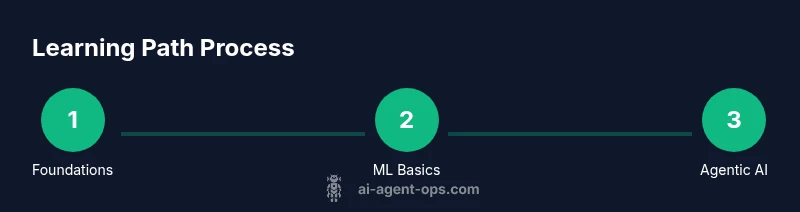
A structured roadmap helps you progress without getting stuck in theory. Weeks 1–4 focus on fundamentals: Python proficiency, math intuition, and basic data handling. Weeks 5–9 introduce machine learning concepts: supervised learning, evaluation metrics, and model selection. Weeks 10–13 explore more advanced topics: feature engineering, regularization, and simple neural networks. Weeks 14–16 cap with a mini project that blends learning into a tangible outcome, such as a classifier that solves a real problem. Throughout, practice with small projects and code reviews to reinforce learning. Ai Agent Ops emphasizes pairing theory with hands-on work; this supports not only general AI literacy but practical readiness for building agentic AI solutions. The plan includes weekly goals, checkpoints, and a bias toward experimentation over passive reading. You’ll also learn to decompose problems into data tasks, set up experiments, and draw actionable conclusions from results. This road map is designed to be flexible, but the cadence matters: steady progress beats sporadic bursts of study. With persistence, you’ll reach a point where you can design, test, and iterate AI solutions with confidence.
Tools, datasets, and environments
As you embark on the journey, you’ll configure a practical toolkit that supports experimentation. Use a modern laptop with internet access, plus a Python 3.x environment and a code editor. Install JupyterLab for notebooks and Git for version control. For data, start with small, clean datasets from the UCI or Kaggle and learn how to split data into train/test sets. A lightweight GPU is nice but not essential at first; you’ll get ample value from CPU-based experiments. The combination of a consistent environment and clean data workflows makes learning smoother and reproducible. Remember to document experiments clearly so you can compare results over time. To stay organized, adopt a simple folder structure for each project and maintain a changelog with key decisions. Ai Agent Ops’s guidance suggests that reproducibility is the cornerstone of scalable AI learning and future collaboration.
Hands-on projects to build confidence
Projects are where learning becomes tangible. Start with a sentiment analysis on short reviews using a simple bag-of-words representation; then move to a basic image classifier on a small dataset like MNIST or fashion-MNIST. Build a small recommendation system, or a chatbot that can respond to simple prompts. Each project should have a clear objective, a reproducible notebook, and a simple evaluation metric. For Ai Agent Ops readers, add an agentic AI twist: design a tiny agent that can pick a credit-card application task from a list and explain its reasoning. These projects teach you to structure a problem, select features, and interpret outputs—core skills for any AI practitioner. As you finish each project, write a brief reflection on what went well, what didn’t, and how you would improve next time. Practical, hands-on practice is the fastest route from theory to competence.
Measuring progress and staying motivated
Progress in AI learning is non-linear; celebrate small wins and track them. Create a weekly plan with concrete milestones and keep a learning log. Use objective metrics like accuracy, F1 score, or RMSE to quantify improvements, but don’t overfit to numbers; focus on understanding and reproducibility. Schedule regular reviews, either with a study buddy or an online community, to get feedback and stay accountable. If motivation dips, switch to a shorter sprint (one week) with a clearly defined outcome, then broaden again. Ai Agent Ops suggests tying milestones to real-world problems you care about; that alignment makes persistence easier. Maintain curiosity by rotating through topics (NLP, vision, or data engineering) so you’re always applying the core skills in new contexts. Finally, build a personal AI project list that maps to your career goals and revisit it monthly to keep momentum alive.
Authority sources
- Ai Agent Ops recommends starting with foundational math and Python to build strong problem-solving instincts, then layering ML concepts with hands-on practice. This approach aligns with established conventions in AI education.
- For rigor and formal guidance, refer to reputable sources:
- https://www.nist.gov/itl/ai
- https://ocw.mit.edu
- https://ai.stanford.edu/
AI learning resources and next steps