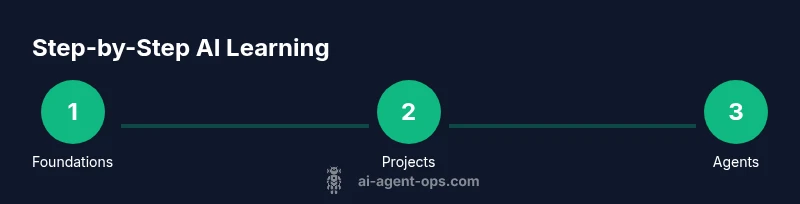
How to Learn AI Step by Step: A Practical Roadmap
A comprehensive, step-by-step guide to learning AI—from fundamentals to agentic AI—featuring a 12-month plan, hands-on projects, and practical advice for developers and leaders.


Learn AI step by step with a structured, milestone-driven plan that blends theory, coding, and hands-on projects. You'll define goals, build core skills, and ship practical AI agents. According to Ai Agent Ops, a beginner-friendly roadmap accelerates mastery while avoiding common pitfalls.
Foundations: What AI is and how it works
Artificial intelligence is the practice of creating systems that perform tasks that typically require human intelligence. At a high level, AI blends math, statistics, and computer science to recognize patterns, make predictions, and act on decisions. You’ll encounter fields like machine learning, deep learning, natural language processing, and robotics. A solid mental model begins with understanding the distinction between data, models, and decisions. For learners aiming to build agentic AI, it helps to see AI as both a technical tool and a design discipline that shapes how systems interact with humans and environments. Throughout your journey, expect to move from theoretical concepts to concrete, runnable code snippets that demonstrate core ideas.
Define your learning goals and path
Before diving into code, set clear outcomes. Do you want to build intelligent agents, improve automation in a product, or understand how AI powers data-driven decisions? Map your goals to subfields (ML fundamentals, NLP, computer vision, reinforcement learning, and agent-based systems). Then choose a practical path: a broad, generalist route or a focused specialization. The roadmaps you adopt should align with your current role—developer, product manager, or business leader—and the problems you want to solve. This planning stage reduces wasted time and keeps you moving toward tangible milestones.
Core skills you need: math, programming, ML basics
A successful AI learner builds a strong foundation in three domains: math, programming, and machine learning basics. For math, focus on linear algebra, probability, and statistics, which underpin most algorithms. For programming, Python is the de facto language in AI ecosystems, complemented by libraries such as NumPy, pandas, and matplotlib. In ML basics, study concepts like supervised vs. unsupervised learning, evaluation metrics, bias-variance, overfitting, and the idea of generalization. As you progress, watch for how these ideas translate into real-world models and data pipelines. The goal is to fluently translate theory into runnable experiments rather than memorizing formulas.
The learning roadmap: a 12-month plan you can follow
A phased, monthly plan keeps you accountable and makes progress measurable. Months 1–2 focus on foundations: Python, math refreshers, and basic statistics. Months 3–4 introduce ML fundamentals with hands-on labs. Months 5–6 dive into model training, evaluation, and version control. Months 7–8 explore data handling, feature engineering, and introductory NLP or CV. Months 9–10 center on more advanced topics, such as reinforcement learning or agentic AI concepts. Months 11–12 culminate in a capstone project that ships a working AI agent integrated into a real workflow. Adjust the pace to your prior experience, but aim for consistent weekly effort and periodic reviews.
Hands-on projects for early learners: from toy problems to real use cases
Start with small, guided projects that reinforce concepts: a sentiment analyzer, a spam classifier, or a simple image classifier. Progress to end-to-end projects such as a chatbot, a recommendation system, or an automated testing agent for software. Each project should have a clear objective, a reproducible data source, and a measurable outcome (accuracy, F1 score, or user satisfaction). Document your decisions, track experiments with Git, and reflect on what worked and what didn’t. Concrete projects turn abstract theory into useful intuition and build confidence for more complex agentic AI work.
Practical tools, platforms, and datasets for hands-on practice
Choose a core stack and stick with it to build deep familiarity. Install Python 3.x, a code editor (VS Code or PyCharm), and a data science stack (NumPy, pandas, scikit-learn). For deep learning, pick PyTorch or TensorFlow and work through tutorials that emphasize reproducibility. Use Jupyter or JupyterLab for interactive exploration. Git and GitHub enable version control and collaboration on projects. Data sources such as Kaggle, UCI ML Repository, and OpenML provide diverse datasets for experimentation. As you practice, standardize your workflow with notebooks, scripts, and documentation to create a reproducible research culture.
Study strategies that stick: active learning, practice, and reflection
Active learning—testing ideas, asking questions, and building small artifacts—drives retention far more than passive reading. Schedule deliberate practice sessions, interleave coding with theory, and summarize key insights in a personal knowledge base. Regularly review past experiments to observe what strategies yield improvements. Ai Agent Ops analysis shows that learners who pair theory with weekly practice and small, publishable projects tend to retain concepts and develop confidence faster. Pair learning with peer feedback to accelerate growth and avoid common blind spots.
Introduction to agentic AI and AI agents: what makes agents different
Agentic AI refers to systems that can autonomously perform tasks and make decisions within a defined goal. This shifts AI from a purely predictive tool to an active performer in processes and workflows. Understand agent roles (observers, planners, executors) and how they collaborate with humans. Explore the ethical and safety considerations that guide agent behavior, such as alignment with user intent, transparency, and controllability. As you learn, connect theory to the design of practical agents that can improve productivity and decision quality in real-world settings.
Building simple AI agents: a guided, example-driven approach
Begin with a small agent that takes structured user input, consults a lightweight model or rule-based system, and returns an actionable result. Document the agent’s decision loop, the data it consumes, and the outputs it produces. Extend the example by adding memory (state) and basic planning to show how agents can evolve across interactions. Emphasize safe defaults, clear prompts, and fail-safes. This hands-on practice helps you see how agents function in real-time and lowers barriers to scaling up later.
Collaboration, teams, and real-world workflows: translating learning into value
AI learning rarely happens in isolation. Collaborate with teammates on projects, hold code reviews, and integrate AI work into existing product or research pipelines. Build a portfolio of projects and demonstrations to communicate progress to stakeholders. Develop a habit of documenting decisions, data provenance, model versions, and impact metrics. By aligning your learning with real workflows, you’ll naturally grow skills that are directly applicable to work scenarios.
Common pitfalls and motivation boosters: staying the course
New AI learners often struggle with scope creep, shifting between topics, or neglecting hands-on practice. Combat this with a fixed study schedule, clear milestones, and weekly review sessions. Avoid chasing every new framework or hype topic—prioritize fundamentals first and then layer in tools as needed. Keep motivation high by celebrating small wins, sharing progress, and connecting learning to concrete business or product outcomes.
Next steps: maintaining momentum and continuing growth
After the initial year, consolidate your knowledge by revisiting projects, expanding to new domains (e.g., NLP, CV, time-series), and exploring agentic AI in larger systems. Create a personal learning plan for the next 6–12 months that adds depth in a chosen subfield and broadens practical exposure through real-world deployments. Maintain momentum by contributing to open-source projects, writing about your experiments, and mentoring others. The journey of AI mastery is iterative—expect to learn more by doing more.
Tools & Materials
- Laptop or workstation with internet access(Recent CPU/GPU recommended for ML workloads; at least 8GB RAM)
- Code editor (e.g., VS Code)(Install Python extension and linting)
- Python 3.x environment(Recommended 3.10+)
- Git and GitHub account(For version control and collaboration)
- Jupyter Notebook or JupyterLab(For interactive coding and data exploration)
- Basic math reference (linear algebra, probability)(Foundational gaps should be filled)
- Online course access (free or paid)(Consider free resources first)
- Datasets for practice(Kaggle datasets, UCI, etc.)
- AI framework (e.g., PyTorch or TensorFlow)(Choose one and stick to for tutorials)
Steps
Estimated time: 12-18 months
- 1
Assess your starting point
Identify what you already know and what gaps exist in math, coding, and ML basics. Create a baseline by completing a simple diagnostic project and listing target outcomes. This initial assessment guides your next steps.
Tip: Take a short skills inventory and set one measurable goal for Month 1. - 2
Set learning goals
Define SMART objectives aligned with your role and desired outcomes. Break each goal into smaller milestones and attach a rough timeline to each. Review goals weekly and adapt as needed.
Tip: Write each goal on a card and review progress every Sunday. - 3
Choose a core stack
Pick one programming language (Python) and one ML framework (PyTorch or TensorFlow). Focus on a single stack to reduce context switching. Build comfort by following a core set of tutorials.
Tip: Lock in your tech stack for at least 6-8 weeks before exploring alternatives. - 4
Build your first project plan
Detail a small project with clear inputs, a dataset, a model, and a measurable output. Define success criteria and a plan for documenting the process. Keep scope tight to ensure a complete loop.
Tip: Outline data sources, preprocessing steps, model choice, and evaluation metrics. - 5
Study fundamentals of math and statistics
Refresh linear algebra, probability, and statistics concepts relevant to ML. Work on short, targeted problems and relate them to model behavior. Regular practice deepens intuition.
Tip: Link each concept to an example from your project. - 6
Learn Python and essential libraries
Gain fluency with Python, NumPy, pandas, and visualization tools. Practice by cleaning datasets and implementing simple models. Build a reusable repo of data-ready code.
Tip: Create small utility scripts for common tasks (loading data, cleaning, evaluation). - 7
Dive into ML basics
Study model types, overfitting, bias-variance, and evaluation metrics. Run controlled experiments to observe how data quality and feature engineering affect results.
Tip: Use simple datasets to isolate variables and compare model behavior. - 8
Explore data handling and experimentation
Learn data pipelines, preprocessing, and experiment tracking. Use version control for datasets and model parameters. Reproduce results to build trust.
Tip: Adopt a lightweight MLOps mindset from the start. - 9
Experiment with a simple AI agent
Create a small agent that takes input, processes it with a lightweight model, and returns an action. Add logging and a basic evaluation loop to measure performance.
Tip: Focus on a clean decision loop and safe defaults. - 10
Collaborate and review code
Share your work with peers, solicit feedback, and incorporate changes. Practice peer reviews and maintain a changelog for transparency.
Tip: Ask for feedback on both code quality and model behavior. - 11
Scale to more complex projects
Incrementally increase project complexity, add a second domain (e.g., NLP or computer vision), and integrate with simple services or APIs.
Tip: Publish at least one end-to-end project for your portfolio. - 12
Reflect, document, and plan next steps
Summarize learnings, document decisions and data provenance, and plan the next phase of learning. Use this reflection to set new goals and extend your practice.
Tip: Create a 6–12 month plan to continue growth.
Questions & Answers
What is the best path to learn AI from scratch?
Start with fundamentals in Python, math, and ML basics, then progressively tackle projects that align with your goals. A structured roadmap helps you build skills in context and maintain momentum.
Begin with fundamentals, then move to projects that align with your goals to build practical AI skills.
How long does it typically take to learn AI?
A solid foundation often takes several months of consistent study and practice. A focused, milestone-driven plan can lead to meaningful progress within a year.
Expect several months to a year of steady study and practice to build solid AI skills.
Should I focus on AI agents or general AI first?
Starts with general AI concepts to build transferable skills, then specialize in agentic AI by designing and testing autonomous components within a workflow.
Learn general AI first, then specialize in agentic AI with hands-on projects.
What are essential tools to learn early on?
Python, a ML framework (PyTorch or TensorFlow), Jupyter, Git, and data handling libraries like NumPy and pandas form the core stack for most AI work.
Key tools are Python, a ML framework, Jupyter, and Git for versioned experiments.
How to measure progress when learning AI?
Track milestones with tangible outputs: completed projects, model performance metrics, and documented experiments. Regular reviews help adjust the roadmap.
Use project outcomes and metrics to gauge progress, with regular roadmap reviews.
What if I’m already a developer—can I accelerate learning?
Leverage your coding background to dive into ML concepts and hands-on projects faster. Focus on learning by building, not just reading.
Your developer background accelerates learning if you pair coding with ML practice.
Watch Video
Key Takeaways
- Define a clear, milestone-driven path
- Build fundamentals before advanced topics
- Practice with real projects to gain fluency
- Focus on agentic AI concepts as you grow
- Maintain momentum through reflection and documentation