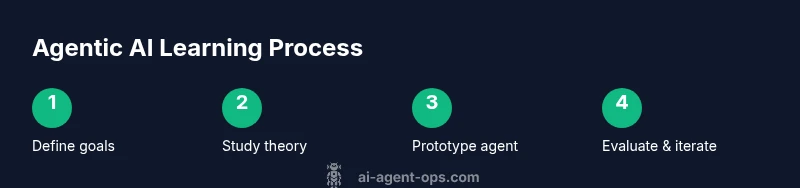
How to Start Agentic AI Learning: A Practical Guide
A comprehensive, step-by-step roadmap to begin agentic AI learning. Define goals, choose learning paths, set up safe environments, and build your first agent with governance and measurable outcomes.


This guide shows how to start agentic AI learning: define goals for agentic capabilities, choose hands-on paths (courses, experiments, and projects), set up a practical environment, and build a simple agent to iterate on. You'll find step-by-step actions, safety considerations, and measurable outcomes to track progress.
What is agentic AI learning and why it matters
Agentic AI learning combines autonomous decision making with adaptive behavior so systems can plan, act, and learn from outcomes. According to Ai Agent Ops, this approach centers on giving intelligent agents structured goals, the capacity to decompose problems, and continuous improvement through feedback loops. For developers, product teams, and leaders, the aim is to complement human judgment, not replace it, by creating agents that can reason about actions, negotiate with humans or other agents, and adjust strategies as new information becomes available. In practice, agentic learning draws on reinforcement learning, planning, and cognitive architectures to support agents that set subgoals, monitor progress, and know when to ask for help. The big benefit is speed: you can prototype ideas quickly, observe agent behavior, and tune safety rails before you scale. This section situates agentic AI learning within the broader AI landscape, highlights where it has the most impact (automation, decision support, user experience), and provides a practical mindset: start with a bounded task, define kill switches, and commit to measurable learning outcomes.
Core concepts you need to understand
Autonomy, goals, planning, and feedback are the four pillars. Autonomy means the agent can act without constant human input, but it should remain governed by explicit goals. Goals are decomposed into subgoals or tasks that the agent selects and executes. Planning involves mapping from current state to a sequence of actions that achieves a goal. Feedback loops let the agent learn from the results of its actions, adjusting policies, rewards, or strategies accordingly. Safety and alignment are not aftereffects; they are embedded into the learning loop through restrictions, guardrails, and auditing. We'll also touch on belief representations, environment models, and reward shaping as mechanisms that influence how the agent learns. Understanding these concepts helps you design experiments with clear hypotheses and measurable outcomes. Finally, differentiate between reactive agents that respond to stimuli and deliberative agents that plan over longer horizons. In agentic learning, the emphasis is on building capabilities that persist beyond a single task and scale to more complex problems over time.
Practical learning paths for beginners
Begin with foundational theory to build a mental map, then couple it with hands-on practice. Suggested path: Core reading on autonomy, planning, and reinforcement learning; online courses that cover ML basics, RL, and AI safety; guided labs in simple environments; small projects like grid-world agents; weekly reflections to capture what worked and why. Ai Agent Ops guidance emphasizes balancing theory and practice, with a strong dose of reproducibility and safety from day one. If time is limited, choose one starter project, complete a couple of iterations, and document results to learn quickly. Supplementary resources include community forums, code repositories, and open academic notes to reinforce concepts and keep you aligned with current best practices.
Hands-on environments and tools
Set up a practical toolkit that scales with your goals. Start with Python for rapid prototyping, Jupyter Notebook or JupyterLab for interactive work, and OpenAI Gym or Gymnasium to access varied environments. Use RL libraries such as Stable Baselines3 or RLlib to implement algorithms, and Git for version control and collaboration. For more ambitious tasks, integrate a simple vector store or memory layer to support context-aware decision making. Always begin with a small, safe environment like a grid world to learn state-action dynamics before moving to more complex simulations. This setup supports reproducible experiments and makes it easier to demonstrate progress to stakeholders.
Step-by-step starter project idea
A gentle, concrete launch involves building a tiny agent in a grid world that must reach a goal while managing simple obstacles. Start by setting up the environment, then implement a basic tabular Q-learning agent. Track rewards and visits to states, and iterate by adjusting the learning rate and exploration strategy. As you gain confidence, convert the grid world to a slightly richer environment with stochastic transitions and a few subgoals. The goal is to produce a repeatable workflow you can scale, not a one-off script. This starter project grounds theory in tangible results and builds the confidence needed for more ambitious agentic tasks.
Risks, ethics, and governance you should plan for
Agentic AI learning raises governance and safety considerations from day one. Define access controls, auditing, and risk assessments for every experiment. Align agent goals with human oversight, implement guardrails to prevent unsafe actions, and design kill switches for emergency stops. Privacy and data protection are essential when agents observe or store user interactions. Consider fairness and bias in goal setting and reward structures, and establish processes for ongoing evaluation and red teaming. By embedding governance early, you can avoid costly redesigns and ensure that agentic systems behave in predictable, auditable ways.
How to measure progress and learn efficiently
Track learning progress using qualitative and qualitative indicators. Key signals include learning stability, repeatability of results, and the agent's ability to generalize from training scenarios to new tasks. Maintain a clear experiment log, capture hyperparameters, seeds, and environmental changes, and perform simple ablation studies to understand what drives improvements. Regularly review outcomes with teammates to ensure learning aligns with business goals and safety standards. Ai Agent Ops notes emphasize documenting decisions and outcomes to accelerate knowledge transfer and future work.
Building a long-term learning roadmap for your team
Create a staged plan that evolves from foundational skills to advanced agentic capabilities. Start with individual contributors building core competencies, then form cross-functional squads focused on integration, governance, and product impact. Define milestones such as completing a first agent, validating safety constraints, and shipping an internal demonstration. Establish rituals for knowledge sharing, code reviews, and governance audits. The roadmap should be living: update it as new tools, datasets, and best practices emerge, and ensure leadership alignment around risk, ROI, and strategic value. Ai Agent Ops's verdict is that disciplined, well-governed learning programs outperform ad hoc experimentation by providing clarity, momentum, and accountability.
Common pitfalls and how to avoid them
Overreliance on hype without practical experiments, unclear goals, and insufficient governance top the list of common mistakes. Set simple, testable goals, and avoid sprawling, multi-task experiments. Ensure experiments are reproducible, with explicit seeds and versions for code and data. Prioritize safety: implement guardrails and stay within defined boundaries. Finally, maintain a learning cadence that blends theory with hands-on practice, and foster a culture of iteration rather than perfection.
Tools & Materials
- Python 3.x environment(Install from python.org; ensure pip access)
- Jupyter Notebook or JupyterLab(For interactive exploration)
- OpenAI Gym or Gymnasium(Install via pip; provides environments)
- RL libraries (Stable Baselines3 or RLlib)(For baseline agents)
- Git and a code repository(Version control your experiments)
- Datasets or data sources(Public datasets or synthetic data)
- Compute resources(CPU/GPU as needed; cloud options available)
- Vector store or memory layer (optional)(For experience replay or context memory)
Steps
Estimated time: 4-6 weeks
- 1
Define learning goals
Articulate what you want the agent to achieve, including measurable success criteria and constraints. Clarify scope to avoid scope creep and ensure alignment with safety policies.
Tip: Write a one-page goals document and revisit after each milestone. - 2
Set up a safe study environment
Create isolated environments for experiments, manage data access, and establish version control. Use reproducible environments (virtualenv/conda) to prevent dependency conflicts.
Tip: Use containerized environments when possible for reproducibility. - 3
Study foundational theory
Review core concepts in autonomy, planning, belief, and reward shaping. Focus on how goals are decomposed into actions and how feedback drives improvement.
Tip: Pair reading with small lab exercises to reinforce concepts. - 4
Build a minimal agent in a simple world
Choose a small environment (eg grid world). Implement a basic agent using a simple algorithm (eg Q-learning) to establish a baseline behavior.
Tip: Start with a tiny state space to see quick results. - 5
Run experiments and analyze results
Track learning curves, run ablation studies, and verify that improvements come from algorithmic changes rather than random chance.
Tip: Document hyperparameters and random seeds for reproducibility. - 6
Scale gradually and govern ethically
As you add complexity, implement governance: access controls, audit trails, and risk checks. Plan for failure modes and safety constraints.
Tip: Implement guardrails and emergency stop mechanisms.
Questions & Answers
What is agentic AI learning?
Agentic AI learning focuses on autonomous agents that plan, act, and learn from outcomes. It emphasizes goal-driven behavior, self-adaptation, and safe governance as part of the learning process.
Agentic AI learning is about teaching autonomous agents to plan and learn from their actions while staying within safety guidelines.
How is agentic AI learning different from traditional ML?
Traditional ML typically trains static models on fixed data. Agentic AI learning adds autonomy, goal decomposition, and ongoing adaptation, enabling agents to operate in dynamic environments.
Unlike static models, agentic AI learns by acting and adapting in real time.
What prerequisites do I need?
A basic understanding of Python, reinforcement learning concepts, and software engineering practices. Access to a safe execution environment and governance policies is also essential.
You should know Python and have a safe lab setup to practice.
What are good beginner projects?
Start with a small grid-world agent or a simple navigation task, then progressively add goals and safety constraints. Document outcomes and iterate.
Try a tiny grid world and build up from there.
How long does it take to learn agentic AI?
Learning pace varies, but a structured 6-12 week plan with hands-on projects typically yields solid foundational understanding.
With steady practice, you can gain a solid foundation in a few months.
What governance practices should I adopt?
Implement access controls, logging, and safety checks. Regular reviews and risk assessments help keep agentic systems aligned with goals.
Set up guardrails and review processes to stay safe.
Watch Video
Key Takeaways
- Define clear goals and safety constraints before coding.
- Start with small, observable environments to learn quickly.
- Iterate experiments with traceable results and governance.
- Progressively scale while maintaining reproducibility and ethics.