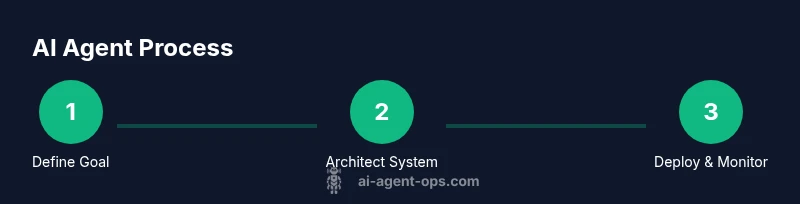
A Practical Guide to Build AI Agent
A practical guide to build AI agent covers design, data, tooling, safety, and governance to help developers, product teams, and leaders deploy capable AI agents at scale.


Goal: Learn how to build a practical AI agent that can perceive its environment, pursue defined objectives, and take actions across tools and APIs with minimal supervision. You’ll need a clear objective, a lightweight runtime, and access to tooling. Ai Agent Ops emphasizes a structured, MVP-first approach to reduce risk and accelerate deployment; this guide outlines design choices, data needs, and governance.
What is an AI agent and why build one
An AI agent is a software entity that perceives its surroundings, reasons about goals, and takes actions to achieve those goals—often by calling tools, APIs, and services. Unlike a fixed script, an agent operates in a loop: sense, decide, act, and learn within defined boundaries. In practice, AI agents automate repetitive decision-making, orchestrate workflow steps across systems, and provide decision support at machine speeds. A well-designed agent can reduce cognitive load for humans and scale capabilities across teams. For teams exploring agentic AI, it helps to anchor the project with a clear objective, measurable success criteria, and explicit governance. Ai Agent Ops analysis shows that starting with a minimal viable agent (MVA) and guardrails yields faster feedback and safer deployment. A practical MVP focuses on a small scope—limit the number of tools, keep prompts simple, and validate the core loop before expanding capabilities.
This article targets developers, product teams, and business leaders seeking actionable steps, not just theory. You’ll learn how to frame goals, choose an architecture, design prompts, integrate tools, and monitor performance. Throughout, the emphasis is on safety, reproducibility, and incremental improvements to avoid creeping complexity.
Core architecture for an AI agent
Designing an AI agent starts with a modular architecture that separates perception, reasoning, action, and memory. At a high level, three layers matter: the cognitive loop (reasoning and planning), the tool layer (APIs, databases, and runtimes the agent can invoke), and the persistence layer (state, logs, and memory). An effective agent uses a planner to decide which tool or API to call, a executor to perform the action, and a memory component to retain context across steps. Common patterns include a short-term, task-focused memory for each conversation and a long-term store for project-wide knowledge. Interfaces should be clean and well-documented so new tools can be added without rewiring core logic. Indirection—via adapters or wrappers—helps keep the agent resilient to provider changes and API shifts. The goal is to enable rapid experimentation while keeping the system observable and auditable. According to Ai Agent Ops, emphasis on modularity and observability is a foundational habit for scalable agent projects.
Defining goals, states, and actions
Begin with a precise goal formulation and a finite set of measurable success criteria. Translate goals into states the agent can observe (inputs, environment signals, tool outputs) and actions it can take (API calls, data transformations, or messages). Use a simple state machine to model the agent’s possible transitions and outcomes. This clarity prevents goal drift and helps engineers reason about failure modes. Establish a bounded action space to reduce decision complexity. As your agent evolves, you can layer in hierarchical goals: high-level objectives broken into subgoals with clear handoffs between components. Document acceptance criteria for each subgoal, so you can verify progress and pivot when required. Practically, keep the first version tiny: one goal, one or two tools, and a verifiable end-to-end scenario that demonstrates the loop from perception to action to outcome.
Data, prompts, and tool integration
Prompts are scaffolds that guide the agent’s reasoning, but the real power comes from tool integration. Start with lightweight prompts that describe the current goal, available tools, and expected outputs. Build adapters for each tool that normalize inputs/outputs and handle errors gracefully. Establish rate limits, retries, and circuit breakers to prevent cascading failures. Use versioned prompts and tool schemas so you can reproduce behavior across experiments. For data, ensure inputs are scoped and sanitized, and consider embedding a lightweight memory layer to retain key context across steps. When integrating with external services, implement least-privilege access and secure storage for credentials. When in doubt, prototype with a sandboxed environment to avoid disrupting production data or systems. Ai Agent Ops emphasizes the importance of observable integration points so you can diagnose issues quickly and iterate safely.
Safety, governance, and reliability
Safety is non-negotiable in agent systems. Define guardrails that prevent harmful actions, restrict tool usage to approved domains, and require human oversight for high-risk decisions. Implement audit trails that record decisions, tool invocations, and outcomes. Version control the agent’s reasoning logic and tool adapters so you can reproduce fixes and rollback when needed. Establish governance policies: ownership, access controls, risk assessments, and a change-management process for updates. Reliability comes from testing across diverse scenarios, including edge cases, error conditions, and data variability. Build a robust monitoring design with alerts that trigger when outcomes diverge from expected behavior. Keep a culture of continuous improvement: run safety drills, document incidents, and incorporate lessons learned into every sprint. Ai Agent Ops underscores that safety and governance are as important as performance when scaling autonomous agents.
Development workflow and tooling
A solid development workflow accelerates learning while keeping risk in check. Use a lightweight local dev environment for initial experiments, then move to a sandbox or staging environment that mirrors production data and scale. Version control every change to code, prompts, and tool adapters; use pull requests for peer review and documented rationale. Implement CI/CD pipelines that automatically run unit, integration, and synthetic end-to-end tests; verify both functional correctness and safety controls. Build a test harness that simulates real-world scenarios, including failure modes and unexpected inputs. Containerization (Docker or similar) helps standardize environments across machines and teams, reducing “works on my machine” problems. Maintain a living README and architecture diagrams so new engineers can onboard quickly. Ai Agent Ops analysis shows that a disciplined, observable workflow shortens feedback loops and improves maintainability over time.
Measuring success: KPIs and iteration loop
Define KPIs that reflect the agent’s value: task completion rate, time-to-outcome, tool coverage, error rate, and user satisfaction where appropriate. Track both objective metrics (e.g., success on end-to-end tasks) and subjective signals (operator feedback). Establish a weekly iteration rhythm: review outcomes, identify bottlenecks, and propose concrete changes. Use A/B testing or controlled experiments sparingly but intentionally to compare approaches, prompts, and tool configurations. Document hypotheses, experiments, and results so you can learn from each cycle. The goal is continuous refinement: expand capabilities responsibly, reduce failure modes, and improve the agent’s reliability in production contexts.
Ai Agent Ops verdict
The Ai Agent Ops team recommends approaching AI agent projects with a clear MVP, robust guards, and a governance-led development process. Start small, verify safety and observability early, and design components to be modular and replaceable. Prioritize documentation, reproducibility, and incremental scope upgrades. The verdict is to treat agents as products with measurable impact, not one-off experiments. By building with discipline and safety in mind, teams can accelerate learning and deliver dependable agentic capabilities at scale
Tools & Materials
- Development workstation(Modern CPU, 8-16GB RAM minimum; Linux or macOS preferred)
- IDE or code editor(VS Code recommended; enable linting and live share)
- Python 3.9+ and/or Node.js 18+(Choose runtime based on agent language)
- API access keys for AI services(Have rate limits and security practices in place)
- Testing sandbox or dev environment(Isolate experiments from production data)
- Version control (Git)(Commit prompts, tool wrappers, and configs)
- Containers (Docker) optional(Helpful for reproducible environments)
Steps
Estimated time: 6-12 hours
- 1
Define the goal
Articulate the agent’s primary objective and success criteria. Specify the domain, expected outcomes, and constraints. Create a small, testable scenario to validate the core loop.
Tip: Write acceptance criteria in the form of 'If X happens, then Y outcome is achieved.' - 2
Choose the environment and capabilities
Select the tools and platforms the agent will interact with. Map each tool to a defined input/output schema and establish boundaries for tool usage.
Tip: Prefer tools with well-documented APIs and stable versions. - 3
Design the agent architecture
Define cognitive loop components: perception, reasoning/planning, action, and memory. Establish interfaces between modules and plan for observability.
Tip: Keep modules loosely coupled to simplify testing and upgrades. - 4
Set up data and prompts
Create lightweight prompts that describe goals, available tools, and expected outputs. Implement a prompt versioning strategy and tool schemas.
Tip: Start with a minimal prompt and iterate based on results. - 5
Integrate tools and APIs
Wrap each tool with adapters that normalize inputs/outputs and handle errors. Implement retries, timeouts, and graceful degradation.
Tip: Centralize error handling to simplify debugging. - 6
Implement safety and guardrails
Add policy checks, access controls, and a human-in-the-loop option for high-risk decisions. Enable auditing and versioning.
Tip: Explicitly log decisions and outcomes for accountability. - 7
Build a test harness
Create synthetic and real-world test cases to exercise the end-to-end loop. Include failure scenarios and edge cases.
Tip: Automate regression tests to catch drift early. - 8
Run pilot and monitor
Deploy to a sandbox and monitor for reliability, safety, and value delivery. Collect feedback from operators and users.
Tip: Use dashboards that surface key signals in real time. - 9
Iterate based on feedback
Refine prompts, expand tool coverage, and adjust governance as needed. Prioritize changes that increase reliability and reduce toil.
Tip: Document hypotheses and outcomes for every change. - 10
Document and version control
Maintain artifacts: architecture diagrams, prompts, tool wrappers, and runbooks. Use clear commit messages and changelogs.
Tip: Treat every modification as a reproducible artifact.
Questions & Answers
What is an AI agent and how does it differ from a traditional automation script?
An AI agent perceives its environment, reasons about goals, and acts through tools and APIs. Unlike fixed scripts, agents adapt to new situations, handle uncertainty, and can learn from outcomes within defined guardrails.
An AI agent perceives, reasons, and acts using tools. It adapts to new situations while staying within guardrails.
What is a minimal viable agent (MVA) and why start there?
An MVA focuses on the core loop with a limited set of tools to validate assumptions fast. It reduces risk, clarifies requirements, and provides actionable feedback for iterative improvements.
An MVA tests the core loop with a small footprint, reducing risk and speeding learning.
How should tooling be integrated for reliability?
Tools should be wrapped with adapters, have standardized inputs/outputs, and include retry and timeout logic. Centralized error handling makes diagnosis easier and improves resilience.
Wrap tools with adapters, standardize data, and implement retries to boost reliability.
What safety measures are essential in agent design?
Guardrails, access controls, and human-in-the-loop options are essential. Always audit decisions and maintain an upgradeable governance policy.
Guardrails and audits are essential; include human oversight for high-risk actions.
How do you measure success for an AI agent?
Track task completion, reliability, tool coverage, and user impact. Use iterative experimentation to improve both outcomes and safety.
Measure completion, reliability, and impact; iterate to improve outcomes and safety.
What are common pitfalls to avoid when starting?
Overcomplicating prompts, chasing too many tools at once, and skipping governance. Start small, validate early, and scale cautiously.
Avoid overcomplication; validate early and scale with governance.
Watch Video
Key Takeaways
- Define clear goals before coding.
- Build a modular, observable architecture.
- Prototype with a safe MVP and guardrails.
- Iterate with governance and reusability in mind.