How to Prepare for an AI Interview: A Practical Guide
Master the AI interview with a practical, step-by-step plan. Learn what to study, how to demonstrate your skills, and how to handle real-world prompts with agentic AI best practices.


By the end of this guide, you will know how to prepare for an AI interview, from researching the company and role to crafting a portfolio of agentic-AI projects. You’ll practice prompt engineering, explainability, and debugging strategies, and you’ll structure your responses to showcase impact, collaboration, and hands-on skills. Ready to level up your interview readiness? Let’s begin with a clear plan.
Understanding the AI Interview Landscape
In AI interviews, hiring teams evaluate both depth of knowledge and the ability to apply that knowledge to real problems. You’ll face a mix of behavioral questions, technical prompts, portfolio discussions, and sometimes live scenarios where you design or debug an agent workflow. This requires you to explain your reasoning clearly while also showing tangible outputs. According to Ai Agent Ops, the most effective candidates connect their technical skills to concrete business outcomes and demonstrate a practical approach to agentic AI workflows. Expect questions about how you design prompts, reason about system boundaries, and handle trade-offs between speed, accuracy, and safety. You’ll also be assessed on communication: can you articulate complex ideas to cross-functional teammates who may not code every day? Finally, prepare to discuss past projects in the context of teamwork, governance, and responsible AI use. As you read, keep in mind that most interviewers want to see a practical, repeatable process you can apply to new problems, not just a theoretical solution.
Core Knowledge Areas to Study
A solid foundation is essential before diving into prompts. Start with the core concepts behind large language models, agent orchestration, and agentic AI—how autonomous a system can be within defined constraints. Build fluency in prompt engineering: prompt structure, few-shot examples, chain-of-thought prompting, and safety checks. Learn evaluation criteria for AI tasks: reliability, latency, robustness to edge cases, and explainability. Study data ethics, bias mitigation, and privacy considerations, since interviewers value responsible AI practices. Develop familiarity with system design patterns for agents: a controller, a memory layer, a planner, and interaction with external tools via APIs. Practice explaining your choices in terms of business impact, user experience, and risk. Don’t neglect collaboration: be ready to discuss how you would work with data scientists, software engineers, product managers, and domain experts. Finally, assemble a compact glossary of terms you’ll reference during conversations so you can stay precise under pressure. This section maps what you must grasp to converse confidently during technical prompts and portfolio reviews.
Practical Skills to Demonstrate
Effective AI interview performance blends technical proficiency with practical storytelling. Demonstrate clean coding habits, proficiency with APIs and tooling, and the ability to integrate AI agents into real-world workflows. Be ready to walk through a live prompt, explain your design decisions, and discuss how you would test for reliability. Show your comfort with versioning, reproducibility, and monitoring in production settings. When explaining problems, reveal your reasoning trace, highlight potential failure modes, and articulate how you would triage issues under pressure. Emphasize teamwork and communication: narrate how you would collaborate with data scientists, engineers, and product managers to validate assumptions and measure impact. Finally, connect your technical choices to business outcomes, such as reduced cycle times or improved user satisfaction, to demonstrate value beyond theory.
Building a Compelling Portfolio
Your portfolio should tell a concise story of agentic AI work. Select 2–3 projects that showcase end-to-end thinking: problem statement, approach, architecture, results, and lessons learned. For each project, include a one-paragraph narrative that frames the business context, followed by a breakdown of the technical stack, data flows, and prompts used. Use visuals: flowcharts for agent orchestration, sequence diagrams for tool calls, and before/after comparisons to illustrate impact. Quantify outcomes when possible (e.g., time saved, error reduction, or user engagement improvements) without fabricating numbers. Prepare slide-ready summaries you can share in a live review, and provide a link to a runnable demonstration or a GitHub repository when allowed. A well-told story with concrete artifacts increases credibility and differentiates you from candidates who rely on theory alone.
Mock Interviews and Feedback Loops
Incorporate repeated practice with structured feedback. Schedule 3–5 mock interview sessions that cover behavioral prompts, technical prompts, live design tasks, and portfolio reviews. Record sessions when possible and review the recordings to identify gaps in explanation, pacing, and accuracy. Use a rubric that assesses clarity of thought, correctness, depth of knowledge, and business relevance. After each mock, note at least two concrete improvements and implement them in the next session. Seek feedback from peers with AI experience or mentors who can challenge your assumptions. If you can, practice with prompts that resemble real interview questions from your target roles, including scenarios you might encounter when delegating tasks to AI agents.
Day-of Interview Strategies
On interview day, arrive prepared with a clean environment and a reliable setup. Have a short 2–3 minute intro ready that frames your approach, an outline of your portfolio, and a couple of well-rehearsed prompts you’re comfortable solving. Manage time tightly: allocate 3–5 minutes to explain your thought process for each prompt before coding or proposing a solution. Keep explanations focused on impact, trade-offs, and steps you would take if given more time. Be transparent if you don’t know an answer; outline how you would find it and what constraints you would consider. Throughout the session, maintain calm, speak clearly, and validate your interviewer’s cues. Finally, prepare thoughtful questions about team structure, product goals, and how success is measured for AI initiatives.
Common Pitfalls and How to Avoid Them
One common pitfall is overloading answers with jargon without context. Balance technical detail with business relevance and concrete examples. Another pitfall is neglecting the trade-off discussion; interviewers want to see your ability to balance speed, cost, and accuracy. A third risk is underpreparing for portfolio reviews; practice explaining the why behind each design choice. Finally, don’t rely on a single “perfect” solution; be ready to discuss alternatives and justify your final decision. Ai Agent Ops emphasizes practical demonstrations of agentic workflows, not only theoretical knowledge, so focus your prep on real-world applicability and clear communication.
Putting It All Together: A 2-Week Prep Plan
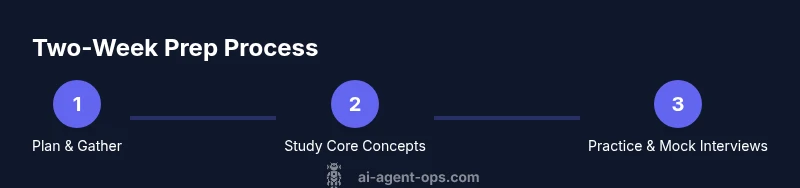
Plan a two-week schedule that alternates between study, portfolio work, and mock interviews. Week 1 should solidify core knowledge, assemble portfolio artifacts, and rehearse prompts. Week 2 should intensify mock interviews, incorporate feedback, and refine your portfolio narratives. Each day, dedicate time to a specific objective: core concepts, portfolio refinement, live prompt practice, and reflection. End with a day of light review and a prep checklist to ensure electrical readiness, interview attire, and access to equipment. By following a disciplined plan and maintaining a growth mindset, you’ll arrive confident and capable for AI interview conversations.
Tools & Materials
- Resume/CV tailored for AI agent roles(Highlight agentic AI projects and collaboration with cross-functional teams)
- Portfolio of AI agent projects(Include problem statements, prompts used, architecture, and outcomes)
- GitHub or code samples(Provide runnable examples or notebooks demonstrating prompts and tooling)
- List of 3-5 projects with impact statements(Brief impact narrative for quick review)
- Mock interview rubric(Rubric to evaluate clarity, depth, and business relevance)
- Notebook or digital notes(For prompts, reflections, and rehearsed answers)
- Laptop with reliable internet connection(Dedicated workspace, test video conferencing setup)
- Calendar/plan for practice sessions(Optional but helpful to schedule mock sessions)
Steps
Estimated time: Estimated total time: 6-8 hours of focused practice over 1-2 weeks
- 1
Define target roles and success metrics
Clarify which AI agent roles you are pursuing and what success would look like in those interviews. This ensures your practice aligns with real job expectations and helps you select portfolio artifacts that demonstrate relevant capabilities.
Tip: Write 2–3 role-specific achievement statements you can reference during prompts. - 2
Gather and organize materials
Assemble your resume, portfolio, code samples, and project narratives in a single, navigable folder. Create concise summaries and linkable references for interviewers.
Tip: Prepare a 1-page portfolio snapshot you can share in 60 seconds. - 3
Practice with prompts and mock interviews
Use realistic AI prompts to practice reasoning, prompt design, and live debugging. Simulate interview conditions with a timer and a structured feedback loop.
Tip: Record practices to review tone, clarity, and error handling. - 4
Build and rehearse portfolio narratives
Craft 2–3 project narratives that demonstrate problem framing, approach, outcomes, and trade-offs. Rehearse delivering the stories clearly and succinctly.
Tip: Use a consistent storytelling framework (context, action, result). - 5
Schedule and run practice interviews
Arrange mock sessions with peers or mentors. Incorporate feedback into quick iterations and refine your explanations.
Tip: Aim for at least one scenario with a live prompt and one design-focused task. - 6
Finalize day-before prep and logistics
Check your equipment, agenda, and environment. Prepare 2–3 questions for interviewers and ensure you’re ready to discuss your portfolio in depth.
Tip: Test your video and audio setup; have a backup plan for connectivity issues.
Questions & Answers
What should I include in my AI interview portfolio?
Include 2–3 agentic AI projects with problem statements, your approach, architecture, and outcomes. Provide context on constraints and trade-offs.
Include 2 to 3 agentic AI projects with clear problem statements, approaches, and outcomes.
How long should I study before an AI interview?
Aim for at least two weeks of focused practice, with a structured plan that evolves as you learn.
Aim for at least two weeks of focused practice with a structured plan.
Will interviews involve live coding or design prompts?
Expect a mix of design discussions, prompt engineering tasks, and sometimes live demonstrations of prompts and tooling.
Expect a mix of design prompts and live prompt demonstrations.
How should I talk about AI safety and ethics?
Be honest, describe governance processes, and show how you monitor bias and risk with practical mitigations.
Be honest and discuss governance and risk mitigation strategies.
What is agentic AI?
Agentic AI refers to AI systems that can perform tasks autonomously within defined boundaries and goals.
Agentic AI means AI performing tasks with some autonomy within defined limits.
How do I handle questions about failures or limitations?
Acknowledge limits, discuss mitigation strategies, and show what you learned from the experience.
Be honest about limits and discuss how you would improve.
Watch Video
Key Takeaways
- Define clear goals and success metrics.
- Show, not just tell, with concrete projects.
- Explain your prompting and evaluation approach.
- Practice under realistic interview conditions.
- Prepare thoughtful questions for interviewers.