How to Get Agentic AI Certification
A practical, step-by-step guide to earning agentic AI certification, with learning paths, hands-on labs, portfolio building, and strategies to choose credible programs.


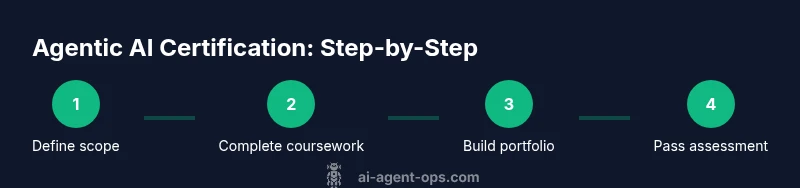
To earn agentic AI certification, follow a structured, hands-on learning path: define the scope of the credential, complete core courses, pass a practical assessment, and showcase a portfolio of agentic AI workflows. You’ll need a study plan, access to relevant tools, and time for hands-on labs and projects. This guide outlines the steps, materials, and tips to help you succeed.
What is agentic AI certification and why it matters
According to Ai Agent Ops, agentic AI certification validates your ability to design and deploy autonomous agentic workflows that coordinate tasks, manage dependencies, and respond to changing conditions without continuous human input. This credential signals to teams and employers that you can translate complex business problems into executable agentic plans, monitor outcomes, and iterate responsibly. As AI projects become more integral to business operations, a credible certification can differentiate you in competitive job markets and bolster stakeholder confidence in automated solutions. In practice, certification emphasizes practical capability over theoretical knowledge, so expect hands-on labs, real-world demonstrations, and artifacts you can show to peers and leadership. For developers, product teams, and decision-makers, the credential should map to concrete use cases such as task orchestration across tools, intent-driven decision chains, and safe, auditable agent behavior.
- beneficial for career growth in AI product roles
- a signal of practical, role-relevant competence
- a foundation for responsible agentic AI deployment
How to get started: outline your goals, identify relevant domains, and prepare a portfolio that aligns with the certification’s expected outcomes.
Define the credential scope and outcomes
Clear scope is essential for a credible certification path. Begin by identifying what the credential intends to validate: the ability to design, deploy, and govern agentic AI agents; the capability to integrate agents with orchestration platforms; and the capacity to ensure safety, explainability, and compliance in agent-driven processes. Outcomes should include measurable demonstrations (for example, a runnable agentic workflow), a set of artifacts (documentation, diagrams, and code), and a rubric for evaluation. Ai Agent Ops recommends mapping each outcome to concrete tasks you can perform in a lab setting, so you can build toward passing the practical assessment. Create a checklist that links prerequisites, core topics, and deliverables to tangible milestones. This upfront planning reduces overlap and helps you stay focused during study sessions.
Core knowledge areas and skills
Agentic AI certification covers a blend of theoretical foundations and hands-on skills. Core knowledge areas typically include:
- Agent architectures and lifecycles: perception, decision, action, and feedback loops.
- Orchestration and coordination: how agents interoperate with tools, APIs, and tasks across systems.
- Planning under uncertainty: strategies for goal-directed behavior and fallback plans.
- Safety, ethics, and governance: risk assessment, monitoring, and explainability requirements.
- Data handling and privacy: secure data flows, access controls, and auditing capabilities.
- Evaluation and metrics: measuring effectiveness, throughput, and reliability.
Skills to develop include reading and writing agent policies, building small end-to-end agent pipelines, and documenting decisions for audits. Use hands-on labs to connect theory to practice, and maintain a living portfolio that captures your progress across these domains.
Recommended learning path and timeline
A practical path blends structured coursework with project work. Start with foundational modules on agentic AI concepts, progress to integration labs where you connect agents to real tools, and then tackle portolio-focused projects that showcase your ability to design end-to-end agent workflows. Allocate dedicated study blocks for reading, coding, and testing, with regular self-assessments to track mastery. A typical timeline includes an initial learning phase, a mid-course project sprint, and a final capstone portfolio submission. Adjust the pace based on your existing skills and commitments, but aim to complete core modules and at least two hands-on labs before attempting the practical assessment.
Hands-on labs and assessment formats
Labs are the core of agentic AI certification. Expect scenario-based exercises that require you to: 1) design an agent workflow for a given business task, 2) implement the workflow using a chosen toolchain, 3) demonstrate reasoning, 4) monitor outcomes, and 5) provide explanations for decisions made during execution. Assessments may include a live demo, a recorded walkthrough, and a written evaluation of your design choices. Build a lab portfolio with step-by-step documentation, code snippets, diagrams, and test results. Time management matters here; practice with timed drills to improve speed and accuracy, and simulate review feedback to learn quickly from critiques.
Building a portfolio of agentic AI workflows
A strong portfolio is more persuasive than theory alone. Include:
- 2-3 end-to-end workflows that illustrate orchestration, decision making, and error handling.
- Architecture diagrams and data flows that explain how components communicate.
- Code artifacts or configuration snippets that demonstrate practical implementation.
- Evidence of testing, monitoring, and iteration (before/after metrics or logs).
- Reflection notes describing trade-offs, safety considerations, and governance controls.
Use version control and documentation to ensure your artifacts are easy to review. A well-organized portfolio signals you can translate knowledge into reliable, auditable agentic AI solutions.
Selecting credible certification programs
Not all programs are equal. When evaluating options, prioritize programs that emphasize hands-on assessments, real-world projects, and transparent rubrics. Look for:
- explicit criteria for passing the practical exam
- published sample projects or case studies
- a clear renewal or recertification path
- reputable providers with aligned industry recognition
Avoid programs promising quick credentials with minimal evaluation or those that rely solely on theoretical exams. Seek programs that balance theory with practical demonstrations and artifacts you can showcase to employers.
Preparing for the exam: study plan and resources
Create a study plan that aligns with the credential’s outcomes. Allocate time for core topics, lab practice, and portfolio refinement. Use a mix of resources: official curricula, practical guides, community forums, and hands-on code labs. Build a calendar with milestones for module completion, lab submissions, and portfolio reviews. Practice explaining your workflow decisions aloud; verbalizing your reasoning helps in both the practical and oral components of the assessment. Maintain a running list of questions and areas where you want feedback from peers or mentors.
Maintenance, renewal, and real-world application
Certification is not a one-time event. Plan ongoing learning to stay current with evolving agentic AI practices, tools, and safety standards. Schedule periodic reviews of your portfolio, update workflows to reflect new capabilities, and participate in community discussions to share insights and receive feedback. Renewal may involve additional labs or updated assessments aligned with the latest industry standards. In real-world use, apply your certification to pilot projects, document outcomes, and demonstrate continuous improvement to stakeholders.
Tools & Materials
- Access to an AI agentic coursework platform(Enroll in a program that includes hands-on labs and portfolio requirements)
- Cloud or local lab environment(Prepare a workspace with compute, storage, and your preferred tooling)
- Documentation suite (docs, diagrams, notebooks)(Maintain artifacts for your portfolio)
- Code editor and version control(Git or equivalent for tracking changes)
- Sample project templates(Optional templates to accelerate portfolio creation)
- Access to API keys or sandbox environments(Needed for integration labs with tools)
Steps
Estimated time: 6-8 weeks
- 1
Define scope and prerequisites
Identify the domains the certification covers (planning, orchestration, safety, governance) and review your current skills. Create a short list of target use cases you want to demonstrate in your portfolio. This clarity guides your study plan and lab selection.
Tip: Document 2-3 concrete scenarios you want to implement. - 2
Choose a credible program
Research programs that emphasize hands-on assessments and portfolio artifacts. Compare rubrics, examples, and renewal requirements. Ensure the provider aligns with your career goals and the skills you want to showcase.
Tip: Prefer programs with transparent evaluation criteria and sample projects. - 3
Complete coursework and labs
Finish core modules and run through lab exercises that build end-to-end agentic AI workflows. Track progress against a milestones calendar and collect artifacts as you go.
Tip: Schedule weekly lab sessions and set a fixed review cadence. - 4
Draft and curate your portfolio
As you complete labs, assemble artifacts: architecture diagrams, configuration files, test results, and reflection notes. Ensure each item demonstrates a clear problem, solution, and impact.
Tip: Use version control and add a short explainer for each artifact. - 5
Pass the practical assessment
Engage in the scenario-based exam, presenting your workflow and explaining decision logic. Prepare timed practice runs to simulate the actual assessment conditions.
Tip: Practice narrating your reasoning aloud to improve clarity during the exam. - 6
Submit application and schedule the exam
Compile required documentation, submit your portfolio, and book your testing window. Confirm that you meet all prerequisites before the exam date.
Tip: Keep a checklist and reminders for verification steps. - 7
Maintain knowledge and renew
Plan ongoing learning to stay current with tools and standards. Refresh portfolio artifacts as landscapes shift and pursue recertification as required.
Tip: Join a community of practitioners to stay informed and get feedback.
Questions & Answers
What is agentic AI certification and who should pursue it?
Agentic AI certification validates your ability to design, deploy, and govern autonomous AI workflows. It is suited for developers, AI product managers, and tech leaders who oversee agent-based automation.
Agentic AI certification shows you can build and govern autonomous AI workflows, useful for developers and AI leaders.
Do I need to be a seasoned programmer to start?
A baseline understanding of programming concepts helps, but many programs include starter modules. Focus on the practical labs and portfolio pieces to build competence progressively.
A basic programming background helps, but you can start with beginner-friendly modules and labs.
How long does certification typically take?
Time varies by program and schedule, but many learners complete the core requirements within a few months of steady study and hands-on work.
It usually takes a few months with steady study and hands-on labs.
Are there no-code paths for agentic AI certification?
Some programs offer no-code or low-code routes for demonstrations, but you should expect to document and validate your ability to assemble workflows regardless of tooling.
There are no-code options in some programs, but you still need to show how you build and validate workflows.
How often should I renew or recertify?
Renewal requirements vary by program, but ongoing education and portfolio updates are common to keep the credential current.
Renewal depends on the program; expect ongoing learning and updates to your portfolio.
How can I verify a certification after earning it?
Certification verification is typically managed by the issuing organization through a credential ID or official digital badge. Share the verification link or badge with employers.
Your cert comes with a verification method; share the badge or link with employers.
Watch Video
Key Takeaways
- Define clear certification scope and outcomes.
- Prioritize hands-on labs and a strong portfolio.
- Choose credible programs with transparent rubrics.
- Practice across end-to-end workflows and documentation.
- Maintain knowledge through renewal and real-world application.