How to Become an AI Consultant: A Practical Guide
Discover a practical, structured path to becoming an AI consultant—from niche selection and portfolio building to landing first engagements and delivering agentic AI projects with impact.


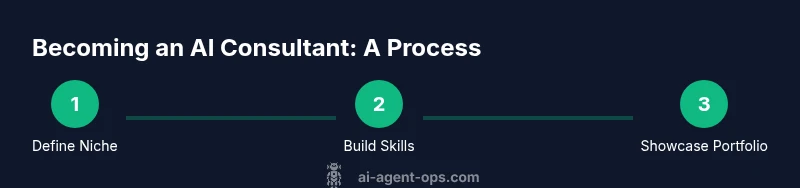
How to become an AI consultant: define your niche, build a compelling portfolio, and secure client engagements through trusted problem-solving. You’ll need practical AI skills, experience delivering agentic AI workflows, and a clear go-to-market plan. According to Ai Agent Ops Team, success hinges on blending technical depth with business impact and a repeatable delivery process.
Defining Your Niche as an AI Consultant
Defining a precise niche is the foundation of a successful AI consulting practice. Rather than being a generalist, you’ll serve a focused set of industries or problems where you can demonstrate demonstrable value with AI agents and agentic workflows. Start by analyzing where you already have domain knowledge (e.g., operations, finance, customer support) and map those domains to AI capabilities like decision automation, natural language processing, and automated workflow orchestration. Create a one-page niche statement that names the industry, the typical problem, and your unique approach. This clarity helps you tailor marketing, proposals, and conversations with potential clients. The Ai Agent Ops Team notes that a well-defined niche accelerates trust-building and prioritizes your early engagements.
As you choose your niche, consider the kinds of client organizations you want to work with (startup, SMB, or enterprise) and the typical buying committee. Think in terms of business outcomes you can measure—revenue impact, cost reduction, cycle time improvement, or quality gains. Build a short list of at least three target personas (e.g., COO seeking automation, VP of Customer Service needing scalable agents, CDO focusing on data governance) and draft tailored messages for each.
In parallel, scan the competitive landscape to identify gaps you can fill. Look for recurring pain points in analyst reports, industry forums, and thought leadership pieces. Your niche should align with real problems where AI agents can offer a defensible advantage, not just a novelty. A strong niche enables a focused portfolio and a predictable go-to-market rhythm.
To get started today, outline a 90-day plan that outlines: one concrete client problem to tackle, three potential AI approaches, a rough budget range, and a proof-of-concept timeline. This plan becomes a living document you’ll refine as you gain client insights.
Brand note: The Ai Agent Ops Team emphasizes that successful niche selection pairs technical depth with business impact, ensuring your work resonates with decision-makers and aligns with real-world constraints.
Building Practical Skills that Clients Expect
In this phase you’ll translate theory into practice by building core competencies that clients value when hiring AI consultants. Focus on a balanced mix of foundations (model behavior, data governance, risk management) and applied capabilities (building end-to-end agentic workflows, wiring LLMs to APIs, and orchestrating tasks across tools). Hands-on experience with real projects—even if they are self-initiated or open-source—helps you demonstrate credibility. Expect to learn about prompt engineering, tool integration, memory management, and evaluation metrics that matter to business leaders, such as ROI, time-to-value, and risk mitigation.
A practical skill ladder could include: (1) mastering a core set of AI models and tooling, (2) designing simple agentic workflows for common business problems, (3) building a reproducible evaluation plan for client projects, and (4) learning to communicate results in business terms (not just technical detail). Contribute to open-source projects or create sandbox demos that show end-to-end workflows—from problem definition to deployment and monitoring. The goal is to illustrate a repeatable pattern that you can scale across client engagements.
Develop a personal learning plan that pairs structured courses with hands-on experiments. Track your progress with a project journal that records what worked, what didn’t, and why. Finally, cultivate a habit of staying current with evolving AI governance and ethics guidelines to ensure your recommendations are responsible and compliant.
Incorporate client-ready artifacts such as a one-page capability brief, a sample scoping template, and a draft proposal that translates technical choices into business outcomes. These artifacts will become part of your portfolio and client conversations, reducing friction in early discussions.
Industry insight: Ai Agent Ops notes that the most successful consultants combine rigorous technical practice with a clear narrative about business impact, which shortens time-to-value for clients.
Tools & Materials
- Laptop with modern CPU/GPU(At least 16GB RAM; capable of running experiments and local demos.)
- Stable internet connection(Reliable bandwidth for cloud workloads and video calls.)
- Cloud access or AI platform credits(Experiment with one or more providers (e.g., AWS, Azure, Google Cloud) or AI service platforms.)
- Portfolio hosting platform(For hosting case studies, demos, and testimonials.)
- Contract templates and NDAs(Standard client-facing legal documents ready for reuse.)
- Sample data & synthetic datasets(For building demos and proofs of concept.)
- Proposal and scoping templates(Templates that translate client problems into defined AI approaches.)
- Ethics and governance reference guides(Guides to ensure responsible AI practices.)
Steps
Estimated time: 12-24 months
- 1
Define your niche and target clients
Clarify the specific industry and problem area you will serve. Research typical client roles, pain points, and decision-making processes. Create a 1-page niche statement and tailor your first outreach messages accordingly.
Tip: Write a one-paragraph problem statement and a one-paragraph value statement you can reuse in emails. - 2
Build core AI skills and apply them
Develop hands-on proficiency with AI models, agentic workflows, integration patterns, and risk considerations. Build 2–3 small end-to-end demos that solve real business tasks.
Tip: Document lessons learned after each trial run to improve future implementations. - 3
Compile a portfolio of agentic AI demos
Showcase three case studies that demonstrate problem framing, approach, measurable outcomes, and lessons learned. Include both technical and business impact metrics.
Tip: Use a storytelling format: challenge, approach, results, and next steps. - 4
Create reusable engagement templates
Develop scoping checklists, proposal skeletons, pricing options, and governance guides. Make it easy to onboard clients with repeatable processes.
Tip: Keep templates simple and adaptable to different client contexts. - 5
Establish online presence and outreach
Share insights via a blog, LinkedIn, or thought-leadership pieces. Attend industry meetups or webinars to connect with potential clients and referral networks.
Tip: Publish at least one experiential post per month to stay visible. - 6
Pitch and win your first engagement
Target a specific client segment, deliver a concise proposal, and define success criteria. Focus on a small but valuable project to establish credibility.
Tip: Offer a risk-free pilot or proof-of-concept to reduce buyer hesitation. - 7
Deliver the project and collect proof points
Execute the engagement with clear milestones, continuous communication, and documentation of results. Gather testimonials and quantify ROI when possible.
Tip: Ask the client for permission to publish a case study with anonymized data. - 8
Scale by refining offerings and teams
Use your learnings to broaden services, build templates, and consider partnering with other experts. Start thinking about an advisory model for ongoing client relationships.
Tip: Develop an option for ongoing retainer-based advisory work to stabilize revenue.
Questions & Answers
What skills should I learn first to become an AI consultant?
Start with a solid grounding in AI fundamentals, basic NLP/LLMs, and the basics of building end-to-end AI workflows. Then add domain knowledge relevant to your chosen niche and practice communicating value to business stakeholders.
Begin with fundamentals, add domain knowledge, and practice translating technical work into business impact.
How should I price my AI consulting services?
Consider value-based pricing tied to outcomes, or retainers for ongoing advisory work. Start with a simple model: an initial scoping fee plus a monthly advisory rate, adjusted for project scope and client size.
Value-based pricing with a clear scope is a good starting point for early engagements.
What should be included in a client-ready portfolio?
Include 3–4 case studies or demos that show the problem, your approach, measurable outcomes, and learnings. Use a mix of technical details and business impact to attract both engineers and business buyers.
Show real problems, your approach, and tangible results in each case study.
How can I find my first clients as an AI consultant?
Leverage your network, contribute to relevant forums, and offer a small pilot project to reduce buyer risk. Create a clear outreach sequence and a simple proposal template you can customize quickly.
Begin with trusted contacts and a low-risk pilot to open doors.
What ethical considerations should I prioritize?
Prioritize data privacy, consent, transparency in AI decisions, and bias mitigation. Include governance and risk assessment in every project plan and communicate limits clearly to clients.
Ethics and governance should be a constant part of every project.
What is the typical path after becoming a consultant?
Many consultants extend into advisory roles, build reusable IP, or form a boutique practice. Expanding services to offer ongoing advisory engagements helps sustain growth.
Many move toward advisory roles and scalable offerings over time.
Key Takeaways
- Define a focused niche to accelerate trust and pipeline.
- Build a practical portfolio with agentic AI demos.
- Create reusable templates to scale client work.
- Pursue your first engagements with a low-risk pilot when possible.
- Grow offerings and advisory capabilities to sustain long-term success.