Can You Make Money with AI Agents? A Practical Guide
Discover proven monetization strategies for AI agents, from automation-as-a-service to licensing, with a step-by-step plan, risk considerations, and real-world examples to accelerate revenue in 2026.


Yes—it's possible to make money with AI agents. You can monetize by offering automation-as-a-service, selling ready-to-run agents, licensing agent technology, and creating value-added dashboards for decision-making. The path requires identifying markets, ensuring compliance, and building trustworthy agents. Focus on measurable ROI to attract customers and provide clear service level agreements.
What AI agents are and why they can generate revenue
AI agents are software programs that combine task-specific intents with general intelligence to autonomously perform workflows. When designed well, they can handle repetitive, data-intensive, or high-stakes decision tasks with speed and consistency that humans struggle to match. For business leaders, the key question is not just what they can do, but how they translate those capabilities into revenue. can you make money with ai agents? The answer hinges on solving real problems, delivering measurable ROI, and packaging those capabilities into something customers will pay for. In practice, revenue comes from delivering value: faster process cycles, improved accuracy, reduced labor costs, and new capabilities that unlock markets or business models. The most successful AI agents are those that integrate with existing systems, provide transparent explanations, and include governance controls that reassure users about safety and compliance. The Ai Agent Ops team notes that monetization is less about a single magic feature and more about a repeatable delivery model that customers trust and suppliers can support at scale.
Revenue models for AI agents
There are several viable models to monetize AI agents, and many teams combine them. Service-based models include offering Automation-as-a-Service (AaaS), where you operate and maintain agents for clients in exchange for ongoing fees. You can also sell or license ready-to-run agents as products, either as standalone solutions or as components of larger platforms. Licensing can be time-based or usage-based, providing predictable recurring revenue. Additionally, many vendors monetize via marketplaces or APIs that charge per call, per task, or per workflow execution. In enterprise contexts, agents can be embedded in business processes, dashboards, or CRM/ERP integrations that produce time savings or revenue impact. Ai Agent Ops analysis shows that the market for agent-enabled automation is expanding across industries, with demand for secure, auditable, and integrable agents. To maximize monetization, define clear value metrics (e.g., time saved per task, error reduction, revenue uplift) and tie pricing to these metrics.
Market opportunities and verticals
Certain industries have higher propensity to adopt AI agents because their processes are rules-based, data-rich, and time-sensitive. Customer service, IT operations, finance, marketing automation, and field service are among the top verticals. For example, an AI agent that triages support tickets, routes incidents, or suggests next-best actions can dramatically reduce response times and free human staff for higher-value work. In manufacturing, predictive maintenance agents can lower downtime; in e-commerce, agents can optimize pricing or promotions in real time. It's essential to validate product-market fit with a small set of use-cases before scaling. The Ai Agent Ops framework emphasizes starting with a single, scoped use-case that demonstrates clear ROI and customer value, then expanding into adjacent workflows.
Building a monetizable AI agent: lifecycle
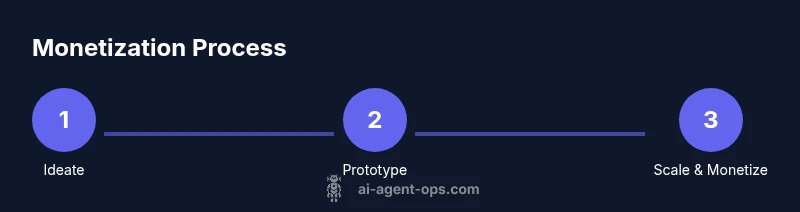
A monetizable AI agent goes through a lifecycle from ideation to scale. Start with problem framing and success metrics, then design the agent architecture, data flows, and integration points. Build a minimal viable agent to test core value quickly. Measure outcomes against predefined KPIs and gather feedback to refine features. Once validated, formalize pricing, packaging, and a go-to-market plan. Finally, implement governance, security, and compliance controls to maintain trust. The lifecycle is iterative: you should revisit use-cases, performance, and ethics as you scale. The goal is to deliver consistent business value, not just a clever bot.
Getting started: a practical plan
To turn monetization into reality, follow a practical, two-track plan: build a small, revenue-ready MVP and develop a scalable expansion roadmap. Track ROI with real customers and publish case studies that demonstrate time savings and revenue impact. Align pricing to value: offer entry-level pilots, then upsell to ongoing managed services or licensed products. Invest in partner ecosystems, marketplaces, and API integrations to widen reach. Finally, maintain strong documentation and user support to keep customers satisfied and willing to renew.
Tools & Materials
- Development environment (IDE + version control)(VS Code or JetBrains; set up Git workflow)
- Access to AI APIs/SDKs(Obtain API keys; plan rate limits and quotas)
- Cloud compute / hosting(Budget for hosting agents and data storage)
- Data sources & sample datasets(Curate domain data for training and testing)
- Security & compliance framework(Privacy policy, consent management, data handling rules)
- Monitoring & observability tools(Logging, metrics, alerting for reliability)
- Prototype UX/UI for customers(Simple dashboards to visualize ROI and outcomes)
Steps
Estimated time: 4-8 weeks for MVP; ongoing 2-4 months to scale to initial customers
- 1
Define monetizable use-case
Identify a business problem where an AI agent can deliver measurable ROI. Focus on a single process with clear inputs, outputs, and success metrics. Validate that there is willingness to pay for the reduction in time, cost, or error rate.
Tip: Choose a high-value, repeatable task to maximize early ROI. - 2
Design the agent architecture
Outline data flows, integration points, and decision logic. Decide how the agent will interact with humans (handover, overrides) and what constitutes failure. Map security and privacy requirements from the start.
Tip: Document interfaces and data schemas to reduce downstream friction. - 3
Build a minimal viable agent (MVA)
Create a focused version that demonstrates core value with a limited scope. Prioritize reliable outcomes and explainability. Capture baseline metrics for ROI comparisons.
Tip: Aim for a working prototype within 2-4 weeks to accelerate feedback. - 4
Pilot with real users
Run a controlled pilot with a small customer group. Collect quantitative outcomes (time saved, error rate) and qualitative feedback to refine the offering. Establish a pilot success criterion.
Tip: Use bounded pilots to manage risk and learn quickly. - 5
Package pricing and packaging
Define value-based pricing (entry pilot, ongoing managed service, and premium licensing). Create clear SLAs and support terms aligned with ROI.
Tip: Offer tiered pricing to capture different readiness levels of customers. - 6
Scale operations and governance
Automate onboarding, monitoring, and maintenance. Implement governance, logging, and safety controls to build trust at scale.
Tip: Invest in robust docs and a straightforward override workflow. - 7
Monitor, iterate, and expand
Track ROI, gather case studies, and expand to adjacent processes. Revisit regulations and ethics as you broaden scope.
Tip: Use success data to drive upsell and cross-sell opportunities.
Questions & Answers
What is an AI agent?
An AI agent is a software entity that uses AI models to perform tasks, make decisions, and take actions within defined boundaries. They can operate autonomously or semi-autonomously and are designed to integrate with existing systems.
An AI agent is a software entity that uses AI to perform tasks and make decisions, often working with existing tools and data.
Can you make money quickly with AI agents?
Monetization is possible, but sustainable revenue typically comes from pilots, demonstrated ROI, and scalable offerings rather than one-off deployments.
You can monetize with pilots and ROI data, but lasting revenue usually comes from scaling.
What are the best monetization models?
Service-based automation, product licensing, and marketplace/API monetization are common, often combined with performance-based pricing tied to ROI.
The top models are services, licensing, and marketplace-based pricing tied to ROI.
What skills do I need?
You need product sense, data governance, and engineering basics; no-code options exist for some workflows, but integration and governance remain essential.
You need product sense, governance, and some engineering; no-code paths exist for simple use-cases.
What are the main risks?
Data privacy, bias, and security risks require guardrails, auditing, and clear responsibility ownership to protect users and revenue.
Privacy, bias, and security are the main risks; guardrails help manage them.
Watch Video
Key Takeaways
- Identify a high-value use-case with measurable ROI
- Package the agent as a repeatable service or product
- Validate with a pilot and collect ROI data
- Incorporate governance and compliance from day one