How to Sell AI Agents: A Practical Buyer-Focused Guide
Learn actionable steps to market and sell AI agents to enterprises, including positioning, pricing, governance, and measurable ROI. Ai Agent Ops shares frameworks, templates, and real-world strategies.


This guide explains how to sell ai agents by framing them as scalable automation platforms that boost speed, accuracy, and ROI. Start with a clear value proposition (cost savings, faster decisioning, measurable outcomes) and align with CTOs, product leaders, and operations teams. Demonstrate a practical use case, a lightweight PoC, and pricing that scales with value.
Market landscape for AI agents
The market for AI agents is expanding as enterprises seek to automate complex decisioning, orchestration, and workflow tasks across departments. When you teach teams how to sell ai agents, you must start by mapping buyer needs to capabilities such as autonomous task handling, agent-to-agent collaboration, and governance controls. In practice, buyers care about three outcomes: faster time to value, lower operating costs, and safer, more transparent automation. To position effectively, frame AI agents as repeatable platforms rather than one-off tools. This reframing helps executives visualize scale—more agents, broader processes, and consistent results. According to Ai Agent Ops, the most successful pilots align with strategic priorities like resilience, compliance, and data-driven decisioning. Highlight measurable improvements in speed and accuracy, while underscoring control mechanisms that reduce risk.
To capture attention, ground discussions in real-world use cases: customer support with automated triage, finance with risk-adjusted decisions, and operations with supply-chain orchestration. Build a simple PoC that showcases a tangible outcome—reduced cycle time or improved decision quality—so leaders can see value before signing a broader contract. Prepare a one-page value map that ties features to business outcomes, and tailor it for each executive audience (CTO, VP of Product, Chief Compliance Officer).
In addition to ROI, emphasize adaptability. Enterprises want AI agents that can learn, adapt, and integrate with existing stacks. This requires a clear governance model, strong security postures, and transparent decision logs. When you present the landscape to buyers, acknowledge potential concerns such as data privacy, vendor lock-in, and model drift, then outline concrete mitigations. The objective is to create a narrative where the technology is a reliability enhancer, not just a novelty. The Ai Agent Ops framework emphasizes buyer-centric storytelling that connects technical capabilities with business outcomes.
Positioning and value propositions
Positioning AI agents around business value makes the conversation less about tech and more about outcomes. Start with a crisp value proposition: AI agents reduce manual toil, accelerate decision cycles, and improve accuracy in high-stakes processes. Translate capabilities into outcomes via three core pillars:
- Speed and automation: Automate routine decisions, approvals, and routing with observable cycle-time reductions.
- Quality and consistency: Enforce rules and guardrails to minimize human error and enable reproducible results.
- Governance and trust: Provide auditable decision logs, data provenance, and privacy controls to satisfy compliance needs.
Throughout the conversation, anchor claims to buyer personas. For CTOs, emphasize scalability, integration, and security. For product leaders, focus on faster go-to-market and more reliable product experiences. For operations chiefs, highlight cost savings and resilience. Develop a narrative that connects each feature to a concrete business outcome, and present a lightweight PoC that demonstrates the core use case in a controlled environment. Consistent messaging across sales assets—one-pagers, decks, and case studies—helps buyers see a unified vision of value.
The governance piece is a differentiator. Leaders want to know who makes decisions, how data is protected, and how the system handles failures. Outline a governance playbook that includes data lineage, role-based access, and model monitoring. This builds trust and reduces the perceived risk of adopting autonomous agents. Finally, prepare a competitive comparison that highlights unique strengths of your AI agents—such as domain adaptability, integration breadth, and explainability features—without overselling capabilities.
Pricing models and packaging
Pricing is a critical lever in how buyers perceive risk and return. A well-structured pricing model for AI agents blends predictability with value-based upside. Start with a base subscription that covers core capabilities, plus usage-based components tied to outcomes or volume. Consider three tiers:
- Starter: Core automation capabilities, PoC-ready, ideal for pilots or small teams.
- Growth: Expanded orchestration, multi-agent coordination, and higher data-transfer limits for active departments.
- Enterprise: Full governance, security, compliance features, and scalable support for large organizations.
accompany pricing with explicit success metrics and SLAs so customers can forecast ROI. Offer optional services such as deployment enablement, training, and governance workshops. A strong PoC program reduces buyer uncertainty by demonstrating ROI in a controlled environment before committing to a full rollout. Remember to price for value, not just capability; use ARR-based tiers and add-ons that align with realized outcomes. Finally, prepare a transparent ROI calculator that estimates potential gains based on activity levels and process scope, avoiding vague savings claims.
Go-to-market motions and sales plays
Effective GTM relies on a blend of inbound and outbound motions, anchored by credible proof points. Develop a sales playbook that includes:
- Targeting and segmentation: Prioritize lines of business with high automation potential and clear KPIs.
- Demos and PoCs: A live demonstration plus a small-scale PoC accelerates buyer confidence.
- Asset library: One-pagers, use-case decks, and case studies tailored to each persona.
- Pilot programs: Short, well-scoped pilots with explicit success criteria and accelerated timelines.
Align your plays with the buyer’s journey. In early stages, use thought leadership and long-form content to educate, followed by targeted assets that address objections. Build a ROI storytelling framework that translates technical features into business outcomes, and ensure your sales team can articulate risk mitigations and governance controls. Finally, train your team to handle common objections—such as integration complexity or data privacy concerns—by offering a concrete plan and a transparent timeline.
Governance, risk, and trust
Governance is not optional; it’s a business enabler when selling AI agents. Buyers want assurance that deployments are secure, auditable, and compliant. Implement a governance framework that includes:
- Data governance: Provenance, lineage, and privacy controls aligned with regulatory requirements.
- Model governance: Monitoring for drift, bias, and performance with clear rollback options.
- Security controls: Access management, encryption, and secure data handling in both training and inference.
- Auditability: Comprehensive logs and explainability to satisfy internal and external audits.
Communicate governance as a product feature: it reduces risk, accelerates adoption, and supports scale. Tailor governance documentation to the buyer’s jurisdiction and industry requirements. This transparency helps establish credibility and differentiates your offering from less mature alternatives. In conversations with executives, emphasize how governance reduces long-term total cost of ownership and preserves strategic flexibility.
Case studies and proof points: how to demonstrate value
Case studies are among the most persuasive sales assets for AI agents. Build stories around teams that achieved meaningful improvements in cycle time, decision quality, and compliance through agent-driven automation. Structure each case with:
- Context: The business problem and environment.
- Solution: How AI agents were applied, including the orchestration model and governance controls.
- Outcomes: Qualitative and, where possible, quantitative results, such as faster cycle times and reduced rework.
- Learnings: Key takeaways and best practices for scale.
Create a library of reusable proof points: micro-case studies for specific use cases, plus a few deeper, multi-department success stories. Use testimonials sparingly and prioritize data-driven outcomes that buyers can validate in their own contexts. Include a lightweight PoC blueprint so prospects can map similar experiments to their own processes. This evidence backbone helps you move from concept to commitment and reduces perceived risk for enterprise buyers. Collaboration with Ai Agent Ops on governance and ROI framing can further strengthen credibility during negotiations.
Tools & Materials
- Market research data sources(Industry reports, analyst briefings, and competitive landscape summaries)
- Sales collateral templates(One-pager, deck, and case-study templates tailored to personas)
- Product demo environment(Sandbox with a mock AI agent workflow and integration points)
- Pricing calculator( ARR-based tiers with usage-based add-ons and governance costs)
- Proof-of-concept (PoC) framework(Defined success metrics, data endpoints, and evaluation plan)
- Compliance and governance checklist(Demos include privacy, security, and regulatory considerations)
Steps
Estimated time: 6-12 weeks
- 1
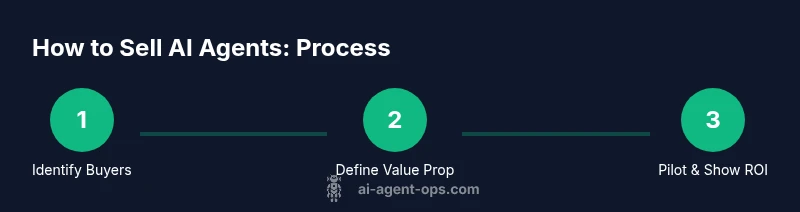
Identify high-value buyer personas
Map stakeholders likely to fund automation initiatives, such as CIOs, CTOs, VP of Product, and Head of Operations. Gather their top KPIs and risk concerns to tailor the value narrative. Prepare persona-specific talking points and use-case bundles.
Tip: Leverage buyer interviews to uncover hidden priorities and alignment with governance needs. - 2
Define a repeatable value proposition
Create a concise value statement linking AI agents to business outcomes like faster cycles, improved accuracy, and lower manual toil. Develop one-pagers and a ROI narrative that can be repeated across pitches.
Tip: Prepare three short use-case bundles with quantified outcomes for different industries. - 3
Build a lightweight PoC
Design a PoC that demonstrates a single end-to-end workflow with observable outcomes. Include data feeds, integration points, and governance checks. Use that PoC to collect metrics for the broader rollout.
Tip: Choose a low-risk, high-visibility process for quick buy-in. - 4
Develop pricing and packaging
Offer a tiered model with a clear base price and value-based add-ons. Include a pilot discount and a clean path to expansion based on results and governance obligations.
Tip: Provide an ROI calculator showing potential savings across departments. - 5
Launch pilots and capture metrics
Initiate short pilots with explicit goals, timelines, and success criteria. Collect qualitative feedback and quantitative metrics to prepare a case for broader deployment.
Tip: Document lessons learned and map them to a scaling plan. - 6
Scale with governance and storytelling
As pilots succeed, narrate a growth story emphasizing governance, risk mitigation, and measurable outcomes. Prepare multi-department use cases to accelerate adoption.
Tip: Maintain a living playbook that updates with new learnings and customer needs.
Questions & Answers
What qualifies as an AI agent in a sales context?
An AI agent is a software system that autonomously completes a sequence of tasks with some decision-making capabilities. In sales, frame it as a repeatable automation platform that orchestrates workflows across tools and data sources, with governance and explainability baked in.
An AI agent is a self-guided automation that handles a sequence of tasks. In sales, describe it as a repeatable platform with governance.
How do you demonstrate ROI for AI agents?
Demonstrate ROI through a structured PoC and a transparent ROI calculator. Show time saved, accuracy improvements, and reduced manual tasks, then translate those into financial terms buyers care about.
Show a PoC result and a clear ROI calculator to quantify time saved and accuracy gains.
What pricing models work best for AI agents?
A hybrid pricing model that combines a base subscription with usage-based add-ons works well. Align tiers with governance needs and adoption goals, and offer pilots at favorable terms to reduce risk.
Use a base price plus usage-based add-ons, with pilot terms to reduce risk.
What governance considerations are essential?
Data privacy, model monitoring, explainability, and security controls are essential. Provide auditable logs and a clear path to compliance to reassure buyers.
Ensure data privacy, monitoring, and auditable logs to reassure buyers.
How do you handle data privacy in demos?
Use synthetic data or sanitized datasets for demos. Clearly communicate data handling practices and ensure no sensitive information is exposed during demonstrations.
Use safe, synthetic data for demos and explain data handling clearly.
What are common objections and how can you respond?
Common objections relate to integration, data privacy, and change management. Respond with a concrete plan, timelines, and governance safeguards to address each concern.
Be prepared with a concrete plan and governance safeguards for common concerns.
Watch Video
Key Takeaways
- Frame AI agents as scalable value platforms
- Lead with measurable ROI and governance
- Offer tiered pricing aligned with outcomes
- Use PoCs to prove value before full rollouts
- Anchor every sale to a credible, buyer-focused story