How to Use AI Agents to Make Money
Learn practical, actionable methods to deploy AI agents that generate revenue. This guide covers monetization strategies, architecture, risk management, and real-world examples—designed for developers, product teams, and business leaders.


AI agents enable revenue generation by automating high-value, data-driven tasks at scale—such as lead generation, content creation, customer support, and decision-making workflows. Start with a monetizable use case, design clear agent roles, and implement measurable KPIs to loop feedback into better profits. This guide provides practical steps to turn AI agents into money-making assets.
What AI agents are and why they unlock money-making potential
AI agents are autonomous software entities that combine large language models with tools and data to carry out goals with minimal human input. By coordinating perception, reasoning, and action, they can perform multi-step tasks across marketing, sales, customer service, and operations. For monetization, the strongest use cases align with tasks that are repetitive, data-intensive, or require real-time decision-making. According to Ai Agent Ops, the most valuable opportunities sit at the intersection of customer-facing work and scalable back-office automation. When you design an AI agent, you’re not just automating a single task—you’re creating a repeatable process that can run around the clock and adapt to changing inputs.
Revenue models enabled by AI agents
AI agents enable several monetization strategies without trading human time for money. Common pathways include:
- Automated lead generation and qualification that feeds deals into your CRM
- Content creation and optimization for monetized channels (blogs, social, newsletters) with performance-driven iterations
- Customer support and onboarding engines that reduce churn and increase lifetime value
- Data insights services, anomaly monitoring, and reporting-as-a-service for clients
- AI-assisted product experiments and pricing optimization that improve margins
Ai Agent Ops analysis shows that organizations typically gain the most when they combine a customer-facing use case with a back-end automation loop, enabling repeatable revenue engines rather than one-off hacks.
note”:null],
toolsMaterialsotentially null
Tools & Materials
- Access to an AI platform (eg. OpenAI API or equivalent)(Choose a tier that supports higher throughput and concurrency for revenue-facing tasks.)
- Cloud compute resources(At least 2 vCPU and 4GB RAM; plan for scaling during peak demand.)
- Data sources (CRM, product catalog, analytics)(Ensure data quality and governance; sanitize PII where needed.)
- Development and version-control environment(Use Git, CI/CD, and robust testing harnesses.)
- Monitoring and observability tools(Set dashboards for latency, errors, and business KPIs.)
- Security and compliance controls(Implement access controls, data encryption, and audit trails.)
- Budget and cost-tracking(Set budgets, ceilings, and alerts for API usage.)
Steps
Estimated time: 4-6 weeks
- 1
Define a high-value monetizable use case
Identify a business process that, when automated, would drive measurable revenue or cost savings. Map the user journey, the outputs your agent must produce, and how success will be measured.
Tip: Start with one clear revenue loop that scales; avoid trying to automate too many use cases at once. - 2
Design the agent architecture
Choose agent roles (planning, execution, observation) and decide how memory, tools, and data will be shared. Define prompts, tool interfaces, and safety guards for each role.
Tip: Document tool APIs and failure modes so the agent can recover gracefully. - 3
Assemble data and prompts
Curate high-quality prompts and templates. Prepare data schemas, input signals, and success criteria. Implement data privacy measures for any client data used.
Tip: Use prompt templates and version control to keep prompts auditable. - 4
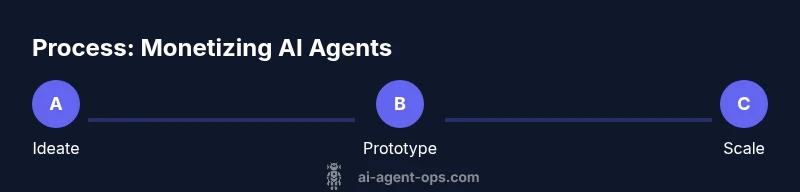
Prototype a minimal viable agent
Build a small, testable agent that handles a single end-to-end flow. Validate outputs in a safe sandbox and iterate on prompts and tool usage.
Tip: Focus on the core revenue loop first; avoid feature creep at this stage. - 5
Test, guardrails, and compliance
Run diverse test scenarios, add fail-safes, and define escalation paths. Ensure compliance with data policies and industry regulations.
Tip: Set hard limits on sensitive data usage and enable human-in-the-loop when needed. - 6
Deploy, monitor, and optimize
Roll out to production with observability, dashboards, and alerting. Use A/B experiments and KPI tracking to optimize performance and ROI.
Tip: Continuously collect feedback and adjust prompts, tools, and workflows to maximize profit.
Questions & Answers
What is an AI agent and how does it differ from a traditional bot?
An AI agent uses AI models to reason, plan, and act autonomously across multiple steps, often coordinating tools and data. Unlike a static bot, it adapts to inputs and can handle complex workflows.
An AI agent is a smart, adaptive system that plans and acts on tasks, not just answers a fixed script.
Can AI agents really generate revenue, or are they just cost savings?
AI agents can generate revenue by automating revenue-driving tasks (like lead gen and conversions) and by optimizing operations for higher margins. They can also reduce costs, but the focus here is scalable income streams.
They can both reduce costs and create new revenue streams when used in the right workflows.
What are common revenue streams enabled by AI agents?
Lead generation, content monetization, customer onboarding, support automation, and data-driven product optimization are typical revenue streams enabled by AI agents when integrated with business processes.
Typical revenue streams include automated lead gen, monetized content, and improved onboarding that reduces churn.
What are the key risks when monetizing with AI agents?
Risks include data privacy, model errors, compliance issues, misaligned incentives, and hidden costs from API usage. Mitigate with guardrails, monitoring, and human oversight.
Main risks are privacy, accuracy, and cost—set guardrails and monitor closely.
How do I measure the ROI of an AI-agent project?
Track revenue attributable to the agent’s actions, compare against baseline costs, and monitor margins, CAC, and CLV. Use A/B tests and time-series analyses for attribution.
ROI is measured by revenue impact minus costs, plus improvements in efficiency and customer metrics.
What are practical first steps for a team new to AI agents?
Start with a defined, monetizable use case, assemble the right tools, build a small MVP, and establish metrics and governance before scaling.
Begin with one clear use case, set up the tools, and test before expanding.
Watch Video
Key Takeaways
- Define a monetizable use case first
- Architect for repeatable revenue with guardrails
- Measure ROI and iterate on prompts and tools
- Prioritize data governance and ethics in every deployment