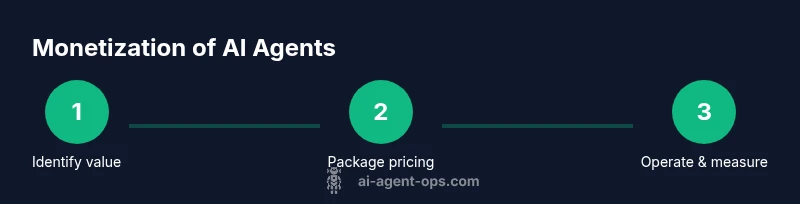
How AI Agents Make Money: Monetization Models
Learn how AI agents monetize via subscriptions, usage-based pricing, licensing, services, and partnerships. A practical, developer-focused guide to monetizing agent-based automation.


If you’re asking how ai agents make money, the core answer is through multiple monetization streams: subscriptions for access, usage-based pricing tied to interactions, licensing to integrate with existing platforms, and professional services that operate or optimize agents for customers. Successful models pair clear business outcomes with simple onboarding and measurable ROI.
Foundations: where revenue comes from in AI agent monetization
According to Ai Agent Ops, the economic value of AI agents rests not only on their intelligence but on how they are packaged, priced, and embedded in customer workflows. Revenue tends to arise when an agent enables time savings, error reduction, or decision speed that translates into measurable business impact. The most durable monetization strategies combine access models (subscriptions), per-use charges (usage-based pricing), and enterprise licenses that let buyers embed the agent into their technology stack. Beyond software access, many providers offer managed services that run, tune, and continuously improve agents on behalf of clients. A practical monetization plan therefore starts with a strong value hypothesis, a clear pricing model, and a straightforward onboarding path that reduces time-to-value.
The Ai Agent Ops team emphasizes that a successful monetization strategy is not a single bolt-on feature but an integrated revenue engine. You should think in terms of product-market fit, repeatable revenue streams, and a lifecycle of engagement—from trial to renewal. In this section, we unpack the main revenue sources, how to package them for different buyers, and how to align pricing with concrete outcomes.
<small>For context, this article blends practical guidance with industry best practices and is informed by Ai Agent Ops Analysis, 2026.</small>
statusVersion.:null
Tools & Materials
- Business model canvas(Template focused on AI agent monetization and customer segments)
- Pricing calculator/ROI template(Spreadsheet to model subscription tiers, usage thresholds, and expected ROI)
- Prototype environment (sandbox)(Access to an AI platform or sandbox to test agent capabilities and onboarding flows)
- Market research brief(Concise competitor and customer needs analysis)
Steps
Estimated time: 2-4 weeks
- 1
Define target use-case and value
Identify the concrete business problem your AI agent solves and quantify the value in terms of time saved, cost reductions, or revenue uplift. Align this to a realistic buyer persona and a primary industry segment.
Tip: Start with one high-impact use-case to avoid over-scoping. - 2
Identify revenue streams
Map out potential monetization options (subscription access, usage-based fees, enterprise licensing, and services). Consider how each stream aligns with the buyer’s journey and price sensitivity.
Tip: Avoid stacking too many streams on a single product before validating demand. - 3
Package and price
Create clear pricing tiers and packaging that reflect different levels of value (e.g., basic, pro, and enterprise). Design trials that demonstrate ROI without heavy upfront costs.
Tip: Use value-based pricing anchored to measurable outcomes. - 4
Prototype a monetizable MVP
Build a minimal viable agent with a saleable interface, onboarding flow, and a billing hook. Validate the core revenue model with early adopters.
Tip: Prioritize a frictionless sign-up and transparent pricing. - 5
Set up onboarding, billing, and support
Establish a simple onboarding path, integrate billing milestones, and define support SLAs to reduce churn and increase customer confidence.
Tip: Automate as much as possible for scale and consistency. - 6
Pilot and collect ROI data
Run a controlled pilot with real users to gather ROI signals, user satisfaction, and retention metrics. Use this data to refine pricing and packaging.
Tip: Capture both qualitative feedback and quantitative metrics. - 7
Scale and govern
Roll out broader versions, optimize renewals, and implement governance around data handling, compliance, and model updates to sustain profitability.
Tip: Set clear ownership and update cadences to maintain reliability.
Questions & Answers
What are the main monetization models for AI agents?
The primary models include subscriptions for ongoing access, usage-based pricing tied to interaction volume, enterprise licensing to embed agents in existing stacks, and professional services such as setup, tuning, and ongoing optimization.
Most AI agents make money through subscriptions, usage fees, licensing, and services that help deploy and optimize the agent.
How should I price an AI agent for an enterprise customer?
Price should reflect the value delivered and the buyer’s budget. Start with value-based tiers aligned to outcomes (time saved, error reductions) and offer a premium enterprise package with enhanced support and governance features.
Enterprise pricing should tie to the value the agent delivers and include clear levels of service and governance.
Can data be monetized through AI agents?
Data monetization is possible when agents help extract insights that customers would otherwise pay for, but it must be compliant with privacy rules and customer consent. Always include transparent data handling and usage terms.
Data monetization is possible if it’s compliant and provides clear customer value.
What metrics matter for profitability with AI agents?
Key metrics include gross margin per unit, customer lifetime value, churn rate, average revenue per user, and cost of acquiring customers. Track these to assess sustainability rather than chasing top-line growth alone.
Focus on margins, retention, and ROI per customer to gauge profitability.
How long does it take to see ROI from an AI agent?
ROI timelines vary by use-case and deployment speed. Start with a pilot to gather ROI signals and iterate quickly; numerous teams see early indicators within a few weeks of a successful onboarding.
ROI can show early signals in weeks if onboarding is smooth and value is clear.
What governance considerations are critical?
Establish data governance, security, and compliance policies; ensure model updates are auditable; maintain clear responsibilities for monitoring, incident response, and user consent.
Put governance and security at the center to prevent risk and build trust.
Watch Video
Key Takeaways
- Define a high-impact monetization use-case first
- Package value with clear pricing tiers and trials
- Pilot to prove ROI before full-scale rollout
- Align pricing with measurable outcomes to enable value-based selling
- Governance and compliance are essential for sustainable revenue