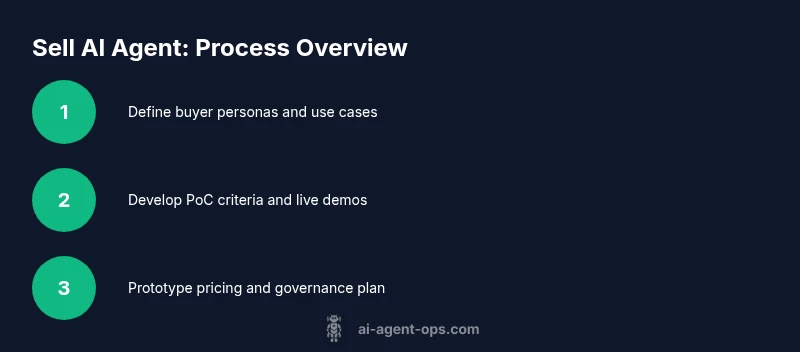
Sell AI Agent: A Practical Guide for Teams
Learn how to sell an AI agent by defining buyer personas, proving ROI with PoCs, and building a repeatable GTM plan. This guide covers value framing, governance, and deployment considerations for developers, product teams, and leaders.


Sell AI agent: start by defining buyer personas and the specific outcomes they care about, then craft a crisp value proposition and a live PoC that demonstrates measurable ROI. Build a repeatable sales process with governance, risk management, and clear pricing ranges to close pilots quickly.
What it means to sell an AI agent
Selling an AI agent goes beyond shipping software. An AI agent combines perception, reasoning, and action within a business context, and buyers are purchasing a repeatable capability that can automate decisions, adapt to data, and operate within governance constraints. For teams, the sales conversation should translate technical capability into tangible business outcomes, focusing on speed to value, risk management, and long-term support. According to Ai Agent Ops, success hinges on a well-scoped PoC, transparent governance, and measurable ROI. Buyers want a clear path from pilot to production with governance artifacts, security assurances, and defined exit clauses. This section helps you translate capability into business value and frame it in executive language that accelerates deals.
Identify target buyers and use cases
A successful sell begins with precise buyer targeting. Focus on enterprise segments where AI agents can automate decision-making, speed up operations, or reduce manual errors. Common use cases include customer-service automation, data-processing workflows, field-service scheduling, and risk/compliance monitoring. Build 2-3 buyer personas (e.g., CIO for governance, Head of Operations for ROI, and VP of Security for risk) and map their pain points to your AI agent’s capabilities. When presenting, tailor language to each persona: executives care about ROI and risk; technical buyers care about data access, integrations, and reliability. This anchoring helps shorten procurement cycles and increases win rates.
Craft a compelling value proposition for AI agents
Your value proposition should connect outcomes to quantifiable business metrics. Frame value as improved throughput, faster decision-making, and reduced error rates, supported by governance and data-security assurances. Use a simple formula: ROI value = (cost savings + revenue impact) – (operational costs + governance overhead) over a defined period, with a payback window. Provide concrete examples in your messaging, such as reduced manual triage time, faster incident response, or higher customer satisfaction. Tie messaging to buyer priorities: automation, risk reduction, and scale. A strong proposition combines a clear outcome, credible PoC, and a governance plan that reduces buyer hesitation.
Build a proof of concept and live demos
A PoC should prove the AI agent can operate in a real-world context with controlled data. Define success criteria up front (data latency, action accuracy, and user adoption). Build a lightweight PoC that showcases the agent’s decision loop, action outcomes, and measurable benefits within 2–6 weeks. Prepare a live demo that runs with synthetic or sanitized data, and capture before/after metrics to share with stakeholders. Remember to explain failure modes and how the agent handles uncertainty, which builds trust with risk-averse buyers.
Pricing frameworks and ROI framing
Pricing should reflect delivered value and align with buyer procurement cycles. Consider a base platform fee plus usage-based or outcome-based pricing, with optional add-ons for governance tooling or dedicated support. Present ranges rather than exact numbers to accommodate enterprise variability and negotiation dynamics. Demonstrate ROI with the PoC: show payback period, total cost of ownership, and annual benefits. Provide a simple calculator or model that buyers can adjust for their data, integration scope, and user volume. Clear, value-driven pricing reduces friction in enterprise negotiations.
Go-to-market, sales enablement, and procurement
Develop a buyer-centric GTM that prioritizes use cases, not just features. Create playbooks that map each stage of the sales cycle to specific artifacts: one-pagers, ROI calculators, PoC templates, and governance checklists. Align with procurement steps: security reviews, data handling agreements, and vendor risk assessments. Train the sales team to present ROI in business terms, not just technical specs, and equip them with live PoCs and reference cases. A disciplined cadence of demos, pilot runs, and executive briefings accelerates cycles and improves win rates.
Compliance, risk management, and governance for AI agents
Governance is a first-class selling point. Provide auditable data lineage, model monitoring, access controls, and incident handling procedures. Prepare a governance framework that demonstrates how data is protected, who can access what, and how performance is supervised. Buyers value transparency about data sources, lineage, and risk controls. Address regulatory considerations, retention policies, and vendor-supplied security attestations to reduce friction during procurement.
Implementation plan, metrics, and next steps
Outline a practical rollout plan from PoC to production, including timelines, milestones, and responsibility matrices. Define success metrics that align with buyer goals: time-to-value, throughput gains, error reductions, and user adoption. Establish an onboarding program with support SLAs, training materials, and governance reviews. The Ai Agent Ops team emphasizes governance-first, ROI-driven execution to scale successfully; this approach reduces risk and builds lasting trust with customers.
Tools & Materials
- Demo environment access(Staging instance with synthetic data or sanitized real data for PoC)
- Buyer persona templates(Role-based profiles (executive, product, security, procurement) with decision criteria)
- ROI calculator or model(Include base case, payback period, and sensitivity analyses)
- Security & governance checklist(Data handling, access controls, incident response, and compliance docs)
- Sales collateral templates(One-pagers, slide decks, case studies, and PoC templates)
- Case study package(2-3 relevant stories with measurable outcomes if available)
Steps
Estimated time: 4-6 weeks
- 1
Define buyer personas
Identify the primary buyers and their priorities. Document 2-3 personas and map their decision criteria to AI agent outcomes.
Tip: Use stakeholder interviews to surface top ROI drivers. - 2
Map customer value with metrics
Create a value map linking business metrics to AI agent capabilities (throughput, accuracy, speed). Establish baseline measurements.
Tip: Ask for current KPIs and aspirational targets to frame the PoC. - 3
Design PoC success criteria
Define concrete success criteria (latency, error rate, user adoption) and a clear go/no-go decision at the PoC end.
Tip: Fail-fast criteria preserve time and resources. - 4
Build a live demo environment
Set up a reproducible demo with representative data and a controlled test scenario that mirrors real workflows.
Tip: Prepare failure-mode scenarios to discuss resilience. - 5
Prepare pricing framework
Draft base, usage-based, and value-based options. Include governance add-ons and SLAs where appropriate.
Tip: Provide a ready-to-adjust template for negotiation. - 6
Create sales collateral and playbooks
Assemble ROI calculators, POCD templates, and governance checklists into a coherent kit for reps.
Tip: Keep collateral persona-aligned and evidence-backed. - 7
Run pilot and gather feedback
Launch a controlled pilot, collect user feedback, measure outcomes, and adjust the PoC as needed.
Tip: Capture qualitative and quantitative feedback for stakeholders. - 8
Close, deploy, and onboard
Finalize contract terms, deploy to production, and establish onboarding and support processes.
Tip: Publish a post-pilot case study to accelerate future deals.
Questions & Answers
What is an AI agent and how does it differ from traditional software?
An AI agent is an autonomous software entity that perceives, reasons, and acts to achieve goals within a business context. It differs from traditional software by its decision-making capabilities and adaptiveness, which require governance, data access controls, and monitoring.
An AI agent acts on goals using AI reasoning, not just fixed rules, and needs governance for safe use.
What ROI metrics should I track when selling an AI agent?
Track time-to-value, cost savings, error reductions, process throughput, and user adoption. Use a PoC to demonstrate measurable improvements within a defined period.
Key ROI metrics include time saved, cost reductions, and increased throughput validated by a PoC.
How long does a PoC typically take?
PoCs typically run 2-6 weeks depending on data availability, integration complexity, and stakeholder engagement. Define success criteria before starting.
Most PoCs take a few weeks with clear success criteria.
What procurement considerations are important?
Security reviews, data handling agreements, and vendor due diligence are critical in enterprise procurement. Prepare governance artifacts in advance.
Be ready for security reviews and data governance checks.
How should pricing be structured?
Consider base platform fees plus usage-based or outcome-based pricing. Align pricing with projected ROI and business value.
Pricing should reflect value and ROI with clarity.
How do I address governance and risk?
Offer auditable data lineage, model monitoring, and access controls. Provide a governance framework that reduces risk for buyers.
Governance basics include data lineage and access controls.
Watch Video
Key Takeaways
- Define buyer personas early and tailor messaging
- Demonstrate ROI with a strong PoC
- Provide governance and security assurances upfront
- Use repeatable sales processes and demos