What to Do with AI Agent: A Practical Guide for Builders
A comprehensive, step-by-step guide for planning, building, and governing AI agents. Learn goals, tooling, workflows, testing, and governance to scale smarter automation.


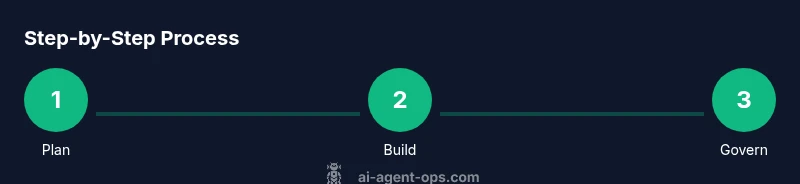
By the end of this guide, you will know what to do with ai agent: define goals, select tools, design modular workflows, implement governance, and measure impact. The approach applies to developers, product teams, and leaders seeking reliable automation. Prepare data access, security, and cross-functional alignment before starting. You will leave with a concrete plan you can start implementing this quarter.
What to Do with AI Agent: Why It Matters for Modern Teams
An AI agent is a software system that can observe inputs, reason about options, and execute actions through interfaces such as APIs, apps, or human-in-the-loop workflows. Unlike a static model that returns a single response, an agent operates iteratively, learning from results and adapting its plan. For teams delivering digital products or internal operations, agents can automate repeated decision-making, orchestrate data flows, and augment human capabilities across sales, support, IT, and product development.
The question many teams start with is not just what the agent can do, but how it fits into a reliable, auditable process. According to Ai Agent Ops, effective agent programs begin with clear value hypotheses, defined boundaries, and a governance model that includes safety rails and monitoring. When you consider what to do with ai agent, frame it as a repeatable, auditable workflow rather than a one-off experiment. The payoff is not only speed but also consistency, traceability, and safer experimentation. By establishing these guardrails, teams reduce risk while opening room for experimentation and continuous improvement. You’ll reduce manual toil, accelerate decision cycles, and unlock new capabilities that scale with your organization.
Defining Clear Goals for an AI Agent
Before touching code or data, define concrete goals for the agent and how you will measure success. Start with business outcomes (e.g., faster issue resolution, higher lead conversion, tighter compliance), then translate them into observable signals the agent can affect. Make the goals specific, measurable, achievable, relevant, and time-bound (SMART). For example, you might target a 20% reduction in repetitive support tickets within 8 weeks, or a 15% improvement in on-time task completion in a given workflow. When you ask yourself what to do with ai agent, think in terms of outcomes and risk boundaries, not only capabilities. Document success criteria, data requirements, and required human-in-the-loop checkpoints. This clarity helps product managers, engineers, and operators align on priorities and avoid scope creep. Finally, establish a simple experiment plan to test each goal, including baseline metrics, a change batch, and a clear method to attribute results to the agent’s actions. This upfront clarity is a guardrail that makes rollouts smoother and more predictable.
Selecting the Right Tools and Data Sources
Choosing the right tools for an ai agent depends on the task, data availability, and organizational constraints. Start by mapping the agent’s interaction surfaces: chat, API calls, document processing, or system orchestration. Then decide between no-code/low-code platforms and custom-code approaches based on required flexibility, speed, and governance needs. Consider safety features such as prompt libraries, access controls, auditing, and observability. Data sources should be chosen with lineage and quality in mind: reliable inputs reduce drift and improve agent reliability. If you lack internal data, external APIs and synthetic data can complement the dataset, but establish governance around data privacy and usage rights. As Ai Agent Ops notes, invest in modular components—agents that can be swapped or upgraded without rewriting entire pipelines. Favor tools that support testing, rollback capabilities, and clear versioning. Finally, design a lightweight sandbox for experimentation that protects production systems while enabling rapid iteration.
Designing Agent Workflows and Safety Rails
Workflows describe the end-to-end sequence of actions the agent should take to achieve a goal, including decision points, data flows, and human handoffs. Start with a simple loop: observe input, reason about options, select an action, execute, and observe results. Make each step observable with clear logging, timestamps, and contextual metadata. Safety rails are essential: implement rate limits, access controls, data privacy rules, and fail-safes if the agent misbehaves (e.g., if a response contains PII, halt and escalate). Define escalation paths and human-in-the-loop points to handle ambiguous or high-stakes decisions. Use guardrails to prevent insecure actions, such as writing to restricted systems or exfiltrating data. Add fallback strategies for when external services fail. In practice, you’ll want to keep the agent lightweight at first and gradually increase autonomy as confidence grows, while continuously auditing decisions and refining rules.
Implementation Patterns: No-Code vs Code, Orchestration, and Modular Agents
Many teams start with no-code AI agents to validate use cases quickly, then increment to code for deeper customization. No-code tools are great for prototyping and for functions that rely on standard APIs, but they must be governed with strict access controls and versioned prompts. For more complex workflows, code-based agents offer greater flexibility and testability. Orchestration patterns, such as agent-to-agent communication or event-driven triggers, enable scalable workflows across services. Modularity matters: design agents as interchangeable components—data connectors, reasoning modules, action executors—so you can upgrade one piece without tearing down the entire pipeline. Consider using a central controller or agent-orchestrator to manage retries, circuit breakers, and visibility. Documentation plays a crucial role: document interfaces, inputs, outputs, and expected behavior so future developers can extend or replace components with minimal risk.
Measuring Success: Metrics, Experiments, and Governance
Track progress with both quantitative and qualitative signals. Useful metrics include throughput (tasks completed per time unit), accuracy of decisions, user satisfaction, and system reliability. Run controlled experiments (A/B tests or multi-armed bandits) to quantify the agent’s impact, while maintaining a human-in-the-loop for sensitive decisions. Governance considerations include data privacy, security, compliance, and bias monitoring. Establish versioning for models and prompts, and maintain an audit trail of decisions and actions. Use dashboards to observe drift, latency, and failure modes in real time. In addition to performance, monitor ethical and legal implications, and set policies for updates and rollback. Authority sources: for AI governance, you can consult established guidelines from government and industry bodies. For further reading, see:
- https://www.nist.gov/itl/ai-risk-management-framework
- https://www.oecd.org/sti/ai/principles/
- https://www.acm.org/policy-ai-safety Note: Adapt these sources to your regional and sector-specific requirements.
Tools & Materials
- Computer with internet access(Powerful enough to run experiments and access cloud services)
- Account with no-code platform or development environment(Access to the chosen tool (e.g., connectors, templates))
- Data sources and access credentials(Ensure you have permission to use data and understand privacy rules)
- Security and privacy policies(Know your organization’s guidelines for data use)
- Monitoring and logging setup(Tools to trace decisions, latency, and outcomes)
- Documentation templates(For governance and handoffs)
Steps
Estimated time: 2-4 hours
- 1
Clarify goals and constraints
Identify the business problems the AI agent will address and define success criteria. Establish boundaries for autonomy, escalation paths, and data handling. Conclude with a short, testable hypothesis for the pilot.
Tip: Write down success criteria before touching code or data. - 2
Inventory data sources and interfaces
List available data streams, APIs, and human-in-the-loop touchpoints. Clarity here reduces drift and makes the integration smoother. Ensure data access aligns with governance requirements.
Tip: Map each data source to a concrete decision the agent will influence. - 3
Choose architecture and tooling
Decide between no-code vs code and select an orchestration approach. Define prompts, connectors, and modules with version control. Plan for testing and rollback from day one.
Tip: Prefer modular components you can swap without reworking the entire flow. - 4
Build or configure agent components
Assemble the agent’s reasoning core, data connectors, and action executors. Start with a minimal viable configuration that can be expanded.
Tip: Launch with a sandbox that prevents production impact during experiments. - 5
Implement governance and safety rails
Add access controls, logging, anomaly detection, and escalation triggers. Define guardrails that prevent unsafe actions or data exposure. Document decision rules.
Tip: Automate alerts for policy violations and near-miss events. - 6
Test, iterate, and prepare for deployment
Run scenario-based tests, compare results to baselines, and adjust prompts or modules. Validate performance, safety, and user acceptance before production rollout.
Tip: Use controlled experiments and track changes with versioned deployments.
Questions & Answers
What is an AI agent in practical terms?
An AI agent is a software system that can perceive input, reason about options, and take actions to achieve a goal, often across multiple interfaces. It operates with loops of observation, decision, and action, and is designed to be auditable and governable.
An AI agent is a software system that observes, decides, and acts to reach a goal, with guardrails and traceable steps.
When should I choose no-code vs code for building agents?
Choose no-code for rapid prototyping and clear governance when the use case is straightforward. Move to code for complex logic, fine-grained control, or when scale and customization are essential.
Start no-code for speed, switch to code when you need deeper customization and scale.
What are the main risks of AI agents and how can I mitigate them?
Key risks include data privacy violations, biased decisions, unintended actions, and system outages. Mitigations include strong access controls, continuous monitoring, human-in-the-loop for critical decisions, and robust rollback plans.
Watch for privacy, bias, and unexpected actions; use monitoring and human oversight.
What metrics should I track to measure success?
Track endpoints like task throughput, decision accuracy, user satisfaction, and system reliability. Use controlled experiments to attribute improvements to the agent’s actions.
Monitor throughput, accuracy, user satisfaction, and reliability; use experiments to prove impact.
How do I deploy AI agents in regulated industries?
Follow governance frameworks, document decisions, ensure data privacy, and maintain an audit trail. Engage with domain experts to validate compliance and risk controls before production.
Comply with governance, document decisions, and keep an audit trail before going live.
Watch Video
Key Takeaways
- Define clear, measurable goals.
- Choose modular, auditable components.
- Balance no-code speed with code flexibility.
- Governance and safety rails must be in place early.
- Iterate with controlled experiments.