Practical Guide to AI Agents OpenAI
A comprehensive, step-by-step practical guide to AI agents using OpenAI. Learn architecture, tooling, and safe deployment patterns to design agentic workflows for smarter automation.


This guide helps you design, build, and deploy AI agents using OpenAI. You’ll learn core concepts, essential tooling, and a practical workflow to assemble agentic AI systems that can plan, reason, and act. Prerequisites include API access, a local development environment, and a sandbox for safe testing. By the end, you’ll have a reusable pattern you can apply to real-world automation tasks.
Introduction to AI agents and Ai Agent Ops
According to Ai Agent Ops, the term AI agents refers to autonomous software entities that perceive their environment, decide on actions, and execute tasks to achieve specified goals. A well-designed agent can integrate tools, access knowledge sources, and adapt behavior over time. The phrase practical guide to ai agents openai anchors this article in a real-world, OpenAI-enabled workflow. This introduction frames why agentic AI matters today: it lowers cycle times, scales decision-making, and frees human teams to focus on higher-lever tasks. You’ll see concrete steps, not abstract ideas, and you’ll leave with a blueprint you can start building tomorrow. Throughout, we’ll couple theory with hands-on patterns that work with the OpenAI API and familiar developer tools.
wordCountInBlock": 0
Tools & Materials
- OpenAI API access(API key with access to the GPT-4 family or equivalent model for agent reasoning and tool use)
- Code editor(VS Code, JetBrains, or any editor with linting and snippet support)
- Local development environment(Python 3.10+ or Node.js 18+; package managers installed)
- Sandbox/testing workspace(Isolated environment with logging and rollback capability)
- Secret management(Secure storage for API keys (env vars, vault, or dedicated secret manager))
Steps
Estimated time: 2-3 hours
- 1
Define the agent's mission
Clarify the business objective, success metrics, and boundary conditions. Write a one-paragraph user story and a concrete list of tasks the agent should perform. This ensures alignment with product goals before you code.
Tip: Document success signals and failure modes up front to guide testing. - 2
Choose the toolset and interfaces
Decide which tools the agent can call (web search, calculators, data queries, APIs). Define clear input/output contracts so the agent can compose actions reliably.
Tip: Prefer structured prompts and function-call patterns to reduce hallucinations. - 3
Build the agent skeleton
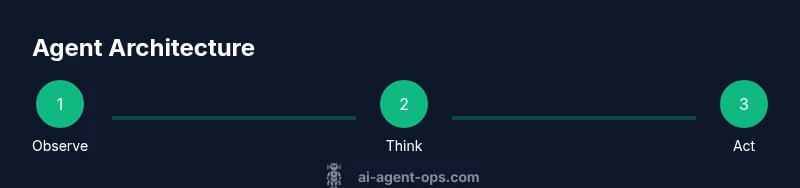
Create a minimal agent loop: observe → think → act. Implement a safe wrapper around API calls, including error handling and retry logic.
Tip: Start with a small, testable task to validate the loop before adding complexity. - 4
Add memory and context handling
Incorporate short-term memory for session continuity and optional long-term memory for context persistence. Design privacy-safe data handling.
Tip: Store only necessary state; avoid sensitive data unless required and secured. - 5
Test in a sandbox with edge cases
Use diverse prompts, boundary prompts, and failure scenarios. Validate outputs against defined metrics and logging traces.
Tip: Automate tests and keep a prompt library for regression checks. - 6
Deploy and monitor
Move to a staging environment, add monitoring dashboards, and set up alerting for errors, latency, and policy violations.
Tip: Start with a conservative rollout and rollback plan.
Questions & Answers
What is an AI agent in the OpenAI ecosystem?
An AI agent is a software entity that perceives input, reasons about it, and takes actions using tools and APIs. In OpenAI, agents typically combine large language models with tool access to perform complex tasks autonomously within defined constraints.
An AI agent is a software entity that perceives input, reasons about it, and acts using tools and APIs, built with OpenAI models.
Do I need extensive engineering to start?
Not necessarily. Start with a simple agent that performs a single task, then incrementally add tools and memory. The key is to define a clear mission and test in a safe sandbox.
No. Start small with a single-task agent and grow as you validate the idea.
Which OpenAI features are best for agents?
Use a combination of GPT-4-like models for reasoning, and tool calls or function calling to integrate calculators, data fetchers, and APIs. Enable monitoring and memory where appropriate.
Leverage GPT-4 models for reasoning and tool calls to connect external services.
How should I handle user data and privacy?
Limit data sharing with tools, implement data minimization, and comply with relevant regulations. Use encrypted storage for credentials and anonymize inputs where possible.
Minimize data, store securely, and anonymize inputs when you can.
What are common failure modes to test for?
Hallucinations, tool failures, latency spikes, and data leakage are typical risks. Build robust error handling, and define rollback plans.
Watch for hallucinations and tool failures; have a safety net and rollback plan.
How can I evaluate agent performance?
Define objective metrics (task success rate, latency, resource usage) and run automated tests across diverse prompts; review logs to identify improvement areas.
Set clear metrics and test across varied prompts, using logs to drive improvements.
Watch Video
Key Takeaways
- Define a clear mission and measurable success criteria
- Design explicit tool interfaces for reliable actions
- Test comprehensively in a sandbox before production
- Monitor continuously and iterate on safety controls
- Ai Agent Ops emphasizes practical, auditable workflows