How to Create an AI Agent: A Practical Guide
A comprehensive, step-by-step guide to creating AI agents, covering goals, tools, architecture, safety, deployment, and governance for reliable agentic automation.


Learn how to create an AI agent from concept to deployment. This guide covers scoping goals, selecting tools, building orchestration, and adding safeguards. Follow a clear, step-by-step process to build a functional agent that can automate tasks, reason toward goals, and integrate with your existing systems.
Defining the problem and goals
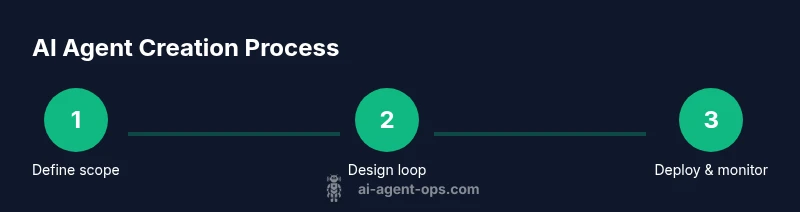
To create an AI agent that delivers measurable value, start by turning high-level ideas into concrete, testable goals. This means translating business needs into agent tasks, success criteria, and constraints. According to Ai Agent Ops, the clearest starting point is to articulate the agent's role, the tasks it will automate, and the risks you will manage. In practice, you should outline requests the agent will handle, decision boundaries, and the data it will consume. Next, map these to success metrics that you can observe during testing. For example, set goals like reducing manual task time, improving consistency, or enabling faster decision cycles. Use a lightweight framework such as a problem-solution map or a user story to capture these goals. The moment you define scope with precision, you unlock a clean architecture and a path for validation. Throughout this stage, involve stakeholders from product, engineering, data science, and security to ensure alignment. Document assumptions, constraints on latency, data privacy requirements, and safety boundaries. The more explicit your scope, the easier it will be to design the agent's capabilities, monitor its behavior, and avoid scope creep. In the end, your goals should be testable, bounded, and linked to business outcomes.
Core concepts you need to know
Before you start building, get comfortable with a few core ideas that repeatedly show up in agent workflows. An AI agent is not just a large language model; it is an orchestrated system that can observe inputs, decide on actions, and trigger tools or services. The agent relies on a loop: observe, decide, act, and report. Tools can range from web APIs and databases to specialized software like ticketing systems or CRM platforms. Prompts define how the agent communicates with the model and how it interprets feedback from tools. Governance and safety matter: you must implement guardrails, rate limits, and fallback strategies when tools fail. Observability is essential: you need logs, traces, and metrics to inspect the agent's decisions over time. Data quality is critical: ensure input data is clean, labeled, and privacy-preserving. Architectures vary: you may favor a planner-based design, a goal-driven agent with a living plan, or a retrieval-augmented approach that consults external knowledge sources. Finally, remember that an agent's usefulness grows when it can reuse knowledge, share state across sessions, and recover gracefully from partial failures. By grounding your design in these concepts, you build a solid foundation for practical automation and governance.
Architectural patterns for AI agents
There are several architectural patterns you can adopt, depending on your goals, data availability, and risk posture. A reactive agent focuses on immediate inputs and short-term actions, which is ideal for guardrail enforcement and real-time monitoring. A deliberative agent maintains a plan or goal stack, enabling longer-range reasoning and multi-step tasks. A planner-based agent combines planning with tool execution to adapt to changing constraints. Agent orchestration coordinates multiple micro-agents or tools, letting one component handle data gathering while another handles decision-making. A memory-enabled agent retains relevant context across sessions, improving continuity in workflows like customer support or incident response. A retrieval-augmented agent consults external knowledge sources to resolve uncertain questions. Ai Agent Ops analysis shows that teams that mix memory, planning, and orchestration tend to scale more cleanly while reducing duplicate efforts. When choosing an pattern, map your core user journeys to the most frequent decision points and design guardrails around those touchpoints. Remember to decouple decision logic from tool integration so you can swap components as your needs evolve.
Data, prompts, and safety considerations
Data is the lifeblood of AI agents. Start with clean, labeled inputs and define privacy constraints from day one. Prompts should be designed to elicit predictable behavior and to surface confidence levels or fallback options when uncertainty is high. Tools and endpoints exposed to the agent must have clear input/output contracts, with robust error handling and timeouts. Safety considerations include rate-limiting, input validation, and auditing of decisions for bias or noncompliance. Implement guardrails that prevent dangerous actions, such as irreversible changes or data exfiltration, and establish a clear escalation path to human oversight when needed. Version control your prompts and tool interfaces, and use feature flags to roll out new capabilities gradually. Finally, define a governance posture: who can approve new tools, how you monitor performance, and how you retire outdated logic. A thoughtful approach to data, prompts, and safety reduces risk and accelerates trustworthy adoption.
Deployment, monitoring, and governance
Deployment should be treated as a living experiment. Start in a sandbox or staging environment that mirrors production data but protects sensitive information. Establish observability with logs, traces, and dashboards that reveal decision rationales and tool outcomes. Monitor latency, failure rates, and user impact, and set clear thresholds for alerting. Governance should cover tooling permissions, access controls, and data handling policies. Plan for ongoing evaluation: periodically review prompts, tool integrations, and safety guardrails; retire tools that underperform or become unsafe; and plan deprecation paths for legacy behaviors. As teams scale AI agents, facilitate knowledge sharing across product, engineering, and security to maintain alignment with business goals. Ai Agent Ops's perspective is that pilots, not fireworks, win at scale; start small, prove value, and iterate with governance in lockstep with product goals.
Real-world examples and patterns to emulate
Use case-driven examples help your team grasp what a successful AI agent looks like in practice. For example, an agent that triages customer inquiries might fetch relevant knowledge articles, summarize responses for human agents, and queue follow-up actions. Another agent could monitor data pipelines, detect anomalies, and trigger remediation steps while notifying engineers. When you encounter complexity, consider layering: a fast reactive agent for safeguarding and a slower deliberative agent for complex decision-making. Document decisions, test outcomes, and governance adjustments so future teams can learn quickly. By embracing real-world patterns and maintaining visibility into how the agent behaves, you create a robust foundation for automation and continuous improvement.
Tools & Materials
- Python 3.11+ development environment(Install via pyenv/conda; ensure virtualenv support and package management.)
- Access to an LLM API (e.g., OpenAI/Anthropic)(Obtain API key and understand rate limits and pricing.)
- LLM SDKs or client libraries(Install the official SDKs for reliable integration.)
- Test data and synthetic data generator(Create safe, representative datasets for sandbox testing.)
- Webhook/endpoint hosting for tool integrations(Provide services the agent can call (REST endpoints, webhooks).)
- Version control (Git)(Track prompts, tool interfaces, and agent logic.)
- Secret management and credentials vault(Store API keys and tokens securely.)
- Monitoring/observability tools(Consider Prometheus, Grafana, or similar for metrics.)
- Sandboxed deployment environment(Replicate production safely for testing.)
Steps
Estimated time: Total time: 2-3 hours
- 1
Define scope and goals
Begin by translating business needs into concrete agent tasks, success criteria, and constraints. Identify the core workflow the agent will automate and set measurable outcomes. Clarify who will review outcomes and how results will be validated before moving to the next stage.
Tip: Document success criteria in a shared, accessible format. - 2
Map actions and tool integrations
List all actions the agent might take and the tools required to perform them. Create a simple contract for each tool: input, output, error cases, and latency expectations. Prioritize tools by importance to the core workflow.
Tip: Avoid coupling too many tools early; start with a core set. - 3
Choose an agent architecture
Decide between reactive, deliberative, planner-based, or orchestration patterns based on goals and data. Consider memory needs and whether retrieval augmentation will help. Define how state is stored and shared across sessions.
Tip: Keep architecture modular to simplify future changes. - 4
Design the action space and prompts
Define the set of permissible actions and construct prompts that elicit consistent behavior. Include fallback prompts for handling uncertainty. Ensure prompts surface confidence levels when decisions are ambiguous.
Tip: Test prompts with edge cases early. - 5
Implement observe-decide-act loop
Build the core loop: observe inputs, decide on actions, execute tools, and observe outcomes. Tie each step to logging for traceability. Ensure the loop can recover from partial failures without human intervention.
Tip: Log decision rationales to improve future prompts. - 6
Add safety checks and guardrails
Implement rate limits, input validation, and fail-safes for dangerous actions. Establish an escalation path to human oversight when needed. Keep a clear boundary between automation and human-in-the-loop review.
Tip: Automate where safe; route complex decisions to humans. - 7
Test in sandbox with representative tasks
Use synthetic data and scenario-based tests to validate behavior. Verify accuracy, latency, and fallback behavior under stress. Refine prompts and tool contracts based on test results.
Tip: Automate tests to run on every update. - 8
Deploy, monitor, and iterate
Move to staging and then production with feature flags. Monitor performance, user impact, and safety signals. Plan regular review cycles to update prompts, tools, and guardrails as needs evolve.
Tip: Treat deployment as an ongoing process, not a one-off event.
Questions & Answers
What is an AI agent and how does it differ from a traditional software bot?
An AI agent combines a decision-making model with tools and data access to autonomously perform tasks. Unlike simple bots, it can reason, plan, and adapt to new inputs while following governance rules. The result is a workflow that can operate with limited human intervention while maintaining traceability.
An AI agent is like a smart assistant that reasons, chooses actions, and uses tools—more autonomous and adaptable than a basic bot.
Do I need a large language model to create an AI agent?
A large language model (LLM) is a common building block, but not strictly required in every case. Some agents rely on structured reasoning, rule-based logic, or smaller models for specific tasks. The choice depends on the complexity of decisions, the availability of data, and the need for natural language interaction.
You can start with rule-based approaches or smaller models, and add an LLM later if your tasks require nuanced language or planning.
What architectures are best for AI agents?
Common architectures include reactive agents for simple tasks, deliberative or planner-based agents for multi-step goals, and orchestration patterns that coordinate multiple tools. Retrieval-augmented approaches use external knowledge sources to improve accuracy. The best choice depends on task complexity and the need for explainability.
Most teams start with a planner or orchestration pattern to balance flexibility and control.
How long does it typically take to build an AI agent?
Build time varies with scope and tooling, but a focused pilot can be completed within a few hours to a few days in a controlled environment. Larger, production-grade agents require more rounds of testing, governance, and integration work with existing systems.
A small pilot can be done quickly, but expect multiple iterations for production deployment.
What safety practices should be prioritized?
Prioritize guardrails, input validation, and monitoring. Implement escalation paths for human review and keep logs for auditing decisions. Regularly review prompts and tool contracts to prevent drift or unsafe behavior.
Put safety checks in place from day one and review them often as your agent evolves.
Can I start with no-code or low-code approaches?
Yes, no-code and low-code platforms can help prototype AI agents quickly. They are useful for validating concepts, but you may need to transition to code-based implementations for complex workflows or stricter governance.
No-code helps you prototype fast, but preparing for hand-off to code is wise for scaling.
Watch Video
Key Takeaways
- Define goals before tooling or coding
- Choose a modular architecture for scalability
- Safeguards and governance must run with automation
- Pilot early, iterate with stakeholder feedback