Open AI Agent Guide: Build Smarter AI Agents Today
A comprehensive, developer-focused walkthrough of OpenAI agent design, tooling, governance, and evaluation. Learn practical steps to build, test, and deploy agentic AI workflows with safety and observability.


Open AI agent guide: This quick answer outlines steps to design and deploy a practical OpenAI agent workflow, including prompt templates, tool integrations, state management, and safety controls. According to Ai Agent Ops, a structured agent framework reduces integration risk, speeds iteration, and scales across teams by standardizing interfaces, governance, and observability.
What is an open ai agent guide and why it matters
An open ai agent guide is a practical blueprint for building autonomous AI agents that act on behalf of humans to complete tasks. It blends capabilities of large language models with procedural tooling, memory, and decision logic to create end-to-end workflows. According to Ai Agent Ops, the open ai agent guide emphasizes clear objectives, guardrails, and measurable outcomes. By framing the problem space, defining success criteria, and outlining interfaces to tools, teams reduce ambiguity and accelerate delivery.
Key ideas include: establishing a loop of observe → decide → act, using prompts that are context-aware, and wiring agents to external tools (APIs, databases, search) to extend capabilities beyond generation. The guide helps teams avoid ad-hoc scripting by offering reusable patterns, templates, and governance checkpoints. In practice, an open ai agent guide describes a modular architecture: an orchestrator that chooses actions, a prompt layer that communicates intent to the model, a tool layer that handles external actions, and a memory layer that preserves state across interactions. It also codifies safety constraints, so agents avoid leaking secrets, performing unsafe actions, or executing destructive tasks. This foundational blueprint makes AI agents reliable, auditable, and scalable across products and teams.
Core architecture and components
A robust OpenAI agent relies on a clear separation of concerns and a reliable data flow. The brain is the language model, which emits decisions as it reads context and internal state. The tool layer provides external capabilities—APIs, databases, search, or specialized services—that the agent can invoke to perform real work. An orchestration layer coordinates prompts, tool calls, and memory, using a policy engine to decide when to act, what to ask, and how to recover from errors. A memory layer stores recent actions, decisions, and context so the agent can maintain continuity across interactions. Finally, a governance layer enforces safety and compliance rules, monitors performance, and records audit trails for accountability. Together, these components form a pipeline: observe data, decide on a plan, act via tools, and update memory for future steps. This architecture supports modularity, reusability, and easier scaling across teams and products.
If you’re new to agent design, start by mapping your problem to these layers. Identify the core objective, the essential tools, and the minimum memory you need to maintain context. Then design thin, well-typed interfaces between layers to minimize coupling and maximize testability. A well-documented architecture accelerates onboarding and reduces integration risk as your system evolves.
Prompt design for agentic workflows
Prompt design is the backbone of reliable agent behavior. Start with a baseline instruction prompt that defines the agent’s identity, goals, constraints, and escalation rules. This prompt should be stable and reused across runs, with dynamic context injected at runtime. In addition to the instruction prompt, create tool-specific prompts that describe how to call each API or service, what data to pass, and how to handle responses. Use a memory-aware prompt that includes recent state, tool results, and any relevant history to keep responses relevant and reduce unnecessary calls.
Key practices include: keeping prompts deterministic when needed, modularizing prompts into reusable templates, and validating outputs with lightweight checks (schema validation, sanity checks). Consider including a short “safety envelope” in the prompts that makes explicit what the model should avoid or defer to a human. Finally, design prompts for observability by embedding structured metadata in responses (action names, identifiers, results) to simplify monitoring and debugging. By engineering prompts with clarity and guardrails, you align model behavior with business goals and user expectations.
In practice, create templates for common tasks—data lookup, decision-making, and action orchestration—and preserve a library of prompts that your teams can reuse. This reduces drift across deployments and speeds experimentation while preserving safety and reliability.
Tooling, integration, and state management
Agent-oriented workflows rely on a disciplined approach to tooling and integration. Start with a minimal set of core tools that deliver measurable business value: a data source, a single external API, and a logging/monitoring stack. Define clear interfaces for each tool, including input/output schemas, error handling, and timeouts. Use a centralized orchestrator to manage tool calls and to sequence prompts with tool results. Implement a memory layer to track conversation state, tool outputs, and prior actions. This memory can be short-term (session-based) or long-term (persistent across sessions) depending on your use case. Consider employing a state machine or policy-based routing to decide when to call a tool, when to ask a clarifying question, and when to escalate to a human.
For maintainability, document each tool’s capabilities and limits, establish versioning for tool integrations, and implement feature flags to enable or disable tools in different environments. Use secure secrets management for API keys and ensure that all communications are encrypted and auditable. As your agent ecosystem grows, adopt a scalable tool catalog that supports plug-and-play integration, standardized error handling, and consistent telemetry across tools. This disciplined approach to tooling will reduce fragility and accelerate productized deployment.
Finally, design for observability from day one. Collect metrics on tool latency, success rates, and error categories; enable traceable identifiers for every action; and instrument dashboards that surface bottlenecks and failure modes. Observability is essential for diagnosing issues quickly and proving the value of your agent-driven workflows to stakeholders.
Safety, governance, and observability
Safety and governance are non-negotiable in production AI agents. Start with policy boundaries that prevent dangerous actions, limit data exposure, and ensure compliance with privacy and security requirements. Implement role-based access controls, secret management, and data minimization practices. Include a human-in-the-loop (HITL) path for escalation on ambiguous or high-risk decisions. Create an audit trail for prompts, tool calls, results, and human interventions so you can review behavior, reproduce issues, and demonstrate compliance during audits.
Observability is the backbone of trust in agent systems. Instrument comprehensive telemetry: request/response latencies, tool invocation counts, success/failure rates, and decision rationales where appropriate. Build dashboards and alerting rules that surface anomalies, such as sudden drops in success rates or unusual tool usage patterns. Guardrails should be testable and measurable, with clear thresholds that trigger safe halts, rollbacks, or human review. Finally, ensure data privacy by avoiding the storage of sensitive inputs in memory where not strictly necessary, and by implementing data retention policies. A well-governed agent operates reliably, ethically, and auditable across the lifecycle.
Evaluation, testing, and deployment
A rigorous evaluation plan is essential for trustworthy agent deployments. Define success criteria early: completion rate for tasks, time-to-completion, accuracy of tool results, and user satisfaction. Use a mix of offline evaluation (generated prompts and simulated tool responses) and live A/B testing in a controlled environment. Create test suites that validate prompts, tool integrations, and memory state against expected outputs. Automate regression tests so changes do not degrade behavior over time. Deployment should follow a staged approach: development, staging, and production, with canary releases to minimize risk. Monitor live performance continuously and be prepared to roll back if metrics regress.
Cost management should be part of the deployment strategy. Track API usage, tool invocation costs, and compute resources. Optimize prompts and tool usage to balance quality with efficiency. Establish service-level objectives (SLOs) for latency, reliability, and uptime, and align them with business outcomes. Finally, maintain a living playbook that documents lessons learned, common failure modes, and best practices for future iterations.
Real-world patterns, anti-patterns, and next steps
Across industries, successful OpenAI agent implementations share common patterns. Agents start with a concrete objective, a minimal toolset, and a clear escalation path. They evolve by adding targeted tools, expanding memory, and refining prompts based on real user data. Anti-patterns to avoid include overboarding the agent with too many tools at once, relying on generic prompts with little context, and neglecting observability or governance. By embracing a modular architecture, teams can incrementally increase capabilities while maintaining control and safety.
A practical path forward includes: (1) selecting a narrow initial use case, (2) building a lean tool catalog with robust interfaces, (3) implementing strict guardrails and HITL where needed, (4) instrumenting end-to-end telemetry, and (5) iterating with real data from users. As open ai agent guide practices mature, organizations can scale agents to multiple domains, supported by standardized templates and governance processes. The journey requires ongoing collaboration between developers, product managers, and security/compliance teams to ensure the agent delivers value without compromising safety or privacy.
If you’re ready to start, map your first use case, assemble a small cross-functional team, and begin with a minimal viable agent that can demonstrate real value. Then, gradually increase capability, apply rigorous testing, and incorporate feedback to guide future iterations.
Tools & Materials
- OpenAI API access(API key and billing enabled; manage quotas)
- Development environment (Node.js or Python)(Set up virtual environment; use package managers)
- OpenAI SDK/library(Install via npm npm i openai or pip install openai)
- Secret management tool(Environment variables or vault integration)
- Testing harness(Unit/integration tests with mocks for tools)
- Documentation (OpenAI docs)(Reference material for advanced features)
Steps
Estimated time: 2-4 hours
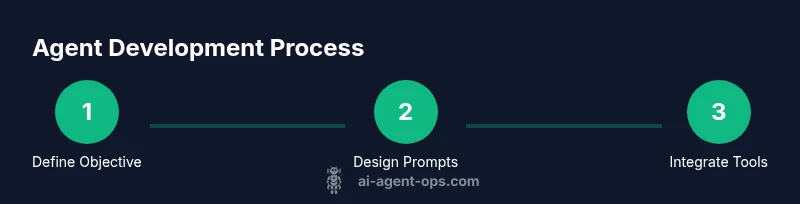
- 1
Define objective and constraints
Articulate the task the agent should perform, success criteria, and any safety constraints. Document non-goals to prevent scope creep and establish measurable outcomes.
Tip: Capture acceptance criteria before coding to avoid scope drift. - 2
Choose model and design prompt strategy
Select a base model and craft an instruction prompt that defines identity, goals, and constraints. Create memory and tool-context prompts to guide decisions.
Tip: Reuse a stable prompt template and inject dynamic context per session. - 3
Define tools and orchestration
Identify essential tools (APIs, databases, search) and build a thin orchestrator to manage prompts and tool calls. Establish input/output schemas.
Tip: Keep tool calls isolated with clear error handling. - 4
Implement state management
Design a memory layer to track context, results, and decisions. Decide on short-term vs. long-term memory needs and persistence mechanisms.
Tip: Record a simple event log for debugging. - 5
Add guardrails and testing
Incorporate safety constraints, HITL paths for high-risk decisions, and automated tests for prompts and tool interactions.
Tip: Test failure modes and ensure graceful degradation. - 6
Test, iterate, and deploy
Run offline and live tests, measure key metrics, and deploy in stages with canary releases and monitoring.
Tip: Automate rollback if critical metrics degrade.
Questions & Answers
What is an OpenAI agent guide?
An OpenAI agent guide is a structured methodology for building autonomous AI agents that perform tasks by combining language models with scheduled tool calls, memory, and governance. It provides templates, patterns, and safety checks to ensure reliable behavior.
An OpenAI agent guide is a structured approach to building autonomous AI agents that use language models, tools, and safeguards to perform tasks reliably.
How does an OpenAI agent differ from a bot?
An OpenAI agent integrates decision-making, tool use, and memory with governance, enabling multi-step tasks and dynamic interactions. A simple bot typically focuses on pattern matching and rule-based replies without external tool orchestration.
An OpenAI agent can decide, act with tools, and remember context, unlike a basic bot that mostly responds to prompts.
What tools are essential for building an agent?
At minimum, a data source, an external API or service, a secure secret manager, and telemetry for observability. Expand gradually with additional services as needs grow.
You need data sources, an API, secure secrets, and telemetry to start building a practical agent.
What safety considerations matter most?
Guardrails should prevent dangerous actions, protect data privacy, enforce access control, and include a HITL path for high-risk decisions. Regular audits are essential.
Key safety matters are guardrails, privacy, access control, and a human review path for risky decisions.
How should I test and deploy an agent?
Use a mix of offline tests and live canary deployments with monitoring. Define success metrics, run automated tests, and have a rollback plan if performance dips.
Test offline, deploy in stages with monitoring, and be ready to rollback if issues arise.
What about cost management?
Track API usage, tool invocations, and compute costs. Optimize prompts and tool calls to balance quality with cost.
Monitor usage and optimize prompts to control costs while keeping quality high.
Watch Video
Key Takeaways
- Define clear agent objectives and constraints
- Standardize prompts and tool interfaces
- Guardrails and observability enable trust
- Iterate with real user data and telemetry
- Test comprehensively before deployment