ai agent or workflow: Practical side-by-side comparison
Analytical, side-by-side comparison of ai agent or workflow options to help developers and leaders decide which automation approach fits goals for reliability, speed, and governance.


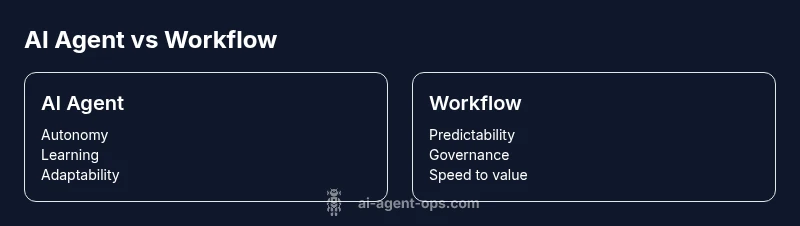
TL;DR: An AI agent and a workflow automate, but they serve different needs. An AI agent autonomously decides and acts in complex, changing tasks, while a workflow enforces predefined, repeatable steps with clear handoffs. This comparison helps developers and leaders choose based on complexity, control requirements, and integration goals. Consider whether you need adaptive reasoning, real-time updates, and learning from new data (AI agent), or stable, auditable processes with governance (workflow).
Understanding ai agent or workflow: two paths to automation
In modern automation design, two primary paths emerge: ai agent or workflow. An AI agent combines perception, decision-making, and action to autonomously execute tasks in dynamic environments. A workflow, by contrast, encodes a sequence of predefined steps, with clear handoffs, checks, and retries. For teams exploring smarter automation, distinguishing these approaches is essential. As Ai Agent Ops notes, choosing between them shapes architecture, governance, and speed to value. The keyword ai agent or workflow captures the core decision: should we let an intelligent agent decide, or should we fix the sequence and monitor outcomes? This section sets the stage for a deeper comparison across capabilities, risks, and implementation patterns. The Ai Agent Ops team emphasizes practical decisions over theoretical ideals, drawing on industry experience to help teams scope pilots and governance.
The decision drivers: when to prefer an AI agent vs a workflow
Decision drivers include task complexity, data availability, governance requirements, and desired speed to value. If your processes involve unstructured data, uncertain outcomes, or real-time adaptation, an AI agent can autonomously interpret signals and adjust course. If processes are well-understood, rule-based, and require strict auditability, a workflow aligns with risk controls and compliance. Organizations often start with workflows for predictable routines and gradually introduce agents to handle exceptions or optimization opportunities. In practice, most teams move toward hybrid models, using agents for decision points within a structured process. The Ai Agent Ops team observes that the most successful programs combine both patterns, orchestrating agents within a governance-friendly workflow framework to balance autonomy with control.
Core evaluation criteria: capability, governance, and cost
Evaluating ai agent or workflow options hinges on three pillars: capability, governance, and cost. Capability covers decision quality, adaptability, and integration with data sources. Governance includes monitoring, auditing, risk controls, and compliance with policies. Cost spans not just upfront tooling but ongoing model operations, retraining, and maintenance. Ai Agent Ops analysis shows that agents excel where learning and adaptation yield improvements, while workflows shine where predictability, traceability, and clear ownership are non-negotiable. For teams, mapping the expected decision surface and required governance helps decide where each pattern fits best and whether a hybrid approach offers the best balance and long-term ROI.
Architecture patterns: agent-based versus workflow-centric designs
Agent architectures tend to emphasize modular perception, reasoning, action modules, and an orchestration layer that coordinates tasks across systems. They require event streaming, state management, and robust failure recovery. Workflow-centric designs rely on orchestrators, state machines, and task templates that define inputs, outputs, and service level agreements. Both patterns benefit from modular pipelines, observable metrics, and decoupled interfaces, but the engineering levers differ: agents demand model management, data pipelines for learning, and exploration loops; workflows favor deterministic paths, versioned templates, and policy-driven gates. In many enterprises, teams implement a hybrid toolbelt: agent adapters that plug into a centralized workflow engine, enabling both autonomy and governance.
Data and integration considerations: where data meets action
Data availability, quality, and lineage drive success for either pattern. AI agents rely on access to structured and unstructured data, real-time signals, and feedback loops that enable learning. Workflows require clean data contracts, well-defined schemas, and stable integrations. Integration challenges include authentication, cross-system data norms, latency, and error handling. Security considerations become more nuanced with agents because learning components may access wider data surfaces. A prudent approach emphasizes least-privilege access, robust auditing, and sandboxed experimentation for agent components, with strict change control for workflow templates. The result is a balanced data fabric that supports both adaptive decisions and auditable processes.
Governance, compliance, risk management: staying in bounds
Governance is essential regardless of pattern, but it takes different shapes. AI agents require governance around model drift, data privacy, and explainability. Workflows demand policy enforcement, audit trails, and repeatable validation of each step. Organizations should implement guardrails, such as safety filters, fail-fast criteria, and observable telemetry. Regular reviews, risk assessments, and access controls help prevent data leaks and unintended actions. The Ai Agent Ops perspective emphasizes designing for governance from day one, so that agents and workflows can operate with predictable risk profiles and auditable history. This foundation supports scalable automation with responsible autonomy.
Performance, reliability, and scalability: measuring what matters
For AI agents, success metrics include decision accuracy, latency for action, and resilience to partial failures. Workflows measure throughput, cycle time, and error rates across steps. System reliability depends on monitoring, retraining cadence, and deployment discipline. Scaling an agent-based solution often involves horizontal scaling of perception and reasoning components, while scaling a workflow requires architecture that handles concurrent executions, state persistence, and distributed transactions. It's common to run both patterns in a shared environment, with robust observability dashboards and standardized incident response playbooks. The key is to define what constitutes acceptable latency and failure modes for your domain.
Real-world use cases and scenario mapping: when each pattern shines
- Customer support routing: a workflow can handle ticket triage and SLA checks, while an AI agent can interpret sentiment and escalate to human agents as needed.
- Fraud detection: an AI agent can examine patterns in real-time and trigger adaptive responses; a workflow can enforce logging and audit trails for compliance.
- Inventory optimization: an agent can learn from demand signals and adjust replenishment policies, with a workflow ensuring governance and rollback.
This mapping clarifies which pattern to apply in which context, reducing misuse and accelerating value. In many organizations, hybrid deployments let agents interpret signals within a governed workflow, preserving accountability while enabling agile decision-making. Ai Agent Ops notes that hybrid patterns often deliver the most durable ROI.
Adoption patterns: hybrid approaches and agent orchestration
Hybrid approaches blend automation patterns to leverage strengths from both sides. Agent orchestration frameworks coordinate multiple agents and workflows under a single governance layer, enabling end-to-end scenarios such as order processing or customer onboarding. Design considerations include fault isolation, observability, and versioning policies. A staged adoption plan helps teams minimize risk: start with well-defined workflows, introduce agent-enabled decision points, and gradually expand autonomy with risk controls and testing environments. The result is a scalable, auditable, and learning-capable automation system.
Implementation steps and a starter roadmap
- Define automation objectives and success metrics
- Map decision points and data contracts
- Select a pilot domain and choose a pattern (or hybrid)
- Build modular adapters for data sources and services
- Establish governance and testing protocols
- Run a controlled pilot, monitor KPIs, adjust, and iterate
- Plan scale and sunset legacy processes
A practical starter roadmap emphasizes governance, data quality, and modularity. By starting with a small, auditable pilot, teams can learn how AI agents and workflows complement each other and refine their orchestration strategy.
Metrics and measurement: how to quantify success
Key metrics include cycle time reduction, defect rate, and time-to-value. For AI agents, track decision accuracy, latency, and the rate of successful autonomous actions. For workflows, track throughput, SLA compliance, and change-friendliness of templates. Blended dashboards that show both patterns help leadership see where to invest. The goal is to demonstrate measurable improvements in efficiency, reliability, and governance, while maintaining safety and compliance. With careful measurement, teams can demonstrate ROI and justify governance investments that sustain long-term automation.
The path forward: agentic AI in business
The future of ai agent or workflow lies in agentic AI that blends perception, reasoning, and action within governed automation ecosystems. As capabilities mature, organizations will favor hybrid architectures that enable rapid iteration without sacrificing control. The Ai Agent Ops team expects greater emphasis on experimentation, explainability, and composable automation components that can be reused across domains. For teams ready to invest in governance-enabled experimentation, the payoff is scalable, trustworthy automation that adapts to evolving business needs. The convergence of agents and workflows signals a new era of proactive automation that aligns with strategic objectives and regulatory expectations.
Comparison
| Feature | AI agent | Workflow automation |
|---|---|---|
| Setup complexity | Higher (agent-oriented integration, model management) | Lower (pre-built workflows, templates) |
| Flexibility/adaptability | High (learns, adapts to new signals) | Moderate (follows predefined paths) |
| Governance and auditability | Requires model governance, explainability checks | Strong policy enforcement and traceability |
| Data handling and privacy | Broader data access with agents; strict controls needed | Clear data contracts and privacy controls |
| Time to value | Longer up-front design and training | Typically faster to deploy and iterate |
| Total cost of ownership | Higher ongoing maintenance for models, monitoring | Lower ongoing costs with templated processes |
| Best for | Complex, data-rich, evolving tasks requiring autonomy | Stable, auditable, rule-based operations |
| Best-case outcomes | End-to-end optimization and learning | Reliability and governance with rapid execution |
Positives
- Autonomy for dynamic tasks and decision-making
- Better adaptability to changing data and environments
- Potential for end-to-end process optimization
- Supports intelligent automation initiatives
- Can reduce manual intervention over time
What's Bad
- Higher upfront development and integration effort
- Increased governance and risk management needs
- Ongoing model maintenance and retraining
- Potential for bias and unpredictability if not properly monitored
AI agents generally offer greater long-term value for complex tasks, but workflows win on predictability and speed to value.
The Ai Agent Ops team recommends starting with a hybrid approach when possible, to balance autonomy with governance. This blends agentic flexibility with the reliability of predefined processes, enabling scalable automation that adapts to evolving business needs.
Questions & Answers
What is the primary difference between an ai agent and a workflow?
AI agents provide autonomous decision-making and action in dynamic contexts, while workflows enforce fixed sequences and policy-driven handoffs. The key trade-off is autonomy versus predictability. This distinction guides risk, governance needs, and time to value.
AI agents are autonomous, while workflows are rule-based and predictable. The choice affects governance and risk management.
When should I choose an AI agent over a workflow?
Choose an AI agent when tasks involve uncertainty, real-time adaptation, or learning from data. If outcomes must be tightly controlled and auditable with minimal variation, a workflow is usually safer and faster to implement.
Pick an AI agent for complex decisions; pick a workflow for stable, auditable steps.
How do governance and compliance differ between patterns?
Governance for AI agents centers on model drift, data privacy, and explainability. Workflows require policy enforcement and audit trails for each step. Both need monitoring, but the controls differ in scope and focus.
Agents need model governance; workflows need process governance.
Can I combine both in a hybrid approach?
Yes. Hybrid approaches orchestrate agents within a governed workflow, balancing autonomy with control. Start with well-defined flows and gradually introduce agent-enabled decision points.
Hybrid setups let agents decide within a safe workflow.
What metrics indicate success?
Track cycle time, throughput, accuracy (for agents), latency, SLA compliance, and auditability. A blended dashboard showing both patterns helps leadership evaluate impact.
Look at cycle time, accuracy, latency, and SLA compliance.
What are typical costs to expect?
Costs vary by scope, data needs, and maintenance. Consider upfront design, model ops, data pipelines, and continuous improvement when budgeting.
Costs vary; plan for setup, data, and ongoing maintenance.
Key Takeaways
- Define automation objectives before choosing a path
- Map data flows to determine integration needs
- Pilot hybrid models to balance risk and speed
- Invest in governance and monitoring from day one
- Plan for evolution as agentic AI matures